At this time
-
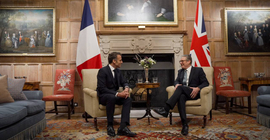
19 May 2025 Article 8th Edition of the Choose France Summit.

-
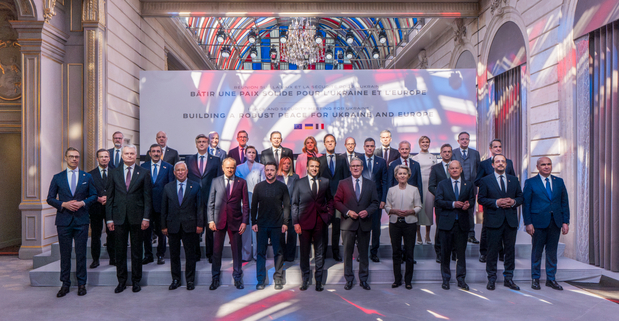
27 March 2025 Article Meeting on Peace and Security for Ukraine.
-
3 April 2026 Press release From France to the Republic of Korea: our commitment for the preservation of the Ocean.
-
19 March 2026 Press release Joint statement from leaders of France, Germany, Italy, Japan, the Netherlands, and the United Kingdom on the strait of Hormuz.
-
17 March 2026 Article Africa Forward: Africa-France Partnerships for Innovation and Growth Summit.
-
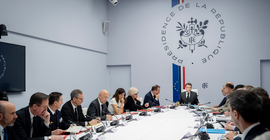
17 March 2026 Article National Defence and Security Council on the situation in Iran and the Middle East
-
16 March 2026 Press release Statement by the leaders of Canada, France, Germany, Italy and the United Kingdom on the escalating conflict between Israel and Hezbollah.
-
12 March 2026 Press release Private sector’s Statement on Nuclear Energy Financing.
-
11 March 2026 Press release Statement by the G7 Presidency.
-
11 March 2026 Press release Declaration of the Nuclear Alliance.
-
10 March 2026 Press release Safe and affordable nuclear energy for all
-
10 March 2026 Press release Statement on nuclear financing.
-
2 March 2026 Article Visit to the Île Longue Operational Base.

-
2 March 2026 Press release Joint declaration of President Macron and Chancellor Merz.
-
1 March 2026 Press release Joint Statement by the Leaders of France, Germany and the United Kingdom on indiscriminate Iranian attacks on countries in the region.
-
28 February 2026 Press release Joint Statement by the Leaders of France, Germany and the United Kingdom on Iran.
-
24 February 2026 Press release G7 leaders’ statement on the war in Ukraine.
-
24 February 2026 Press release Co-Chairs statement – Meeting of the Coalition of the Willing.
-
17 February 2026 Press release India – France Joint Statement.
-
9 February 2026 Article One Health Summit: better health for all life and the planet.
-
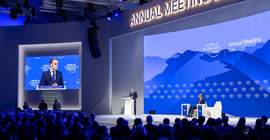
20 January 2026 Article World Economic Forum 2026 in Davos.
-
18 January 2026 Press release Statement by Denmark, Finland, France, Germany, the Netherlands, Norway, Sweden and the United Kingdom.
-
9 January 2026 Press release Leader’s Declaration of France, the United Kingdom and Germany on the situation in Iran.
-
6 January 2026 Press release Paris Declaration - Robust Security Guarantees for a Solid and Lasting Peace in Ukraine.
-
6 January 2026 Press release Joint Statement on Greenland.
-
18 December 2025 Press release New UK-France Nuclear Steering Group met for the first time in Paris.
-
5 December 2025 Press release Joint Statement Between the French Republic and the People’s Republic of China on Enhancing Global Governance.
-
5 December 2025 Press release Joint Declaration on Further Cooperation in the Peaceful Uses of Nuclear Energy between the People's Republic of China and the French Republic.
-
5 December 2025 Press release Joint Statement between the French Republic and the People’s Republic of China on Cooperation in Addressing Global Climate and Environmental Challenges.
-
5 December 2025 Press release Joint Statement between the French Republic and the People’s Republic of China on the situation on Ukraine and the situation on Palestine.
-
25 November 2025 Press release Chairs’ statement following 25 November Coalition of the Willing Leaders’ meeting.
-
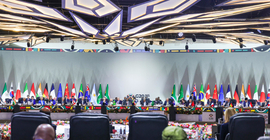
23 November 2025 Article Visit to South Africa.
-
22 November 2025 Press release Leaders’ statement on Ukraine.
-
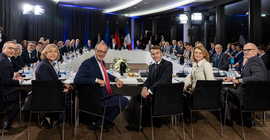
18 November 2025 Article Summit on European Digital Sovereignty in Berlin.
-
18 November 2025 Article Germany, France and the European Commission launch Frontier AI Initiative at the Summit on European Digital Sovereignty.
-
18 November 2025 Article Achieving Europe’s Cloud and Data Sovereignty.
-
18 November 2025 Article Fairer Markets in Support of Digital Sovereignty.
-
18 November 2025 Article Simplification of the EU Digital Rulebook.
-
18 November 2025 Press release Summit on European Digital Sovereignty Delivers Landmark Commitments for a more competitive and sovereign Europe.
-
6 November 2025 Press release Joint press release - The Belém Call
-
29 October 2025 Press release Paris Declaration on Multilateral Action for Information Integrity and Independent Media.
-
24 October 2025 Press release Chairs’ statement following 24 October Coalition of the Willing Leaders’ meeting.
-
24 October 2025 Article Videoconference meeting of the Coalition of the Willing for Ukraine.

-
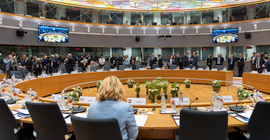
23 October 2025 Article European Council of October 2025, in Brussels.
-
21 October 2025 Press release Joint statement on peace for Ukraine.
-
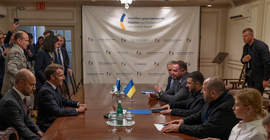
24 September 2025 Article 80th session of the United Nations General Assembly: last day.
-
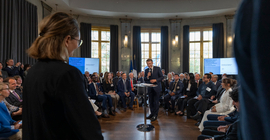
23 September 2025 Article 80th session of the United Nations General Assembly: day 2.
-
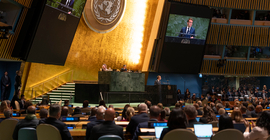
22 September 2025 Article 80th session of the United Nations General Assembly in New York: opening day.
-
2 September 2025 Press release Conclusions of the Franco-German Defence and Security Council.
-
1 September 2025 Press release Franco-German Economic Agenda.
-
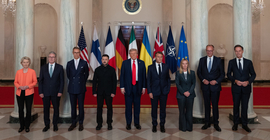
19 August 2025 Article Meeting in Washington alongside President Zelensky.
-
17 August 2025 Press release Statement of the co-chairs of the Coalition of the Willing, 17 August 2025.
-
13 August 2025 Press release Statement of the Co-chairs of the Coalition of the Willing.
-
23 July 2025 Press release Joint communiqué from Vanuatu and France on their commitment to maritime delimitation.
-
17 July 2025 Press release Joint communiqué on the occasion of the visit to France by His Highness the Amir of Kuwait, Sheikh Meshal Al-Ahmad Al-Jaber Al-Sabah.
-
14 July 2025 Press release Joint declaration of the 37th UK-France Summit.
-
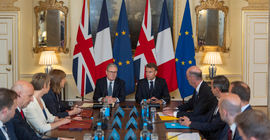
10 July 2025 Article State Visit to the United Kingdom: third day.
-
10 July 2025 Press release Statement of the Coalition of the Willing meeting.
-
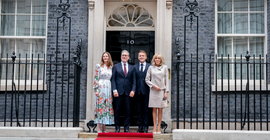
9 July 2025 Article State Visit to the United Kingdom: second day.
-
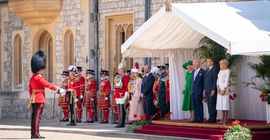
8 July 2025 Article State Visit to the United Kingdom: first day.
-
30 June 2025 Press release Pact for Prosperity, People and the Planet (4P) meeting in Sevilla.
-
30 June 2025 Press release Launch of a coalition for premium flyers contribution to fair transitions and resilience.
-
22 June 2025 Press release E3 leaders’ declaration on the situation in the Middle East.
-
17 June 2025 Press release G7 Leaders’ Statement on Recent Developments Between Israel And Iran.
-
16 June 2025 Press release The Nice Commitments for the Ocean.
-
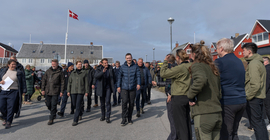
15 June 2025 Article Official visit to Greenland.
-
11 June 2025 Article Visit to VivaTechnology.

-
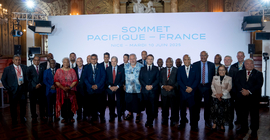
10 June 2025 Press release Final Declaration of the 6th Pacific-France Summit in Nice.
-
10 June 2025 Article UN Ocean Conference in Nice : Day Three.
-
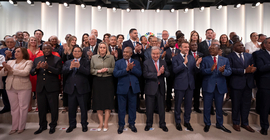
9 June 2025 Article UN Ocean Conference in Nice: Day Two.
-
9 June 2025 Press release For a Preserved Ocean: Protecting the Deep Sea on the High Seas from Mining.
-
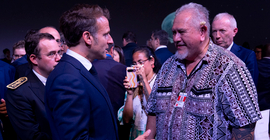
8 June 2025 Article UN Ocean Conference in Nice : Day One.
-
28 May 2025 Speeches France-Indonesia Joint Declaration on the peaceful resolution of the question of Palestine and the implementation of the two-State solution
-
28 May 2025 Press release Joint statement between the President of the Republic of Indonesia h.e. Prabowo Subianto and the President of the french Republic h.e. Emmanuel Macron on the state visit by h.e. Emmanuel Macron to Indonesia Politics
-
26 May 2025 Press release Joint statement on Independence Day of Georgia.
-
19 May 2025 Press release Joint statement from the leaders of the United Kingdom, France and Canada on the situation in Gaza and the West Bank.
-
19 May 2025 Article 8th Edition of the Choose France Summit.

-
15 May 2025 Article 20th Anniversary of the Global Markets Conference.

-
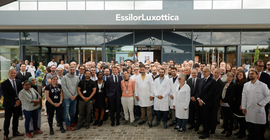
12 May 2025 Article Inauguration of EssilorLuxottica’s Centre of Excellence.
-
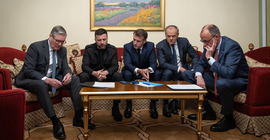
12 May 2025 Article Visit of the President of the French Republic to Ukraine.
-
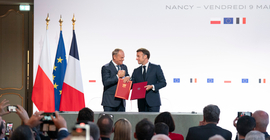
9 May 2025 Article Signing of the Franco-Polish Friendship Treaty in Nancy.
-
9 May 2025 Article Video Message from the President of the Republic for the Peoples' Summit for Peace in Jerusalem – 9 May 2025.
-
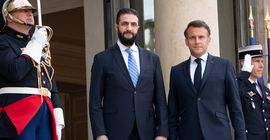
7 May 2025 Article Meeting with Ahmed Al-Charaa, Interim President of the Syrian Transitional Authorities.
-
7 May 2025 Press release A Franco-German “reset” for Europe.
-
5 May 2025 Article Launch of "Choose Europe for Science" at the Sorbonne.

-
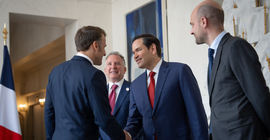
17 April 2025 Article Meeting with Steve Witkoff, Special Envoy of President Trump, and Marco Rubio, U.S. Secretary of State.
-
7 April 2025 Press release Joint press release following the summit between France, Egypt and Jordan on the situation in Gaza.
-
31 March 2025 Press release Syria Roadmap - Eastern Mediterranean Quint Meeting.
-
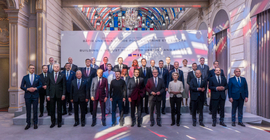
27 March 2025 Article Meeting on Peace and Security for Ukraine.
-
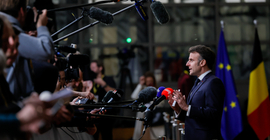
20 March 2025 Article European Council – 20 & 21 March 2025.
-
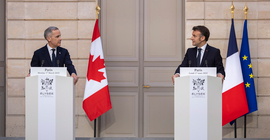
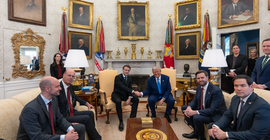
17 March 2025 Article Working lunch with the Prime Minister of Canada, Mark Carney.
-
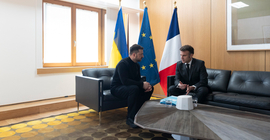
6 March 2025 Article Extraordinary European Council – 6 March 2025

-
11 February 2025 Press release The Paris Charter on Artificial Intelligence in the Public Interest.
-
11 February 2025 Press release Statement on Inclusive and Sustainable Artificial Intelligence for People and the Planet.
-
11 February 2025 Article Make France an AI powerhouse.
-
17 January 2025 Press release G7 Leaders statement on ceasefire and hostage deal.