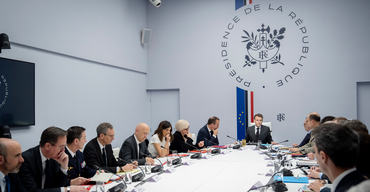
The President of the Republic convened a National Defence and Security Council meeting on the situation in Iran and the Middle East on Tuesday, 17 March 2026.
In his opening remarks, he reiterated France’s position and objectives, which are:
- to protect its nationals;
- to stand alongside its partners in the region;
- to ensure freedom of navigation and maritime security in the area.
Watch the opening remarks:
17 March 2026 - Check against delivery
Introductory remarks by the President of the French Republic at the National Defence and Security Council on the situation in Iran and the Middle East.
Prime Minister,
Ministers,
Ladies and Gentlemen,
Thank you for attending this Defence Council meeting. Before we begin, allow me to pay tribute to the memory of Chief Warrant Officer Arnaud Frion of the 7th Alpine Chasseurs Battalion of Varces. The nation has just paid homage to him this morning. Thank you, Minster, for chairing that ceremony. Officer Frion lost his life serving France in Iraq during a drone attack perpetrated by pro-Iranian militia while he was fighting terrorism, combating Daesh, defending Iraqi sovereignty and, ultimately, defending our security. I would like to reiterate that the nation stands fully alongside his family, his loved ones, his brothers in arms. And of course, my thoughts also go out to our injured soldiers, some of whom are still in intensive care.
As always, this Defence Council meeting aims to take stock of all issues and the situation in the Middle East, and to examine the consequences of the ongoing military operations by the United States and Israel in the region and Iran’s massive retaliation, which has affected many countries in the region. I would like to reiterate that France did not choose this war, we are not involved in it and our position is solely defensive, in order to protect our nationals and support our allies. Our objectives are clear, they have been set out since day one and they have not changed.
First, to protect our nationals, our diplomatic and military facilities and our interests in the region.
Second, to stand with all our partners, those with whom we have defence agreements, and alongside whom we often work to fight terrorism and improve regional security and stability. And so we have honoured our commitments and will continue to do so, we are loyal partners and we have provided them with clear support from the outset, helping them to protect their people, also with the very clear objective to prevent as far as possible the conflict from expanding further into the region. So each of our partners recognizes our work alongside them, for their security. With specific regard to Lebanon, which is such a close friend to France and to which we are exposed in light of UNIFIL and our presence within the UN troops, and where we are working alongside the Lebanese authorities to, there too, preserve its sovereignty and territorial integrity and continue the relentless fight against Hezbollah.
And our third category of objectives is, of course, to ensure freedom of navigation and maritime safety in the region. This is something we have also said from day one and a task to which we have contributed on several occasions and which is vital to our interests, especially economic interests, not only those of France but also, as we are all aware, in terms of natural gas and oil, or international interests as well as to freedom of navigation. We have a presence with many of our partners in the eastern Mediterranean, where the situation has stabilized, but we are shouldering our responsibilities, alongside Cyprus in particular, which has been targeted, and are monitoring the situation in Lebanon. We are fully committed to maritime safety and the freedom of navigation in the Red Sea and in the Bab-el-Mandeb Strait. We have a European framework of operations that must remain. This strict framework is still relevant and must continue on. It is called Operation Aspides and is under Greek command. This framework must not be expanded to include other operations. It works and has been reactivated. We have conducted effective actions in recent years with several partners. These actions are still relevant.
With regard to the Strait of Hormuz, which is, of course, the most sensitive situation, we are, in a few minutes, going to take stock of the situation, but I will now reiterate the framework in which we have been able to express our viewpoints, or in which we have already begun to shape our decisions. We are not party to this conflict. And, therefore, France will never take part in operations to open or liberate the Strait of Hormuz in the current context. However, we firmly believe that once the situation calms down – and intentionally, this term is sufficiently broad – once the situation calms down – which means once the main bombardments have stopped – we are ready, with other nations, to take responsibility for an escort system. This would entail political and technical work, with all of the actors working in maritime transport, with insurers and operational actors. We have begun discussions with India, with several other European partners and partners in the region. This work will require discussions and deconfliction with Iran, because under no circumstances can this be an operation of force. And, therefore, this work needs to be done in the coming days and weeks. It is a mission that we are ready to take on for the freedom of navigation of both container ships and tankers, which must be completely different from the war operations and bombardments under way. However, we are ready to take on this responsibility under this framework – which is clearly a more complex and proactive framework – and a mission that we are currently shaping.
Lastly, we will examine very closely the other most sensitive issues, including Iraq and Lebanon, which I have mentioned.
But I would like to reiterate here today, to end my introductory remarks, that France has a simple and clear duty in the region and that is to protect our citizens and our interests, to be reliable partners for everyone, and to work towards de-escalation and stability. This is the framework in which we would like to move forward. Thank you.
Latest news
See all articles and topics-
2 September 2026 Franco-Dutch tech dialogue.
-
3 September 2026 Visit to the United Kingdom.
-
7 September 2026 Lumière declaration on the future of cinema and the moving image.
-
8 September 2026 Joint statement by President Macron, Prime Minister Burnham and Prime Minister Carney on the two-state solution.