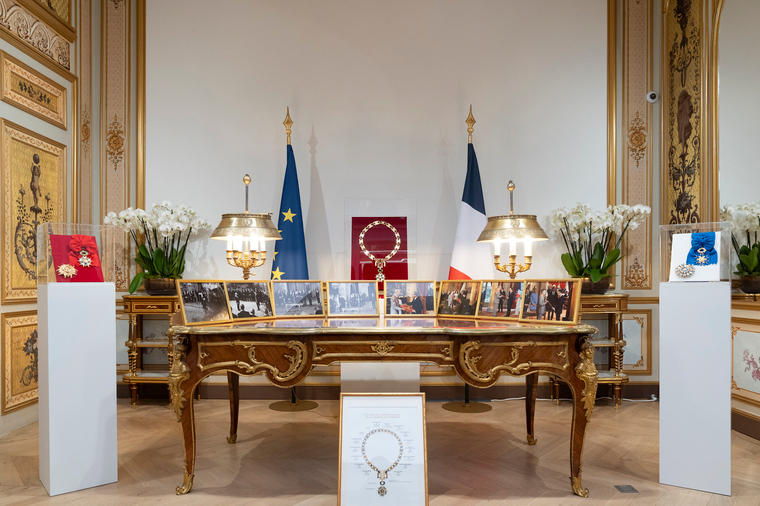
The President of the French Republic holds honorific titles conferred by virtue of his office.
While the Grand Master of the Legion of Honour is the best known of these titles, others, with more remote historical origins, remain less familiar.
The role of the Head of State is defined by the Constitution of the Fifth Republic, notably in Article 5: “The President of the Republic shall ensure due respect for the Constitution. He shall ensure, by his arbitration, the proper functioning of the public authorities and the continuity of the State. He shall be the guarantor of national independence, territorial integrity and respect for treaties.”
Beyond his political and constitutional powers, the Head of State is also the holder of a set of honorarific titles inherited from our national history and bearing witness to France’s historical relations with other States.
Some of these titles are conferred upon him as soon as he takes office. He thus becomes Grand Master of the Legion of Honour and of the National Order of Merit, two of the highest French distinctions. This role enables him to honour citizens who have distinguished themselves through civil or military merit.
By tradition, the President also serves as honorific canon of several cathedrals and churches, and as patron of academies and national institutions.
These titles, often inherited from the Ancien Régime, carry no executive power, but they assign the President responsibility for safeguarding our country’s historical heritage and major intellectual institutions.
Grand Master of the Legion of Honour
As Grand Master of the Legion of Honour, the President of the French Republic plays a central role in recognising and promoting republican values. This function gives him supreme authority over the national order, enabling him to award insignia to deserving recipients. The President ensures that distinctions are awarded to citizens who have made an exceptional contribution to the Nation in the civil, military, economic, cultural or scientific fields. As Grand Master, he embodies excellence and integrity, the fundamental values of the Order. He presides over decoration ceremonies, which mark solemn moments of public recognition. Eligibility for the Legion of Honour is subject to specific conditions, reflecting the Order’s prestigious and merit-based character.
Grand Master of the National Order of Merit
As Grand Master of the National Order of Merit, the President of the Republic plays an essential role in promoting the values of merit and excellence. Created in 1963 by General de Gaulle, this distinction rewards citizens who have rendered eminent service to the Nation in a variety of fields. In this capacity, the President oversees nominations and ensures that distinctions are awarded fairly and transparently. He presides over the ceremonies at which insignia are presented, marking moments of public recognition for the recipients. The Grand Master guarantees the independence and neutrality of the Order by ensuring that appointments are made without favouritism. He may also propose reforms to adapt the Order to contemporary challenges. Through his action, he strengthens the prestige of the National Order of Merit, in France and abroad. The President thus embodies excellence and integrity, which are the Order’s guiding values.
Co-Prince of Andorra
The suzerainty over the Valleys of Andorra was granted in 988 to the Bishop of Urgell, who enfeoffed it to the House of Caboet in 1159. In the thirteenth century, the Counts of Foix entered into rivalry with the Bishop of Urgell, resulting in the 1278 paréage, which divided sovereignty between the two lords. In 1479, the County of Foix was incorporated into the Kingdom of Navarre, and in 1589 Henry IV attached the Andorran prerogatives to the French Crown. In 1663, the Bishop of Urgell adopted the princely title, marking the beginning of the Andorran co-principality. After the French Revolution in 1792, France renounced sovereignty over Andorra, but Napoleon I restored it in 1806. The Treaties of Valençay (1813) and Paris (1814) confirmed Andorran sovereignty, followed by successive French governments. In 1967, General de Gaulle became the first French Co-Prince to visit Andorra since Henry IV. In 1993, the Andorran Constitution established the Co-Princes as joint heads of state, with symbolic functions and judicial prerogatives. On 18 July 2017, Emmanuel Macron received the Andorran Head of Government and unveiled a distinct official portrait featuring the French and Andorran flags. Since 31 May 2025, the Bishop of Urgell, Monsignor Josep-Lluís Serrano Pentinat, has served as Episcopal Co-Prince.
Canon of the Lateran
The title of first and only honorific canon of St John Lateran is a symbolic honour conferred on the French Head of State, without religious or administrative authority. Inherited from the Ancien Régime, it is rooted in the history of relations between France and the Catholic Church, particularly with the Basilica of St John Lateran, the Pope’s cathedral in Rome. Its origin dates back to 1604, when Henry IV, following his reconciliation with the Catholic Church, concluded an agreement with the basilica chapter, exchanging protection and revenues for this title. Symbolically transmitted to all French Heads of State, the title gradually declined in importance before being revived in 1957 by René Coty. Since then, several Presidents, including de Gaulle, Giscard d’Estaing, Chirac and Sarkozy, have taken possession of the title, whereas Pompidou, Mitterrand and Hollande did not. Emmanuel Macron formally took possession of the title on 26 June 2018. Today, the title recognises the President’s role in preserving Franco-Italian historical and cultural heritage, without affecting the principle of secularism. It thus symbolises the historical ties between France and the Catholic Church.
Other canon titles
The President of the Republic also holds several other honorific canon titles, some of which are inactive, such as that of proto-canon of the Cathedral of Notre-Dame-du-Réal in Embrun. He is also proto-canon of the Basilica of Notre-Dame de Cléry and honorific canon of several cathedrals and churches, although these titles are mainly symbolic.
Patron of Chambord
Chambord Castle, built by Francis I between 1519 and 1547, is a Renaissance architectural masterpiece and was inscribed on the UNESCO World Heritage List in 1981. Acquired by the State in 1930, it became a national domain in 2005 and was placed under the protection of the President of the Republic. Presidential hunts, inherited from the royal hunts, were established there in 1965 by General de Gaulle and continued by his successors. Reduced in 1995 under Jacques Chirac, they were definitively ended in 2010 by Nicolas Sarkozy. Chambord, a site of exceptional natural and architectural beauty, is a privileged venue for French diplomacy. It has hosted visits by Presidents including François Mitterrand, François Hollande and Emmanuel Macron, in line with Georges Pompidou’s wish to make it a symbol of France’s prestige. A notable visit took place on 2 May 2019, when Italian President Sergio Mattarella visited at Emmanuel Macron’s invitation to mark the 500th anniversary of the death of Leonardo da Vinci. Chambord thus remains an emblematic place where history, diplomacy and prestige converge.
Patron of the Institut de France
The title of Patron, formerly reserved for the Académie française, has, since 2006, extended to the Institut de France and its five academies. Founded in 1795, the Institut brings together leading scientific, literary and artistic figures with the aim of advancing the sciences and the arts. In 1985, President François Mitterrand marked the 350th anniversary of the Académie française, recalling Richelieu’s original ambition. In 2006, legislation made the Institut and its academies legal entities under public law, making the President of the Republic their Patron. This role reflects the State’s commitment to academic excellence and the transmission of knowledge. The Patron oversees the development of the Institut, preserving its values and missions. He takes part in official ceremonies, as Emmanuel Macron did in 2024 for the Dictionnaire de l’Académie française.
Patron of the Order of Liberation
The Order of Liberation, created by General de Gaulle in 1940, is a French honorific distinction awarded for exceptional contributions to the liberation of the country during the Second World War. Unique in character, it has not been awarded since 1946 so as to preserve its symbolic nature. The second national order after the Legion of Honour, it comprises only one rank, that of Companion of the Liberation, and one insignia, the Cross of Liberation. In total, 1,038 Crosses were awarded to individuals, 18 to military units and 5 to French communes. The last Companion, Hubert Germain, died in 2021 and was honoured in a national tribute. Placed under the protection of the President of the Republic, the Order preserves the memory of the Companions and promotes the values of courage and sacrifice. This symbolic role strengthens ties between generations and ensures the transmission of the legacy of the Liberation.
Updated : 19 January 2026