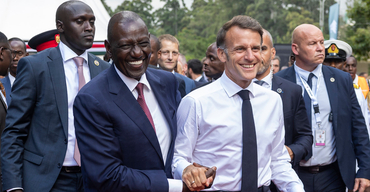
The President of the Republic visits Kenya from May 10 to 12, 2026, as part of the Africa Forward Summit.
The “Africa Forward: Partnerships Between Africa and France for Innovation and Growth” Summit aims to boost economic exchanges and investment and to strengthen joint responses to major global challenges.
The first day of the Summit was dedicated to youth.
Upon their arrival at the University of Nairobi, President Emmanuel Macron and Kenyan President William Ruto participated in an opening session titled “Future Makers.”
Watch the exchange:
The two leaders then viewed immersive artworks created by artists from the “Creation Africa” program, before taking part in a second session entitled “Africa Forward: Creation in Motion.”
Watch the session:
This was followed by a sequence entitled “Africa Forward: Sport for Sustainable Development.”
Watch the discussion:
The President of the Republic then watched sports demonstrations featuring young athletes participating in the French Development Agency’s (AFD) sports and development program.
He then took part in the closing ceremony of the business forum.
Watch the closing ceremony:
11 May 2026 - Check against delivery
Speech by the President of the French Republic at the closure of the Business Forum
Thank you, Mr President, William.
Prime Minister, Ministers, Ambassadors, business leaders,
I am delighted to be here today. Thank you, Mr President, Not only for your welcome and for organizing this important meeting, the first of its kind, but also for co-chairing this Africa Forward Summit.
Mr President,
Ladies and gentlemen,
The President and I are very pleased to have the honour of concluding this event, although I know many people still have to speak. Aliko and several of his colleagues are also going to speak and talk about what comes next. All that will continue. But I would like to say a few words, to express a few views building on President Ruto’s words, and I would like you to be able collectively to realize the importance of this Summit. Traditionally, an Africa-France Summit was called an Africa-France Summit, not “Africa Forward”, and it would start with the Heads of State and Government. There was a degree of involvement from economic leaders, sometimes there would be a business forum on the sidelines, but essentially, it was all in the hands of the Heads of State and Government and scripted, to an extent.
This Africa Forward Summit has been designed to put young people front and centre. President Ruto and I met with young people this morning and talked about youth, culture and creativity, sport, energy, health, digital technology and agriculture. All day, you have held an unprecedented Business Forum on the theme “Inspire and Connect Africa Forward”, enabling business encounters – and I will come back to this – and providing a platform for the business leaders and investors that you are: business leaders from across the continent, from across France and Europe. That is a unique achievement that will continue with our Summit tomorrow, which some of you will attend to talk in a totally novel setting with the Heads of State and Government who will be in attendance.
And so I would like first and foremost to warmly thank our Kenyan hosts, the university and all your staff, and of course the staff of the ministries for that, Mr President.
Thank you so much. And I would also like to thank the co-organizers, Bpifrance, Business France and Proparco. Together, you have built this absolutely unique event.
Bravo to you all, and thank you.
I would also like to thank all the businesspeople who have taken part, our professional federations, MEDEF, French international chambers of commerce and industry, French Foreign Trade Advisers (CCEF), the French Council of Investors in Africa (CIAN), and Alpha, for their efforts, as well as our volunteers, who have made this day together possible, as well as tomorrow and beyond. Thank you all.
“Africa Forward, Inspire and Connect” has generated immense, almost overflowing energy. We initially expected between 2,000 and 2,500 people, but there are almost 7,000 of you. That has never happened before. Never has there been a business forum at this level with so many participants. We have had splendid engagement, with key speakers from the economic world, entrepreneurship and civil society, with experts from all backgrounds who have brought food for thought to the 32 panels organized across the four agoras – Build, Produce, Trust and Innovate – and with six sessions held behind closed doors. Almost 7,000 participants, and more than 700 business meetings. That is the fruit of this unprecedented moment, with absolutely unique results that are bringing transformation. As you said, Mr President – and I believe we are here together because we share a vision – the partnership between France and Africa is built on solid foundations. Many companies here support them. There are €64 billion in annual trade and €50 billion of French direct investment in Africa. Meanwhile, African investment in France is growing constantly. A million jobs have been created by French companies in Africa, and diaspora remittances are a source of over €5 billion. They must not be forgotten. In the last decade, our relationship has been profoundly transformed, based on what President Ruto mentioned, and we believe very deeply in these changes.
There has been a change in vision. The President put it very well when he said we are changing and that French companies are changing. We need to speed that up. In commentary in France, it does not always come across enough, and I sometimes do not hear it enough in some Francophone countries in Africa. People say that France is disappearing, it is turning away from Africa.
No, not at all. But the relationship is changing, and rightly so.
France’s presence in Africa has been shaken over the last 25 years. That is normal and quite right. Why has it been shaken? Because for too long, too many people, both, it has to be said, in big companies and in government bodies, saw Africa as their back yard. They would say: “we are French, everything is open to us”. That is over.
China has arrived, and so have Turkey and the United States, among many others. And many other African countries. They have said: “We are more competitive than you, and better than you”. They have won market share and countries that have developed have given this market share to people who were more competitive than us.
And?
Africa is developing at an unparalleled rate. It is the world’s most dynamic continent. Last year, its economic growth was faster than South-East Asia’s. It is a continent with more than a billion young people under 30. So it is time for us, France and Europe, to wake up, as we have been doing in recent years.
And we have woken up.
The AFD has brought new momentum, in partnership with Bpifrance, to everything we have done in recent years, like the Choose Africa and Digital Africa initiatives and our Talent Passports. Everything we do for young people and our diasporas has to go faster, and further. We have woken up and said: “we want to win back market share in Francophone Africa, but also win some in Portuguese-speaking Africa and English-speaking Africa, because Africa is a whole continent, but not because that is a right, because we want to be the best”.
A new approach is needed, and President Ruto put that splendidly.
The African continent does not want us to come along with aid. People in Africa want us to come and invest. They do not want us to come along and explain what is right and what fits with what we have to offer, saying “we are very good at this and that, let us explain: you need this but you didn’t realize, but we’re coming”. That will no longer work. We now need to build things together, alongside the African continent, and ask where businesses want to develop, in energy, infrastructure, education, agriculture or health. We need to invest together and produce together. This conceptual revolution is what we have set in motion in recent years.
During the COVID-19 pandemic, we took action immediately. I called Moussa Faki, who was then African Union Commission Chairperson. We held an African Union Bureau meeting together and launched a platform to produce diagnostics and tests in Africa and to begin producing vaccines. William will remember that we launched projects here, and in Rwanda, and in South Africa, with Cyril, and African and European companies worked together to develop manufacturing. We did that because the African continent had had enough of just receiving medicines produced elsewhere. At the time, Africa accounted for 20% of vaccine demand, but 1% of vaccine manufacturing. That is the state of affairs that we are changing.
Similarly, when we launched new initiatives in the cultural and creative industries, in energy and in digital technology, alongside business leaders who are here with us today, we took a co-production approach, because the Nigerians said: “we know what we’re doing, don’t worry, but come and help us to be better integrated within ECOWAS”. Because working in partnership with businesses from the Francophone world like yours is a smart way to work better with Côte d’Ivoire and Senegal, for example, and progress in our regional integration. Our whole strategy over the last decade has been one of awakening, new vision, respect and mutually beneficial partnerships. The message is, firstly, that diasporas in France are an asset. We have millions of young people with African origins. We want them to thrive.
Secondly, we want our French companies, jobs and recruitments to be accelerators of growth on the continent.
Thirdly, this continent has everything it needs to succeed. We want to help it, to invest alongside Africans, and move away from the vertical approach and into an approach of equality, partnerships and joint investment.
And fourthly, we want to work together to build solutions for the future, because those solutions will be built for this continent and with its young people. As we saw this morning, and as the President underlined, mobile payment was invented here and has developed much faster in Africa than in Europe. All our Kenyan friends know that, and so do our Moroccan friends too. That is what is at the heart of Africa Forward. It is a change of vision and a change of approach.
I simply wanted to tell you today that out of this engagement and everything that has been done, we have very real outcomes for the African continent. Today, through your commitment and work, €23 billion in investment has been announced for the African continent.
€2 billion. This €23 billion includes €14 billion from French businesses that are here. Major groups, mid-caps and SMEs are investing €14 billion across the continent. I applaud all their business leaders here today, who are investing €14 billion, evidently in Kenya, but in all the countries gathered here today, and who will create over 250,000 direct jobs in France and Africa.
Alongside this, €9 billion has been raised in investment in Africa by African entrepreneurs and investors. This is unprecedented and it is precisely the springboard that we needed, that we need and that we now want to take to a new level.
A huge round of applause to all of you here for this remarkable outcome. I would like to thank the French businesses here for coming on board. We have spoken a great deal about Orange, we saw Canal+ earlier and we saw bioMérieux. We have businesses that are in the healthcare sector: Castel and others. We have businesses in all sectors. Let’s not leave anyone out. We have family businesses, we have listed groups and we have SMEs. You have played the game outstandingly. We have businesses that have grown from all regions here. I am so pleased that you are here alongside great Malagasy, Beninese, Senegalese, Nigerian and Moroccan leaders, and that together you are building projects, because that is precisely what the future is.
I wanted to tell you that I also see the future in a totally reciprocal relationship. We set up with Jean and some others – Tony was there too, and Gilbert and Mike, we have all the friends who are here, Professor Rabiou was with us this morning for the villa, and Aliko as well – we set up this Franco-Nigerian African Council. Nigeria played a key role in Choose France two, three and four years ago, and will do so again. What I wanted to tell you about the bilateral relationship is that I would also like to see more African investors in France. We are not just here to invest in the African continent by your side. We also need great African business leaders to come and invest in France. That is also the foundation of this relationship, now totally unfettered, because it is also a change of view and a reality. There are today on the African continent remarkably innovative and ambitious investors and entrepreneurs who are helping us to change France and create industrial jobs in our country. This is a source of immense pride and it is the key to this fair reciprocal relationship that William just spoke about.
A huge bravo for these investments and for what has been achieved.
I would like to wind up by answering President Ruto with regard to what he said and what we are going to do in the future and at Évian. You have these tens of billions in investment and this change of perspective that we have been able to make over these last ten years together, but we want to go further. If we are honest, what are the challenges today that need to be taken up for Africa to gear up for its business success?
We know what they are.
First: education. Frankly, what Morocco has achieved is an incredible revolution. I will say it here, Mr Prime Minister, that what you have done under the authority of His Majesty the King is a model for the continent. It’s in primary, secondary and university education that the best outcomes can be seen, and young people from your country achieve some of the best results in our École Polytechnique. It’s an extraordinary model. Kenya is doing absolutely tremendous things. Nigeria is doing tremendous things. You can see it here. And that’s why we started the day with the President, with an investment from the Agence Française de Développement (AFD) in engineering and in AI, with Saclay, here, in President Ruto’s alma mater. Education, education!
Second: energy. You are facing this battle. The African continent needs to transform its power supply. There are remarkable treasures, hydroelectricity treasures. I am referring to the Democratic Republic of the Congo with the entrepreneurs here, and major projects being built in DRC. And I am referring to the Republic of the Congo. I am also talking about the major hydrocarbons. Algeria has tremendous development potential, here too with investors and entrepreneurs who can make Algeria one of the future eldorados for transitions by gas, not simply for the African continent, but the entire Mediterranean.
In many of your countries, you are looking to develop civil nuclear energy, and we would like to be partners in that. Energy is a tremendous driver for change. You have great energy entrepreneurs here. We would like to be partners in this development.
The third challenge is infrastructures. As has been so well said, digital infrastructures, transport infrastructures and energy infrastructures, including green, are key to developing your countries’ economy. They are key to the African continent’s sovereignty. And this is where we have exactly the same challenge. We started the day this way with the President in that we, too, want our own sovereignty over our infrastructures, just as you do. Education, energy, infrastructures and structuring the economy. That is the fourth challenge.
One of the major challenges facing Africa, as you know, is that a huge number of jobs are created, but far too many are in the informal economy. Businesses on the African continent need to be helped to structure, by improving governance and enabling them to grow and thereby pay better wages, enter the banking and finance system so that more households in Africa, young and not so young, can access sustainable housing, the basic services of education and healthcare, and sound development. The ability to make the African economy a more formal economy is key. It is here that we need to help your governments and assist them with structuring these strategies.
The fifth and last challenge, I am probably not covering them all, but these are the five I wanted to talk about, is that to succeed in this, you need massive public and private investment.
This investment strategy is the one we are conducting. You have, so to speak, played your part with the announcements today of the €23 billion in investment from France and the African continent for Africa. What we want to do in the future and at the G7 is to structure an investment framework for the African continent. There is no reason today why there is so little private investment in a continent full of energy and youth such as yours. On this continent, if the value chain, which is at the heart of the challenges, is set up, if participation in the formal economy is encouraged, then Africa will not be a continent from which materials and minerals are simply extracted. They need to be processed, industry is needed. Smart agriculture is needed for its structure and to secure all these opportunities.
If that is the goal, then massive investment is needed. To achieve this, we need to resolve the issue of African countries’ ratings and those of many businesses. We need to solve the question of the treatment of risk for investors, often non-African, and sometimes certain African investors.
Five years ago, together we launched the Summit on the Financing of African Economies in Paris. We built an IMF special drawing rights issuing strategy to reallocate them to Africa. We succeeded with over 100 billion special drawing rights reallocated on the African continent.
A Franco-African initiative.
With the IMF, this enabled us to do what? To develop projects together with the States. Significantly, a dozen programmes were rolled out.
That was the first step.
The second step was in Paris in July 2023. William was there. We fought with a lot of leaders who were there for the Paris Pact for Peoples and the Planet (4P). And there, we said, “We need more leverage”. We were both at a roundtable with the President of the World Bank and the Managing Director of the IMF and we said, “We increase the leverage so that when we put in IMF and World Bank money, it triggers the same amount of private money each time.”
We completely transformed leverage.
Much more private money was unlocked.
There remains a problem that we have not solved and that we need to solve between now and Évian. Today, we do not have any real mechanism that guarantees first losses. We need to handle the issue of the ratings of many African States, which are often below “B-”, because the World Bank’s MIGA programme has made countries up to “B-” eligible for guarantees. Below that, no guarantees. Only fifteen or so African States are eligible. We need above all to have real first-loss mechanisms.
There are a lot of mechanisms today that cover second losses, but that is not enough. It means that a huge number of banks, investment funds and entrepreneurs, sometimes African, but mainly non-African, do not come to invest here. There is a solution and it is right here in Kenya. And that is ATIDI. The President of the African Development Bank came to see me a few weeks ago and said to me, “Let’s look at that.It works. It’s first loss.”
We, France, will co-invest with you and become shareholders in ATIDI to stand by our African friends and others.
Above all, together with our African brothers and William, we will tomorrow structure the course of action that will enable us to make ATIDI the real platform, the real guarantee mechanism covering first losses for the African continent. We will both go together to Évian in mid-June to convince the G7 to endorse this and for all the wealthiest economies to accompany us to get this security behind us.
There you are, my friends. I won’t keep you any longer. I will stop there.
I must say we felt a great deal of energy all day long. I wanted to tell you how proud we are, with President Ruto, to stand with you and tell you that it is you who will write the future. The young, and the not-so young, all those who are the bearers of the continent’s future, whether you are entrepreneurs, artists, academics, researchers, journalists or sportspeople, with this forum, you have, I believe, opened a new era. With this €23 billion in investment announced today and everything that we will launch, this is the dawning of a new era. It starts today in Nairobi, in your alma mater, Mr President, dear William. There will be no going back.
Together, we will co-produce, co-invest and co-invent because this is the direction of the new relationship between France, Europe, between us and Kenya and the entire African continent.
Thank you very much.
(Translated from French)
The day ended with an official dinner attended by the heads of state and government participating in the Summit.
Latest news
See all articles and topics-
25 August 2026 Joint statement by France and Saudi Arabia on the occasion of the visit of His Royal Highness Prince Mohammed bin Salman bin Abdulaziz Al Saud, Crown Prince and Prime Minister of the Kingdom of Saudi Arabia, to the French Republic.
-
2 September 2026 Franco-Dutch tech dialogue.
-
3 September 2026 Visit to the United Kingdom.
-
7 September 2026 Lumière declaration on the future of cinema and the moving image.