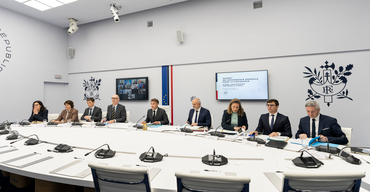
The Head of State chaired the Global Convergence for Growth Summit via videoconference on Thursday, June 11, 2026.
This summit aims to foster cooperation between advanced and emerging economies to ease tensions and create the conditions for balanced, sustainable, and inclusive growth.
Reducing global macroeconomic imbalances is a priority for the President of the Republic. He is committed to establishing a partnership between the G7 countries and all those who share his goal of growth.
This objective is consistent with France’s efforts to restore a strong industrial base in Europe and to balance trade with both China and the United States. It is also in the interest of the most vulnerable countries.
This conference signals a new willingness on the part of China, the United States, and Europe to engage in a coordinated economic approach.
The G7 Summit in Evian from June 15 to 17 and the G20 Summit to be held this coming December provide the appropriate frameworks for discussing global economic cooperation.
This Convergence Summit brought together representatives of the G7 and its partner countries in Evian (Brazil, South Korea, Egypt, India, and Kenya), as well as representatives from China and the IMF.
Participating Countries
- Mr. Friedrich MERZ, Chancellor of the Federal Republic of Germany;
- Mr. Mauro VIEIRA, Minister of Foreign Affairs of the Federative Republic of Brazil;
- Mr. Mark CARNEY, Prime Minister of Canada;
- Mr. ZHANG Guoqing, Vice Premier of the People’s Republic of China;
- Mr. KOO Yun-Cheol, Vice Premier and Minister of Economy and Finance of the Republic of Korea;
- Mr. Scott BESSENT, Secretary of the Treasury of the United States of America;
- Mr. Jamieson GREER, United States Trade Representative;
- Ms. Nirmala SITHARAMAN, Minister of Finance of the Republic of India;
- Mr. Giancarlo GIORGETTI, Minister of Economy and Finance of the Italian Republic;
- Mr. Iwao HORII, Minister of State for Foreign Affairs of Japan;
- Ms. Rachel REEVES, Chancellor of the Exchequer of the United Kingdom of Great Britain and Northern Ireland.
International Organizations
- Mr. António COSTA, President of the European Council;
- Mr. Valdis DOMBROVSKIS, European Commissioner for Economy, Productivity, Implementation, and Simplification;
- Ms. Kristalina GEORGIEVA, Managing Director of the International Monetary Fund (IMF).
Review the opening remarks:
11 June 2026 - Check against delivery
Opening speech by the President of the Republic at the Global Convergence for Growth Summit.
Emmanuel MACRON
[Thank you for] joining this virtual meeting and this convergence summit.
I'm very grateful that you've joined us for this important discussion. We will be collectively efficient. Our common goal should be clear. It's to put the global economy back on a stronger growth path.
I think we all share this objective.
In order to deliver, we need obviously sound domestic policies and effective international cooperation. Some of the challenges we face are manifestations of global imbalances.
Over the recent past, those imbalances have widened considerably, reaching levels not seen since the 2007, 2008 global financial crisis. The current global geopolitical situation is even obviously increasing these imbalances.
It will be one of the key focuses of our discussion at the G7.
It will be a very important topic for the G20 chaired by the US, and significant progress has been made in the past few months on reaching a common understanding on key aspects regarding imbalances. All the work done by the IMF and the Group of International Economists chaired by Hélène Rey is helping a great deal in this respect. I want to thank all of them.
The international consensus is forming around a few points.
First, there is urgency to act. Global imbalances have been persistent and have widened in recent years, endangering economic growth and financial stability. The call to action issued by the African countries in Nairobi was very clear in that regard.
Second, addressing global imbalances is a shared responsibility of both surplus and deficit economies. And especially the resynchronization and coordination of the right approach between Europe, China and the US are absolutely critical in this regard.
Third, coordination is key. And if they are not addressed through a coordinated approach among the world's major economies, these imbalances risk unwinding in a disorderly manner, leading to abrupt economic and financial adjustments and force addressing global imbalances is first and foremost in our own national economic interests.
A well-calibrated rebalancing would be a driver of stable and sustainable long-term growth.
Obviously, in this discussion, the IMF has a central role in the surveillance framework of imbalances for policy advice and to a certain extent monitoring of progress. The government and surveillance framework is key.
We all know what we have to do.
We know in Europe that we are lagging behind in terms of productivity and investment. I look forward to today's discussion and in particular I expect a policy-oriented and inclusive discussion on this urgent issue in order at our level to converge in terms of assessment and in terms of better coordination for our key policies.
I think the main question is clearly : how far are we ready to go collectively to rebalance our growth models to deliver stability and prosperity to our peoples ?
I won’t be any longer, but here was a way I wanted to frame our common discussion.
I suggest, if you agree, to start with the IMF and thank you, Kristalina, for being here in order precisely to frame this discussion and present the key objectives in more detail.