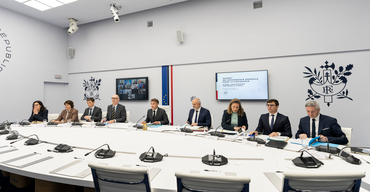
Le chef de l’État a présidé le Sommet de Convergence mondiale pour la croissance, ce jeudi 11 juin 2026 en visioconférence.
Ce sommet vise à initier une coopération entre les économies systémiques et émergentes pour apaiser les tensions et créer les conditions d’une croissance équilibrée, durable et partagée.
La résorption des déséquilibres macroéconomiques mondiaux est une priorité du Président de la République. Il s’engage pour établir un partenariat entre les pays du G7 et tous ceux qui partagent son objectif de croissance.
Cet objectif est cohérent avec les efforts de la France pour restaurer une industrie forte en Europe, équilibrer le commerce avec la Chine ainsi que les Etats Unis. Il est aussi dans l’intérêt des pays les plus fragiles.
Cette conférence signale une disponibilité nouvelle de la Chine, des États Unis et de l’Europe de s’engager dans une démarche économique coordonnée.
Les sommets du G7 à Evian du 15 au 17 juin prochain et du G20 qui aura lieu au mois de décembre prochain constituent les cadres appropriés pour évoquer la coopération économique mondiale.
Ce Sommet de Convergence a réuni des représentants du G7 et de ses pays partenaires à Evian (Brésil, Corée du Sud, Egypte, Inde et Kenya), ainsi que des représentants de la Chine et du FMI.
Pays participants
- M. Friedrich MERZ, Chancelier de la République fédérale d’Allemagne ;
- M. Mauro VIEIRA, Ministre des Affaires étrangères de la République fédérative du Brésil ;
- M. Mark CARNEY, Premier ministre du Canada ;
- M. ZHANG Guoqing, Vice-Premier ministre de la République populaire de Chine ;
- M. KOO Yun-Cheol, Vice-Premier ministre, Ministre de l’Économie et des Finances de la République de Corée ;
- M. Scott BESSENT, Secrétaire du Trésor des États-Unis d’Amérique ;
- M. Jamieson GREER, Représentant américain au Commerce ;
- Mme Nirmala SITHARAMAN, Ministre des Finances de la République de l’Inde ;
- M. Giancarlo GIORGETTI, Ministre de l’Économie et des Finances de la République italienne ;
- M. HORII Iwao, Ministre délégué aux affaires étrangères du Japon ;
- Mme Rachel REEVES, Chancelière de l’Échiquier du Royaume-Uni de Grande-Bretagne et d’Irlande du Nord.
Organisations internationales
- M. António COSTA, Président du Conseil européen ;
- M. Valdis DOMBROVSKIS, Commissaire européen à l'Économie, à la Productivité, à la Mise en œuvre et à la Simplification ;
- Mme Kristalina GEORGIEVA, Directrice générale du Fonds monétaire international (FMI).
Revoir les propos introductifs :
11 juin 2026 - Seul le prononcé fait foi
Propos introductifs du Président de la République lors du Sommet de Convergence mondiale pour la croissance.
Emmanuel MACRON
(Traduit de l’anglais)
Merci de participer à cette réunion virtuelle et à ce sommet de convergence.
Je vous suis très reconnaissant de nous avoir rejoint pour ces échanges importants. Nous serons, ensemble, efficaces. Notre but commun doit être clair. Il s’agit de remettre l’économie mondiale sur la voie d’une croissance plus forte.
Il me semble que nous partageons tous cet objectif.
Afin d’obtenir des résultats, nous avons évidemment besoin de stratégies nationales viables et d’une coopération internationale efficace. Certaines des difficultés auxquelles nous sommes confrontées sont le fruit des déséquilibres mondiaux.
Dernièrement, ces déséquilibres se sont aggravés de façon significative, et ils ont atteint des niveaux que l’on n’avait plus connu depuis la crise financière de 2007-2008. La situation géopolitique mondiale actuelle contribue aussi à l’accroissement des déséquilibres.
Il s’agira du point central de nos discussions au sommet du G7.
Il s’agira également d’un thème important du G20 présidé par les États-Unis, et des progrès importants ont été accomplis ces derniers mois vers une analyse commune des éléments clés de ces déséquilibres. C’est notamment grâce à tout le travail accompli par le Fonds monétaire international et le Groupe des économistes internationaux présidé par Hélène Rey. Je tiens à leur adresser mes remerciements.
Le consensus international s’articule autour de plusieurs points.
D’une part, il est urgent d’agir. Les déséquilibres mondiaux sont persistants et se sont aggravés au cours des dernières années, ce qui menace la croissance économique et la stabilité financière. L’appel à l’action lancé par les pays africains à Nairobi était très clair à cet égard.
D’autre part, l’atténuation des déséquilibres mondiaux relève de la responsabilité commune des économies excédentaires et déficitaires. La resynchronisation et la coordination d’une bonne approche entre l’Europe, la Chine et les États-Unis sont absolument essentielles à cet égard.
Enfin, la coordination des efforts est cruciale. S’ils ne sont pas traités dans le cadre d’une approche coordonnée des grandes économies du monde, les déséquilibres mondiaux risquent d’évoluer de manière désordonnée, ce qui conduirait à des tensions et à des ajustements économiques et financiers brutaux. L’atténuation des déséquilibres mondiaux est, d’abord et avant tout, dans nos intérêts économiques nationaux respectifs.
Un rééquilibrage bien calibré portera une croissance stable et durable à long terme.
Évidemment, dans cette discussion, le FMI joue un rôle clé de surveillance des déséquilibres au profit du conseil stratégique et, dans une certaine mesure, de suivi des progrès. Le cadre de gouvernance et de surveillance est essentiel.
Nous savons ce que nous avons à faire.
Nous savons en Europe que nous avons du retard en matière de productivité et d’investissement. Je me réjouis des échanges qui auront lieu aujourd’hui et je compte notamment sur une discussion inclusive, orientée sur les stratégies, sur cette question urgente pour, à notre niveau, converger en matière d’évaluation et d’amélioration de la coordination de nos principales stratégies.
Je pense que la question clé est évidente : jusqu’où sommes-nous tous prêts à aller pour rééquilibrer nos modèles de croissance et ainsi garantir stabilité et prospérité pour nos populations ?
Je m’arrêterai là, c’est ainsi que je souhaitais encadrer nos discussions communes.
Je suggère, avec votre accord, de commencer avec le FMI et je vous remercie, Kristalina, d’être ici précisément pour encadrer les discussions et présenter les objectifs clés en détail.