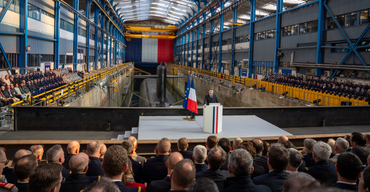
On Monday, 2 March 2026, the President of the Republic visited the Île Longue operational base.
Six years after his address to the trainees of the 27th class of the War College, the Head of State delivered a speech dedicated to France’s nuclear deterrence.
He emphasised that the current international context is marked by a period of profound geopolitical rupture and reaffirmed the robustness and effectiveness of France’s deterrence posture.
The President of the Republic announced an increase in the number of nuclear warheads within France’s arsenal and revealed the name of the next French nuclear-powered ballistic missile submarine: L’Invincible.
"Our country possesses exceptional weapons: nuclear weapons, which form the foundation of our security. If we had to use our arsenal, no State, however powerful, could shield itself from it; and no State, however vast, could recover."
He also presented a new stage in France’s deterrence doctrine, referred to as “forward deterrence.”
"France will always assume on her own the responsibility for the deliberate crossing of the nuclear threshold, fully factoring in the interests of our allies."
This gradual approach will enable France’s partners to take part in deterrence exercises and may, where appropriate, include the situational deployment of elements of France’s strategic forces on the territory of allied nations.
Watch the speech:
2 March 2026 - Check against delivery
Speech by the President of the Republic on France’s nuclear deterrence.
Prime Minister,
Ministers,
Ladies and gentlemen,
The context in which I stand before you today, at the heart of the Île Longue base, a cathedral of our sovereignty and a symbol of our country’s constant commitment to nuclear deterrence for more than 65 years now, is a solemn one.
In a few days, the SSBN Le Téméraire, which you can see in front of you, will take to the sea. It will drop into total stealth and will play its full role, from the depths, as the ultimate guardian of our freedom of action and our independence. We owe all this to the constant commitment of my predecessors and of our military, since the first French nuclear test in 1960, the first operational alert of the strategic air forces in 1964, the first stone laid right here at Île Longue in 1965, and the first patrol of the SSBN Le Redoutable in January 1972. We also owe it to the expertise of our research centres and our industrial base, and to the professionalism and devotion of the military and civilian personnel who serve our nuclear deterrence, from secret workshops, from the depths of the seas, or from high in the sky. I am grateful to them all.
For its deterrence, our nation has made a constant financial, scientific and technological effort that is exceptional in all respects and unparalleled in Europe. Already, three generations of men and women have worked to build, consolidate and optimize this cornerstone of our defence strategy. At a time when our certainties have been shaken, where our adversaries are growing bolder, where alliances face headwinds, France’s deterrent must remain a constant. As President of the Republic, elected by direct universal suffrage, I am its guarantor. I have come here to reiterate, with the greatest determination, the commitment of the nation and my own commitment to the continuation of this fundamental mission.
Our deterrence is robust and effective. Anyone who would dare to attack France must understand the unbearable cost they would have to incur. But constant does not mean inert. In February 2020, six years ago now, true to the tradition of the Republic, I set out the foundations of our nuclear doctrine and its global role. Things have changed since then. The weight of the last six years is that of decades for France and Europe. And the last few months have had the weight of years. Our competitors have evolved, as have our partners. The world has become a tougher place, as the last hours have shown once again. It is therefore with the greatest solemnity that I have come today to announce before the nation an evolution equal to the challenges faced by France and Europe. We must strengthen our nuclear deterrence against the combination of threats, and we must conceive our deterrence strategy within the depth of the European continent and with full respect for our sovereignty, with the progressive implementation of what I will call “forward deterrence”.
Yes, we are currently at a geopolitical tipping point fraught with risks. The French people know this, and this period justifies a hardening of our model. Russia is waging a slow and cruel war against neighbouring Ukraine which is, as our national strategic review noted, a major risk for our Europe. The same Russia asserts brutal imperialism and revisionism and, despite already having a vast nuclear arsenal, is constantly developing new weapons. These include hypersonic nuclear missiles, nuclear-powered missiles said to have unlimited range, nuclear torpedoes, and even a project that is particularly dangerous for humanity: nuclear weapons sent into space.
China, meanwhile, has begun a vigorous effort to catch up with the United States. It is building more weapons today than any other country. Just recently, it exhibited the latest advances in its nuclear triad. Nobody knows what direct or indirect, nuclear or non-nuclear consequences a conflict might have if it broke out in the Far East or elsewhere, but it would not be without consequences for us. China, like Russia, is developing increasingly sophisticated systems to protect its territory, an approach that is also being embraced by the Americans, with their Golden Dome project.
In Asia, the arsenals and strategic forces of other possessor States, like India, Pakistan and North Korea, are growing fast. Moreover, we can no longer consider threats in isolation, as new links have emerged between them. What is the price for North Korea’s massive support for Russia’s war of aggression? What are the ramifications of the alliance treaty between the two countries? And what about the position of extreme dependency on China that Russia has put itself in? We must take all that into account. That, and the ongoing war in the Middle East, which is bringing and will continue to bring instability and potential conflagrations to our borders – and Iran has nuclear and ballistic capabilities that have not yet been destroyed. I will come back to that in the coming days. As for our American allies, who are themselves modernizing their arsenal, they have played a key role in Europe’s defence since 1945, and will continue to do so. We are grateful to them and, in terms of deterrence, they directly contribute to our protection through NATO’s nuclear mission. But their recent national security and defence strategies illustrate a reordering of US priorities and are a strong incentive for Europe to address its own security more directly. We must take on board this call to take greater charge of our destiny, and as you know, that is exactly what I have been saying since the first day of my first term.
The period we are living in also has another characteristic. In the current atmosphere where norms are falling apart, we are facing both an increased risk that conflicts may cross the nuclear threshold and an intensification of conflict below this threshold. And that has very direct implications for us. The risk of that threshold being crossed is all the greater because, firstly, conflicts involving nuclear-weapon States, possessor States and proliferating States are growing. Have we not seen, just recently, outbreaks of violence involving India, Pakistan, Iran and Israel? Have we not also seen irresponsible behaviour, particularly on the part of Russia, which has tailored its updated doctrine to threaten Ukraine, amid normalization of discourse on nuclear weapons, officials brandishing thoughtless threats, and launches of dual-capability missiles like the Oreshnik, right near European borders? All this represents a major shift, making the risk of crossing the threshold more tangible.
At the same time, nuclear powers like France must also get used to the possibility of major conflicts below the nuclear threshold in their immediate environment. In recent months, have we not seen waves of missiles fall on nuclear-weapon States and possessor States? One day, Europe may find itself in a similar position. To manage this type of situation before the nuclear threshold is crossed, specific capabilities are needed: early warning to detect threats, expanded air defences to protect us, and deep strike capabilities to respond and act offensively. That is what mutual support, ”shouldering”, between capabilities is about. For our nuclear deterrence to be strong, every dimension of our conventional capabilities must be strong. Our defence rests on these two pillars, and I underlined their importance in 2020. But recent years have illustrated the glaring shortfalls of such mutual support between capabilities in Europe. This situation is untenable. And you will see that it is central to my thinking.
All this shows, in any case, that nuclear threats are growing and diversifying, that they are increasingly interconnected, that they may be preceded by episodes of intense conflict below the nuclear threshold, and that our potential adversaries are hardening their defences. We must learn lessons from this. In this dangerous and uncertain world, as I have already said several times, you have to be feared if you want to be free. I am convinced of that. Our country possesses exceptional weapons: nuclear weapons, which form the foundation of our security. The chain of command is totally clear, and the final decision lies in the hands of the President of the Republic alone.
In these times of uncertainty, and I say this before the nation with determination, as President of the Republic, I will never hesitate to make decisions that are essential to protect our vital interests. If we had to use our arsenal, no State, however powerful, could shield itself from it; and no State, however vast, could recover. Just one of our submarines, like the one behind me, carries firepower equivalent to the sum of all bombs that fell on Europe during the Second World War. That’s close to a thousand times the power of the first nuclear bombs. I stand before you today to deliver a speech of asserted strength in the service of peace. And this power, as you know better than anyone, does not come without effort. The continued credibility of this instrument is the fruit of important decisions made in the last decades, which have gained pace in recent years. The three years following the end of the Cold War were a parenthesis in history, during which we enjoyed the weakness of our adversaries and the certainty of empathy on the part of our allies. And so we gradually abandoned the land component of our deterrent, and our arsenal dwindled. Those times, so recent, are already seeming so distant.
Since 2017, I made it clear that “peace dividends” were no more. I have worked to ensure the renewal of all our capabilities for the next decades. Our future strategic submarines are being built. Those who have steadfastly ensured a permanent presence at sea since 1972 will therefore see a third generation take to the waters, right here, at Île Longue.
The first steel for the hulls of these new submarines began to be cut a few months ago, in Cherbourg. I would like to congratulate the military, industrial and scientific actors who are working for this success. Very few nations in the world are capable of building such nuclear submarines, which are an unequalled technological prowess, as stealthy as they are effective, capable to strike our potential aggressors anywhere. In the tradition of the christening of our submarines, I today have the unique honour of announcing that the next SSBN under the French flag will be named L’Invincible and will take to the water in 2036.
The same rigour has been applied to the overhaul of other areas of deterrence. For several months, we have had a new M51.3 missile on our nuclear-powered ballistic missile submarines (SSBNs) and a new ocean-based nuclear warhead optimized to penetrate all defences. Our strategic air forces and our nuclear naval air forces have modernized their nuclear cruise missile and we have plans to launch a very ambitious strategic supersonic and manoeuvring missile programme that will equip our combat aircraft and the future aircraft carrier in the decade ahead.
Our national Tritium programme has been consolidated, ensuring our ability to pursue nuclear weapons production in a completely independent and self-sufficient manner. As you can see, our military reinforcement – initiated nearly ten years ago – is now bearing fruit.. You can see some effects here today and we also will continue our efforts with respect to the conventional component. And yet, the context that I spoke about earlier has led me to a clear conclusion: we cannot be satisfied with the current trajectory. I owe the nation, today and in the future, the absolute assurance that our deterrence will remain credible and that when extreme circumstances arise, it will protect us from any situation of blackmail or capitulation.
The evolution of the defences of our competitors, the emergence of regional powers, the possible coordination between adversaries and proliferation risks, all of this, after careful examination, has led me to this conclusion. A strengthening of our arsenal is indispensable.
This is not about entering into any kind of arms race. That has never been our doctrine. It would be useless to enter into such a costly race. As I have said, what is essential is that all adversaries and all combinations of adversaries cannot imagine the slightest possibility of striking France without being certain that they would suffer damage that they could not recover from. There is no need to have equal arsenals for that to happen. Our doctrine therefore rejects the idea of flexible nuclear response. French nuclear capabilities are strategic and exclusively strategic because these are weapons of a whole other kind than those that can be used on a battlefield.
France, since François Mitterrand, has abandoned any notion of tactical use of nuclear weapons and we will not go back on this. Within this deliberate asymmetrical approach, France has always defined the size of its arsenal in strict accordance with the operational effectiveness of our nuclear deterrent. My responsibility is to ensure that our deterrent maintains, and in the future continues to maintain, its power of assured destruction in the dangerous moving environment, beset by proliferation, that I just pointed out. As a consequence, I have decided to increase the number of warheads of our arsenal. To put an end to any speculation, we will no longer release figures on our nuclear arsenal, as we have done in the past. To be free, we must be feared, and to be feared, we must be powerful. This increase in our arsenal is a testament to this.
But to be powerful, and this is the second focus of my speech today, we must be more united. And I will now speak of Europe. Our security was never conceived within the sole limits of our territory, in both conventional and nuclear terms. It is a clear geographical fact that exists and that we cannot negotiate. I will also add, today more than ever: independence cannot be solitude. When it comes to nuclear issues, this has been recognized by all of my predecessors without exception. But today, the conditions are now truly in place to draw its tangible consequences.
To explain this point, allow me to take the time to dwell upon a central element of our nuclear doctrine, the vital interests of the nation. French nuclear deterrence is intended to deter any State from encroaching on our vital interests. And what are they? We have never laid them out specifically. We have never laid them out, deliberately. Our red lines are not clear. They cannot be. Without a doubt, our interests, although they cover mainland and overseas France, should not merely considered as what is within our national borders.
Could we consider that the survival of our closest partners might be put at risk without it affecting our vital interests? Or conversely, that an extreme threat in Europe only concerns us? For these fundamental reasons, successive Presidents have referred to the European dimension of France’s vital interests. In February 2020, I reiterated the offer of all my predecessors, since President François Mitterrand, of a dialogue with European countries that would wish to develop this dimension with us more deeply. I had even offered to involve these countries in exercises of our deterrent.
Six years later, we are in a different strategic universe. We must move into an entirely new stage and articulate for our times the intuition already formulated by General de Gaulle. I believe I am in a position to affirm that our partners now stand ready for this.
First of all, last July, we forged closer ties with the United Kingdom, a major partner and independent nuclear power with which, since 1995, we have acknowledged that no situation affects the vital interests of one without those of the other also being affected. We have strengthened our bilateral nuclear cooperation, asserted our joint solidarity with the Europeans, and opened up the possibility of coordinating our respective deterrents. This winter, for the first time since our deterrent has existed, senior British officials attended one of our strategic air forces’ exercises.
But our ambition must be greater, because it is Europe’s security, our security, which is at stake in the future. Contact has been made with a first group of allies, of course starting with our crucial partners, Germany. They responded positively to France’s offer.
Today, a new step of France’s deterrence can now be taken. We are entering the path of what I will call “forward deterrence”. I prefer to be clear from the start, there will be no sharing of the ultimate decision, nor of its planification, nor of its conduct. Under our Constitution, the decision to employ nuclear weapons rests solely with the President of the Republic, who is accountable to the French people.
Therefore, there will also be no sharing of the definition of our vital interests, which will remain of sovereign assessment for our country. And for this reason, as with other nuclear alliances, including when they have plans and procedures, there will be no guarantee in the strict sense of the term. A rigid guarantee would not be wise. It would lower the nuclear threshold and reduce the uncertainty of our adversaries in equal proportion.
With forward deterrence, our doctrine will retain its original foundations: its strictly defensive character, the refusal of any nuclear battle, and the total and deliberate distinction between conventional and nuclear realms. The same holds true for the opportunity of a nuclear warning shot, unique and non-renewable: it will always be decided at France’s sole discretion, to demonstrate very clearly that the nature of a conflict has changed and that France intends, through this means, to preserve an ultimate chance to restore deterrence.
So France will always assume on her own the responsibility for the deliberate crossing of the nuclear threshold, fully factoring in the interests of our allies. This is a progressive approach. It offers, first of all, the possibility for partners to participate in deterrence exercises. It may also involve signalling, including beyond our strict borders, or conventional participation of allies’ forces in our nuclear activities. It will finally involve the temporary deployment of elements of our strategic air forces to allied countries.
In the same way that our strategic submarines dilute naturally in the oceans, guaranteeing a permanent-strike capability, our strategic air forces will also be able to be spread deep into the European continent. This dispersal across European territory, a sort of archipelago of forces, will complicate the calculations of our adversaries and will make this forward deterrence very valuable to us. It will strengthen our defence, while giving it room to operate: it will offer it a new strategic depth, in line with the challenges of European security. It will be, I believe, very valuable to partners who will follow this approach with us, and whose territory will gain a strong link with our deterrence.
It has been clear since the beginning, to us and to our partners, that this effort will come as an addition to NATO’s nuclear mission. In which, I would like to point out, we do not take part. The forward deterrence we are proposing is a distinct effort which has its own value and is perfectly complementary to NATO’s at both strategic and technical level. The work we have started on this project with the Europeans has been done in full transparency with the United States of America and in close coordination with the UK.
I would like to thank those allies who have demonstrated their trust by working intensely towards these future partnerships, in compliance with our international obligations, and particularly the Nuclear Non-Proliferation Treaty. Germany will be a key partner in this most ambitious effort, of course, in the spirit of the Treaty of Aachen. The first steps of cooperation will begin this year and could include visits of strategic sites and joint exercises.
Other countries have already agreed to this dialogue, in addition to our British and German partners and friends, whom I have already mentioned: Poland, the Netherlands, Belgium, Greece, Sweden and Denmark will join it. This is a genuine strategic convergence between our countries, that will give real depth to the defence of our continent. Discussions are also open with several other countries and will be developed the next weeks and months.
Mirroring what we have put in place with the UK, exchange bodies at political level will be created with each of these countries in the next few days. This requires joint work on the threat and intelligence, specific means of communication, organization, but also a common understanding of the drivers of escalation and how to respond to them, particularly in the conventional phase.
That is also why the approach of forward deterrence, by its very nature, strengthens our protection and that of our partners. In the same way that France creates for Europe’s adversaries new strategic dilemmas through forward deterrence, our partners are contributing in exchange to collective security and therefore France’s security. That is the very nature of mutual support between nuclear and conventional capabilities.
The experience of recent years shows that there are at least three areas where our Europe, if it had to confront an escalation and handle it under the nuclear threshold, would benefit from new collective resources: early warning, meaning the capability to detect and track missiles that could target us, using a combination of satellites and radar systems; control of our airspace with expanded air defence and anti-missile and anti-drone defences; and deep strike capabilities. By joining us in such reciprocal mutual support, partner countries can help strengthen the capabilities of Europe in these three fields. It would be a fair distribution of efforts, and France would clearly benefit from it.
Already, projects are moving forward, and we will continue to quicken the pace. First, regarding early warning systems, the JEWEL programme will provide Europeans with the sovereign capabilities to detect missiles targeting them from space. As for air defence, the new generation SAMP/T NG surface-to-air missile system will provide world class performances. Denmark and Ukraine have already announced they are acquiring them. In terms of deep strike capabilities, Germany, the United Kingdom and France, in the framework of our ELSA initiative, will work together on long-range missile projects. This will give new options to conventionally manage escalation, at a time when adversaries are deploying new technologies and weapons. As the partnership grows stronger, other projects and contributions will appear, in a spirit of European sovereignty and complementarity.
This is the new layer that I want to add to France’s defence, and the new cohesion that it will create for our continent. You can see it for yourselves, it is therefore a major shift that I have chosen to bring about for our deterrence. The context allows me at last to make the words “European dimension”, pronounced by nearly all my predecessors, a reality that benefits both our country and our allies.
In the troubled times we are living through, it will also be necessary to rethink the rules that govern the security of our continent and of the world. It is a whole framework that must be rebuilt, and Europeans should be able to fully defend their interests. And they will be able to because they will have born their share of the burden, strengthened their strategic independence and taken the major decisions that I have just mentioned. Today, international agreements on arms control are at a loss. Let’s look at the situation with clear eyes. Everyone has taken their liberties. The United States put an end to the anti-ballistic missiles treaties. The United States and Russia put an end to the intermediate-range nuclear force treaties, the provisions of which Russia had long violated. The New START Treaty, which governed US and Russian nuclear arsenals, ceased to exist a few weeks ago. Russia deratified the Comprehensive Nuclear Test-Ban Treaty, which the United States, meanwhile, had never ratified. A resumption of tests would end an almost 30-year-long moratorium. China, meanwhile, is catching up, and is not taking part in anything. So let’s be honest: The field of rules has turned into a field of ruins. And the prevailing animosity does not inspire the confidence required to rebuild the norms of collective security. That is why we are right to harden our position and we made the decisions I have just announced.
Unfortunately, such anomy applies not only to those who already have nuclear weapons, but also to those who are seeking to acquire them. The Review Conference of the Parties to the Treaty on the Non-Proliferation of Nuclear Weapons will be held in May, to a backdrop heavy with threats, with the concerning advances of the North Korean programme, the Iranian crisis, and the growing attempts of all those who, in Asia, Europe and elsewhere, are seeking alternatives to the security guarantees that they thought they could rely on. That is the spirit of our times. But France does not plan to resign itself.
In arms control, our own record is indeed exemplary. And I want to recall that today. We dismantled the land component of our deterrence and our enrichment facilities for military purposes. We ceased our nuclear tests, developed a high-performance simulation system and have always rejected any arms race. The forward deterrence approach that we are proposing is not escalatory, and as it enhances the feeling of security in Europe, it provides significant benefits to prevent potential future risks of proliferation on our continent.
But we must change our rationale, first and foremost. Yes, Europeans have become used to their security depending on rules made by others, in other times, and rescinded also, sometimes, unbeknownst to them , often at their expense. Let us be clear, the European security architecture was just that: agreements dating to the Cold War negotiated by others, including when they concerned us, and they were terminated by the very same States that had signed them, with no consultation, even when they were our allies. This era calls for another method. We must rebuild a body of rules – as far as we are concerned, one rooted in our security interests and those of our continent.
This will require, first and foremost, an effort that Europeans must undertake on how Europe’s stability should be organized. I am inviting our partners to take part in the initial work we have started with the Germans and the British on this matter. The strategic convergence allowed by forward deterrence will help to that effect When our European interests are established, we will be able to go further and open a negotiation framework in order to control certain conventional capabilities and their positioning. This approach must be prepared right away by enhancing our European independence, and tomorrow it must aim for a new security framework in all these areas, particularly between Europeans and Russians, at the very least, and at international level, by aiming to involve the USA and China, including regarding nuclear capabilities, on an equitable basis.
Above all, as you will have understood, I want the Europeans to reclaim control of their own destiny. Let’s not forget, that being said, that beyond the numbers in the arsenals and security architectures, there is an ethical dimension to what we are talking about. Nuclear weapons inherently inspire terror. The moral questions are not limited to the iron laws of strategy with its disembodied rationale. It is only right that such weapons continue to provoke rational discussions to limit and govern their use, and maintain the ultimate goal of a world without nuclear weapons. This must remain our horizon.
It is also right to persistently fight for peaceful uses of atomic energy. That is the very spirit of the NPT. And France is in a good position to promote civil nuclear energy. After all, what other country relies on that energy as we do? Nuclear energy produces 70% of our electricity. It is a low-cost, decarbonized energy that makes our country attractive. That is what makes France the right choice to host a summit in Paris on 10 March to encourage the development of this energy, its uses and its financing. I believe in the virtues of a reliable nuclear energy system, and innovation in the field. I believe in its value to tackle the voracious needs of new technologies. I am determined to help the International Atomic Energy Agency to foster sensitive new technologies, with appropriate regulation.
Ladies and gentlemen, it is time for me to conclude. I would like you to take a moment to appreciate this place, unique in the world. The operational base of Île Longue, at the far end of Finistère. Île Longue, which is truly at the farthest edge of Europe – its western cape and its fortress. I would like you to think about everything it signifies, in all its dimensions. Mass, power and independence. And I would add, strategic solidarity. What you have before your eyes is a valuable heritage of which we are the custodians and that we will continue to perpetuate tenaciously. We will therefore continue to develop the wonderful tool of power, an expression of French engineering, patiently erected since the beginning of the Fifth Republic. Since 2017, I have been firmly committed to the renewal of our strategic forces, and I will pursue this commitment through to the end of this term.
France will be strengthened by a modernised, powerful and sovereign nuclear force, calibrated to face up to our threats. While always remaining sovereign, France will also be strengthened by being firmly anchored on the European continent, by the strategic depth it provides, and the strengthening of ties among allies and the new forms of complementarity they make possible. The coming half-century will be an age of nuclear weapons. France, determined, free and confident will fully play its role. It will continue to fortify itself and, for its own benefit, will join up this cape on the Atlantic ocean to the core of Europe. That is my message today, let us be strong, let us be united, let us be free.
Long live the Republic, long live France.
(Translated from French)
The President then visited the facilities of the oceanic component of France’s deterrence and met with the women and men who ensure its continuity and operational excellence on a daily basis.
This visit provided an opportunity to pay tribute to the commitment and professionalism of the armed forces, who are the guarantors of national sovereignty and the security of the French people.
Latest news
See all articles and topics-
14 September 2026 Joint Statement on Finland’s Participation in French Forward Deterrence.
-
15 October 2026 France and the Netherlands held their first Nuclear Steering Group meeting in Paris.
-
7 October 2026 MED9 Summit in Croatia.
-
2 October 2026 Videoconference with G7 leaders on the global energy situation.