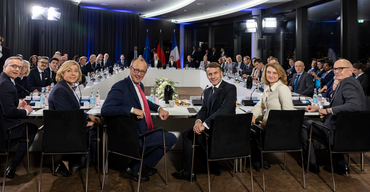
Le Président Emmanuel Macron s'est rendu à Berlin le mardi 18 novembre 2025 à l’occasion du Sommet sur la souveraineté numérique européenne, qu’il a co-présidé aux côtés du Chancelier allemand, Friedrich Merz.
Ce Sommet est une illustration concrète de l'agenda franco-allemand pour la compétitivité économique agréé lors du Conseil des ministres franco-allemand du 29 août à Toulon.
Il a permis d’accélérer la convergence dans le domaine du numérique, notamment sur :
- les enjeux de simplification,
- les enjeux de compétitivité,
- les enjeux de souveraineté des données,
- la protection et l’équité au sein du marché européen.
Les services numériques, et particulièrement les secteurs du cloud et de l’intelligence artificielle, ont été mis à l’honneur.
De nombreuses annonces d’investissements privés et des partenariats entre acteurs français, allemands et européens ont été faites.
Revoir le discours du Président lors du sommet :
18 novembre 2025 - Seul le prononcé fait foi
Discours du Président de la République à l’occasion du Sommet sur la souveraineté numérique européenne .
Emmanuel MACRON
Dear Chancellor, dear Friedrich, Commissioner, ministers, entrepreneurs, investors, ladies and gentlemen. Thank you very much, Friedrich, for this opportunity to be here with you and with our entrepreneurs and investors and academics and ministers for such an important event. And let me first apologize, Madam and everybody, for my delay. I’m responsible for that. But I wanted to welcome in France Boualem Sansal, and I want to reiterate my greeting and my big thanks to the German diplomacy and to you, and President Steinmeier, for your incredible help. He’s back, thanks to you.
I have to say, and this is a pleasure and not a coincidence, that I do agree totally with what Chancellor Merz expressed right now. And indeed, we are together completely convinced that we have entered a technological race in the digital field, which clearly affects the pillars of our society. And of course, our economy has entered the race for AI, cloud computing, chips, quantum technology, from downstream to upstream. In all these different transformations, the competition is definitely a very fierce and global one.
Talking about digital sovereignty is relevant to our competitiveness and our ability to innovate, but also to the health of our democracies, the efficiency of our public services and the protection of our citizens, particularly our children. And I will revert to that. And this is also taking place in the context of a great confrontation you mentioned, Friedrich, between the U.S. and China. And let’s be clear : Europe doesn’t want to be the client of the big entrepreneurs or the big solutions being provided either from the U.S. or from China. We clearly want to design our own solutions.
Not to say that we don’t want to cooperate. Being more sovereign and more independent doesn’t mean you want to be in autarky, no. But it means that on the key pillars, on the key building blocks, you want to preserve your sovereignty. And this is just a refusal of being a vassal. Indeed, there is a short-term cost not to be a vassal, because you have to reinvest, you have sometimes to take very bold decisions to be sure you will not create new dependencies or preserve existing dependencies. But I think it’s very important for us.
This transformation presents us with a twofold challenge : innovate to remain competitive while protecting our data, our infrastructure and more broadly our sovereignty. And this is this agenda of innovation and protection — which is not protectionism — which is so important, where probably we prioritised during the past few years the regulation of our domestic players. And this is what we have to change. We have to innovate before regulating, and we have to protect, not be overwhelmed by the non-European competitors. This is the right approach, according to us, in order precisely to deliver this digital agenda.
Germany and France are convinced that this challenge can only be met collectively at European level, in a spirit of unity and shared responsibility. And thank you once again for this summit, this invitation and the opportunity to be together, to have our commissioner and so many ministers and the current presidency. Because if we let the Americans and the Chinese have all the champions, one thing is certain : we may have the best regulations in the world, but we won’t be regulating anything.
This is why our willingness is clearly to do everything we can to build European champions on the different key building blocks, key elements of our digital strategy, and to deploy a holistic approach, as you perfectly phrased it.
I would like to take this opportunity to highlight some of our achievements first before going to the top priorities of this summit.
First of all, I want to remind all of us that we have very strong assets. And having framed the discussion by insisting on this fierce competition with China and the U.S., I really believe that until now we underestimated what we can do together as Europeans. First, we have a 450-million-consumer market, and this is a huge asset. This domestic market is not to be underestimated. Only the European market can provide both the scale and the core values that can allow our tech companies to thrive and export their products on international markets. This is why the single market agenda is so important.
Second, we are attractive, as was shown at the Summit for Action on AI in February in Paris, clearly illustrated by the commitments and announcements of this summit today in Berlin. And clearly, we have a momentum precisely to attract more and more investments, 12 billion mentioned here. Our two countries are attracting a lot of investment coming from the rest of the world to build more data centers and solutions. And we clearly have a lot of assets : we have talents in Europe, we have this domestic market, we have energy and we can deploy as well critical solutions. So, I want to insist on the fact that we are an attractive place and we have a lot of assets that we can provide.
Third, we have a very strong Franco-German convergence. This summit on European digital sovereignty is a concrete result of the agenda that we set during the Franco-German Council of Ministers co-chaired in Toulon at the end of August this year and which allowed the adoption of 8 roadmaps in the critical sectors necessary to our competitiveness and around 30 flagship initiatives. This summit is a new demonstration of a Franco-German reflex that plays out at all levels, as shown by the number of companies and stakeholders present today.
Fourth, we have also managed to develop remarkable tools at the European level, and this is an asset. In a world where technology is much faster than legislation, these tools do not yet allow us to ensure the ambition of European digital sovereignty. But in the current geopolitical context, preserving our digital acquis is of utmost importance. With GDPR in 2018 and more recently with the DSA and DMA framework, and the upcoming Cybersecurity Act, the EU is endowed with several key legislations respecting a fair balance between ensuring ethics, consumer protection, safeguarding democracy, while also favouring innovation and competitiveness.
Now, what we want to do is clarification of some remaining issues. This is part of the outcome of this summit and of a simplification agenda. But I want to insist on that even in front of entrepreneurs, because this set of very important regulations is an asset. In a democracy like the U.S., it is not sustainable to have tech companies without any regulation. It’s impossible, because you cannot dedicate the strength of your economy to the Seven Magnificent. And more than that, you cannot delegate the whole functioning of your democracy to the Seven Magnificent. It’s unbearable.
We do believe in innovation, we do believe in sovereignty, we do believe in these digital innovations, but in our societies with our values, and in the fact that we all live in democracies — and this is a chance — and we are neither dictatorships, autocracies nor a democracy with a strange collective choice which is indeed to renounce any capacity to regulate. Because we know the result of that : some monopolies, the dysfunction of the market, and at the end of the day the killing of potential innovation and, more than that, the dysfunction of democracies.
The fifth point on our European assets is that we have tech leaders, from startups to well-established companies, that are ready to make this message their own. By bringing together a wide range of private, Franco-German and European initiatives, this summit has shown that we are aligned with the digital sector. I want to cite here the landmark partnerships between Mistral and SAP in AI, the partnerships between Pasqal, the CEA and the German Jülich Supercomputing Centre in quantum, the partnership between Owkin, Institut Gustave-Roussy and la Charité Berlin on AI and health, as well as all the announcements made by the EU AI Champions Initiatives. This is the best evidence of the fact that we do have a lot of champions, a lot of energy in this room and a lot of common projects.
These five points are here to say that we have everything if we want to deliver the agenda of more sovereignty in the digital field, and if we want to be much more sovereign on AI, quantum, chips and so on.
Now let me just flag some of the critical outcomes of this summit I wanted to underline, completely in continuity with the words of the Chancellor. With all these efforts, we have created the conditions for a European model for tech which puts our values and our economic principles at the forefront. Creating this framework was necessary but not sufficient. We have to move to execution and take action to unleash the full potential of the European tech ecosystem.
For this reason, we put digital sovereignty, fostering domestic champions and freeing ourselves from dependence on foreign technologies at the forefront of the economic agenda that we set during the Franco-German Council of Ministers. And this summit is the time to implement this agenda and to achieve true European sovereignty, which means freeing ourselves from technological dependencies at every level of the value chain, from critical infrastructures and hardware to data, cloud and software.
And we will move forward with three priorities that we believe are key to strengthening European tech companies and fostering the emergence of new leaders.
First, simplification. I cannot agree more with the words of the Chancellor. We work very hard together, engaging with our Members of Parliament and the Commission to deliver a big simplification agenda at the European scale. This is a necessity, because sometimes we put tariffs to ourselves in a certain way and we have to lift them.
I have said it : Europe has implemented pioneering legislation to ensure that the digital transformation wouldn’t hinder the democratic principles and consumer protection that stand at the heart of the European model. This is good. But what we have now realised is that over-regulation as well has a cost. The Draghi report estimates that reducing administrative burdens could unlock 200 billion euros.
So, because streamlined and coherent regulatory framework enhances clarity, supports startup development and strengthens European competitiveness, we need concrete measures towards simplification. Our approach is to prevent legal uncertainty and to adapt existing legislation to fit our standards for consumer and data protection, while preventing value regulatory burden. And it’s feasible and it is part of the outcome of this summit.
On the GDPR, thanks to the Franco-German agreement, now we will push together and we are asking the Commission to simplify by improving the calibration of regulatory obligations with a risk-based approach, much more proportionate, much more adapted. This is what a lot of companies are requesting from GDPR.
We want to preserve this regulation. It's very important for a series of topics and our values. But we need this adaptation. On the AI Act, we ask for a 12 month postponement of compliance for high risk AI systems. Necessity, as well, to use this time in order to accelerate our innovation agenda. The priorities defined today, and the measures that we are taking are part of a wider agenda, as I mentioned, to simplify digital regulation as well as CSRD and the CSDDD to allow all European companies to scale up. And part of this simplification agenda is the deepening of the single market. The most important simplification agenda for all of you is to create a real digital single market. And it is not yet the case. Your domestic market is still the German or the French market. And you have to face additional regulations or the regulators when you cross the border.
The top necessity, the core of our agenda together with Chancellor Merz, is clearly to streamline regulation in some critical sectors and digital as part of them, in order to simplify, merge some administrative bodies and deliver concrete and in real terms a single digital market. As Friedrich Merz mentioned, we need in parallel to create an actual savings and investment union. This is a necessity to accelerate on this agenda. Why ? Because in order to deliver a sovereign agenda on the digital side. It's true as well for energy and other sectors, we need more innovation and we have to finance this innovation. Obviously, we will push together to have more common financing from the EU. We have our own programs and we try to work together, but we have to mobilize much more private money. The paradox is that our continent is number one in terms of savings, but one of the worst places to use these savings on innovation and equity, which is crazy. This is a result of our over regulation on banks and insurance. But as well as, the fact that we don't have a proper capital market union. This is why we want to accelerate the securitization agenda beginning of 26, in order to deliver this agenda, to take part of the savings in the banks and insurance, to go to innovation and to invest on equity. And in parallel to accelerate the implementation of the capital market union, to have a proper integrated place and channel much more of the savings on innovation.
Second, after simplification, innovation, precisely. This is the second common priority. Europe can capitalize on a world class university system, on a wide pool of talent and of ideas, but also on the quality of existing infrastructure, including a rapidly increasing computing power capacity and the experience of established industrial groups that are partnering with emerging players to develop vertical tech solutions. On this issue, I just wanted to insist on the fact that we have to follow up our cooperations on our programs on both sides, in order to educate and train more and more talents. And in parallel to build more and more computing capacities. What we need to deliver and to succeed, especially on AI, is talents and computing capacities. On this issue, state governments and the EU have a role to play, to ensure that new actors have access to appropriate infrastructure, including computing power and frontier research centers and today, with a JUWELS supercomputing facility in Germany and Adastra in France. Tomorrow, thanks to the AI Factory and AI gigafactories initiatives at the European level, as well as to the IPCEI AI that we initiated with Germany and several other member states, we have the beginning of such cooperation. Now let's accelerate and let's deliver this capacity. It is absolutely critical.
Third point and part of the achievement of this summit, protection. To limit the risk of extraterritorial enforcement of foreign laws, to limit our dependency, we have to act and to take bold decisions. Otherwise, we will speak about sovereignty, but we will be super dependent on external on foreign solutions or decisions. This is why we have a first issue in terms of sovereignty data. We need to strengthen the protection of European data with the revision of the Cyber Security act as well as in the design of the EU Cloud Certification scheme. We have to create the capacity to store the data on our continent but we have to preserve this data and the use of this data from extraterritorial laws. Otherwise, we are not sovereign anymore. We also need to protect our market. Dominant players today, often non-European, as we mentioned together, are abusing their market power and preventing new challengers from being successful and innovating. This is a reality. Our goal is to restore fair digital markets, where competition can fully play its role to the benefit of innovation and competitiveness.
To that end, the DMA adopted in 2022 during the French Presidency, should be leveraged. And we welcome together the recent announcement of the Commission to consider launching a market investigation into the qualitative designation of cloud hyperscalers. I think this is very important move forward in the implementation of DMA. We need a fair market where the top leaders are not the ones to kill the competition. Otherwise, there is no chance to have innovation and fair competition. More generally, we are already seeing the positive impacts of regulations such as DMA and DSA which strongly incentivize all digital actors to respect both our economic roots and core European values. However, our procedures must be quicker while preserving a high level of quality in the inquiries. But we have clearly to accelerate the implementation of these regulations. To go further, I strongly believe that European preference needs to become our guiding principle, starting with public procurement. If we believe in digital sovereignty, if we want to help our champion to succeed, our top priority as governments, but as well as large European companies, is to have a European preference agenda.
Because guess what ? The Chinese have a Chinese exclusivity as soon as they can and the Americans have a very strong American preference. Sometimes in the regulations, but most of the time the practice. We are the only place where there is never a European preference not to say a fascination for non-European solutions sometimes. This is why the collaborative work that France and Germany are launching to define the notion of European digital services will be key to the concrete implementation of European preference. We launched a working group together to say : what does it mean having a European digital service ? We will fix it rapidly, work with the Commission and our colleagues, but this is a necessity. We have to put it in our regulation to create this preference. And I mentioned this partnership between SAP and Mistral. The letter of intent that our two governments signed today with SAP and Mistral is for me a game changer. It will be the preference for an existing European solution which will be used for public administration in our two countries. This is a game changer for me, the whole model of what we need. I do encourage all the large companies, all the local authorities and the governments present in this room just to look at the competitive map each time you want to take a digital solution, either a competitive and high-quality European solution. If it exists, take it, please take it, adopt it !
This is your unique chance to be sure that you will secure your provider with European regulation, that you will prevent yourself from some extra territorial laws or decisions today or tomorrow. And it will be the best way to help this ecosystem to be competitive. In this context, this is why we have to accelerate our adoption agenda and I want to conclude with this point. Adoption now is critical. We were probably incomplete with Mr. Chancellor. We didn't speak sufficiently about all the infrastructures, our chip agenda and so on. You mentioned that today and we will revert in the months to come on this issue. Now one of the critical races where we have to accelerate is that for all the critical players in the different fields of the industry, we have to accelerate the agenda of adoption for AI. It's true for public administration, but it's super important as well for the different sectors of our industry. Why ? Because it will be the best way to provide activities and clients to the AI Quantum companies. Second, because it will improve productivity and competitiveness of these key players. And third, it will secure the use of cheap use on our soil. But adoption is a new race and we will have it in the weeks, the 26th of this month in Paris, the adopt AI summit, as a follow up, of this one. But it's very important to take very seriously this agenda as well.
My very last remark will be to protect citizens in this digital space. I wanted to flag that in this context of European digital sovereignty, because it's part of it, even if I don't want to elaborate today. If we speak about sovereignty, we should not underestimate our democratic and I would say our cognitive sovereignty. But if you look at our situation today, you give the responsibility of your teenagers who spend on average 4 to 5 hours per day on the social networks. You give the responsibility of the content they are exposed to to U.S. private providers or big Chinese companies. And they design the content, they are in charge of the algorithm, they are in charge of the content with DSA and our regulation, but still being implemented. So when we speak about cyberbullying, when we speak about being exposed to pornography, when we speak about having some mental disease, etc.
I mean, let's be clear, this is exactly made by these platforms to your children. We decided de facto to give them this exclusivity. So this is why, if we want to speak about sovereignty, we have to protect much more our children vis a vis all these contents and all these platforms. The agenda of children and teenagers protection is a necessity for their mental health, for the sustainability of our education system. Second, if we want to protect our democracies and preserve the well functioning of our democracies, let's regulate as well the content of this platforms. Let's be much more demanding because please don't believe, once again, on the so called “free speech agenda” for me, we don't speak about free speech when the algorithm is hidden and in the hands of very few players, and when they don't implement the laws decided by the citizens of a country.
This is the Wild West, notF free speech. So let's be clear, if we want digital sovereignty, we will have to better protect our children, our teenagers and our democratic space. I will stop here. I want to thank all of you. I want to thank you, Mr. Chancellor and ministers, for this unique opportunity. As you can see, we have a lot of assets to succeed as Europeans and to cooperate with others, but cooperating as a prerequisite, not being dependent. We can deliver this agenda of being much more innovative, protecting the key building blocks and being more sovereign. This is exactly what we want to do and I want you to be sure that there is a very strong alignment and partnership between Germany and France on this agenda. Our willingness in the months to come is as well to structure a core team in order to implement in the months and years to come a clear common digital approach between Germany and France. When we speak about AI, when we speak about quantum, when we speak about all the key issues we mentioned today, we need to build the common integrated market and approach it together. We strongly believe in this common approach and we strongly believe in the European perspective and the close cooperation at 27 and with the European Commission.
Thank you for your attention.
A l'issue du sommet, le Président de la République et le Chancelier allemand ont donné une conférence de presse conjointe, avant de se retrouver en fin de journée pour un entretien bilatéral, puis de retrouver le Premier ministre du Royaume-Uni pour un dîner de travail.
Revoir la conférence de presse :
18 novembre 2025 - Seul le prononcé fait foi
Conférence de presse conjointe du Président de la République et de Friedrich Merz Chancelier fédéral d’Allemagne.
Emmanuel MACRON
Merci beaucoup, Monsieur le Chancelier, cher Friedrich, pour l'accueil et pour l'organisation de ce sommet, pour les mots que vous venez de prononcer.
Je ne veux pas ici paraphraser ce que le Chancelier vient de dire, mais ce sommet est une concrétisation de ce que nous avons ensemble décidé et de ce réflexe franco-allemand pour faire avancer à la fois nos écosystèmes, nos économies et notre Europe. C'est un peu la même démarche qu'on veut avoir quand on parle d'automobile ou quand on parle d'espace, c'est-à-dire une action concrète où l'Allemagne et la France bâtissent de commun des convergences et portent aussi un agenda commun en Europe.
Monsieur le Chancelier vient de le dire, notre premier objectif, et je crois que c'était confirmé par la discussion qu'on vient d'avoir avec des entrepreneurs et des investisseurs, c'est de poursuivre un agenda de simplification que nous poussons depuis plusieurs mois. On est en train de continuer à pousser pour simplifier des règles qui sont trop contraignantes dans notre Europe et qui pèsent sur la compétitivité de nos entreprises. C'est ce qu'on fait sur CSRD, CS3D et d'autres.
C'est aussi ce qu'on veut faire pour simplifier et approfondir notre marché unique, c'est-à-dire lever des règles qui entravent la réalité de ce que devrait être le marché unique, c'est-à-dire un marché de 450 millions d'habitants. Ensemble, nous poussons pour avoir un marché unique du numérique beaucoup plus intégré, et ça a été rappelé par nous deux tout à l'heure, par un marché des capi
Ce qui est absolument vital si on veut réussir la bataille du numérique, qu'il s'agisse de l'intelligence artificielle ou du quantique, parce qu'elle requiert beaucoup d'investissements publics et privés. Donc, il faut avoir justement cette simplification européenne. De manière plus spécifique, ce sommet a permis de bâtir deux convergences franco-allemandes qu'on va relayer au niveau européen maintenant. On demande ensemble à la Commission européenne le report d'un an des dispositions du règlement sur l'intelligence artificielle concernant les systèmes d'IA taux, et donc, de l'épargne et de l'investissement, beaucoup plus intégré en Europe.
à haut risque, ce qui était un point important pour nos systèmes d'innovation. Nous demandons ensemble une simplification du règlement général sur la protection des données, là aussi pour avoir une approche plus proportionnée. Évidemment, on tient beaucoup à cette réglementation, mais on a ensemble sorti un texte qui permet d'avoir une approche beaucoup plus proportionnée et d'évaluation, justement, des risques.
Ensuite, sur l'innovation, deuxième chose après la simplification, si nous voulons plus de souveraineté européenne, il faut des acteurs européens qui innovent et qui proposent des solutions pleinement compétitives. On a aujourd'hui deux écosystèmes très forts, avec des grands groupes, mais des acteurs émergents également, une offre complète d'infrastructures, et donc, on veut continuer notre agenda d'innovation. 1) Nous avons confirmé plusieurs programmes de formation, on les a dans nos stratégies respectives, pour continuer d'avancer, de former des talents et de les échanger. 2) On a besoin d'infrastructures critiques, en particulier infrastructures de calcul, laboratoires de recherche de pointe et autres. Là, c'est tout ce que nous faisons pour les supercalculateurs. Par exemple, ce qui est fait de commun, et c'est une bonne avancée aussi de ce sommet, entre le supercalculateur Alice Recoque en France et Jupiter en Allemagne, ce sont aussi des initiatives qu'on a avec AI Factory et AI Gigafactory lancées par la Commission européenne. Et c'est le sens de l'initiative annoncée sur l'IA dite de frontière qui doit permettre la reconnaissance des meilleurs centres de recherche en IA en Europe. S’appuyant d'ailleurs sur ce qu'on a pu faire dans nos différents pays. On a mis en place des clusters IA en France ces dernières années qui vont totalement dans ce sens.
Donc, pour l'innovation, c'est l'accélération de nos formations, des centres d'excellence allemands-français, franco-allemands et communs, et des infrastructures de calculs indispensables en plus grand nombre et consolidées ensemble. Nous continuerons à porter le même agenda d'innovation au niveau européen. Ça vaut pour l'IA, ça vaut aussi pour le quantique, les semi-conducteurs, les architectures de réseau.
Le troisième point, c'est ce que j'appellerais la protection. On a besoin, si on veut avoir en effet une plus grande souveraineté européenne, de protéger d'abord nos données. C'est pour ça qu'on soutient un agenda commun, justement, de préservation de nos données en Europe et de protection à l'égard des lois extraterritoriales ou de ce qui peut les menacer. Donc la certification de la cybersécurité pour les services de cloud est à cet égard un agenda très important et une initiative importante à venir.
Ensuite, nous voulons ensemble agir pour avoir une préférence européenne, et c'est exactement ce que nous avons fait — et je trouve que c'est l'un des débouchés très concrets de ce sommet — en matière de services et d'intelligence artificielle pour nos administrations. On a deux grands champions, un champion historique du logiciel qui est SAP en Allemagne, un champion des modèles et de l'IA générative, qui est Mistral AI en France, ils se sont mis ensemble pour justement permettre d'avoir de l'apport, du soutien et d'avoir une solution franco-allemande.
On a signé une lettre d'intention ensemble, faisant que nos gouvernements s'engagent, à prendre l'offre commune Mistral-SAP. C'est l'illustration d'un agenda franco-allemand où on met l'IA en commun avec des entreprises puissantes européennes et où on décide de bâtir un agenda franco-allemand d'achat, une préférence européenne. Il y a d'autres solutions qui sont non européennes, mais on avance ce faisant. Je pense que cet exemple est extrêmement important, comme plusieurs autres, qui sont la concrétisation de ce que nous venons de faire, plus les régulations pour protéger les offres européennes.
Je ne veux pas être plus long. Mais voilà, simplification, innovation et protection par la préférence européenne sont à mes yeux des axes très importants qui ressortent de ce sommet et qui nous permettent d'avancer sur ce réflexe franco-allemand, cette convergence entre nos deux pays pour bâtir un agenda commun d'abord pour nos écosystèmes et nos économies, mais également pour pousser ensemble le même agenda au niveau européen.
Merci beaucoup.
Journaliste
Une question sur le service numérique européen. Vous voulez établir une définition. Qu'est-ce que, vu d'aujourd'hui, vous considérez comme souverain, notamment pour le cloud souverain ? Ça doit répondre à quels critères et dans quelles mesures le but est notamment d'éviter des perturbations comme celles qu'on a vécues aujourd'hui avec Cloudflare ?
Emmanuel MACRON
Alors, nous voulons donc mettre en place une préférence européenne. La difficulté qu'on a eue quand on est rentré dans la technique de certains sujets, c'est qu'il n'y a pas de définition établie, en effet, du service numérique européen. C'est pour ça que, très concrètement, on lance un groupe de travail franco-allemand qui doit aller assez vite, mais qui va permettre de bâtir des définitions concrètes, c'est-à-dire est-ce que c'est 100 % d'offres — c'est des questions très pratico-pratiques — mais est-ce que c'est 100 % d'européens ou est-ce qu'on accepte des partenariats non européens ? Est-ce que ça couvre les infrastructures ou simplement les services ?
Il y a des tas de questions très technique, pour avoir une définition franco-allemande qu'on poussera ensuite au niveau européen. Le fait que cette définition même n'existe pas dit à quel point on est en retard sur un agenda de préférence européenne, parce qu'on n'a pas construit la définition qui permettrait de bâtir le droit pour avantager, protéger un acteur européen quand il y a une offre concurrente non européenne.
Donc ça, c'est ce qu'on doit bâtir dans les prochaines semaines. On ne va pas préempter cette réponse aujourd'hui. Elle est très technique. Aller, si je puis dire, segment par segment. Ce qu'on veut faire, c'est très clairement de dire, quand il y a une offre européenne, elle doit être préférée et privilégiée. Pour ce qui est du cloud, on n'est pas sur des offres totalement fermées. Ce qu'on a avec S3NS ou avec Bleu, par exemple, ce sont des offres où il y a des participants non européens. Mais il y a des infrastructures européennes et un minimum de contenu européen qui permet de se dire que c'est beaucoup plus solide que des gens qui ne le sont pas. Et c'est aussi pour ça, ce qui vous permet de dire, quand vous avez des acteurs qui refusent de rentrer dans le cahier des charges que vous donnez, que d'autres s'y joignent, on a raison de favoriser les acteurs non européens qui se joignent à nos cahiers des charges. Donc par rapport à ça, est-ce que ça veut dire que ça nous immunisera totalement des attaques cyber ou des défaillances ? Restons prudents. En tout cas, ça nous mettra mieux en capacité de les prévenir, de nous protéger des risques cyber.
Et l'un des buts de la préférence européenne, c'est de mieux maîtriser, c'est d'être protégé de certaines formes de risques cyber et c'est d'être protégé de l'extraterritorialité de certaines décisions et de certaines lois, ce qui sera aussi un problème. Donc là, on a vraiment mis en place une méthode commune, ce qui est pour moi une des grandes avancées de ce sommet.
Journaliste
Vous avez reçu ce matin à l'Élysée Boualem Sansal. Tout d'abord, comment va-t-il ? Et puis ensuite, puisque vous avez abordé la coopération franco-allemande sur ce point, est-ce que vous estimez aussi que cette libération peut entraîner un réchauffement des relations avec l'Algérie ? Est-ce que vous allez rencontrer ce week-end, en marge du G20, le Président Abdelmadjid Tebboune. Et puis, très rapidement, la coopération allemande sur ce point a été importante. La coopération européenne aussi sur le narcotrafic. Vous avez, ce matin, organisé une réunion. Est-ce que vous considérez qu'aujourd'hui, comme votre prédécesseur, d'ailleurs, François Hollande, le narcotrafic est le principal danger pour la République, au même titre que le terrorisme ? Merci beaucoup.
Emmanuel MACRON
D'abord, c'était une joie de pouvoir accueillir Monsieur Boualem Sansal et son épouse. Ils étaient émus, heureux de revenir en France, et ils étaient en bonne forme. Et je veux ici leur dire toute l'affection de la nation. C'était un moment important, et ce qui a expliqué le retard que nous avons eu ici, je m'en suis excusé auprès de Monsieur le Chancelier.
Je veux ici redire ma gratitude à l'égard de l'Allemagne, sa diplomatie, Monsieur le Chancelier et les ministres compétents, et du président Steinmeier pour vraiment les bons offices qui ont été faits par l'Allemagne pour nous aider à mener ce chemin qui a permis de sortir d'un an d'emprisonnement. Et donc c'est vraiment une étape importante, à la fois à titre personnel, mais pour le pays et pour un écrivain auquel nous sommes attachés. Maintenant, vous savez quelle est ma position depuis toujours sur ce sujet.
Je pense que nous, nous voulons des résultats pour notre pays. Et donc, moi, je tiens à ce que la France soit respectée et à ce qu'elle mène un dialogue sérieux, calme et exigeant. Et nous, nous sommes respectueux de tout le monde. Et donc si ces conditions sont remplies et qu'on peut obtenir des résultats, moi je suis disponible évidemment à tout échange à mon niveau. Et je l'ai eu par le passé. Et donc nos équipes diplomatiques et nos équipes resserrées sont en train de travailler à cela. Et mon souhait, c'est que nous puissions avancer pour à la fois être plus efficaces sur les grandes questions économiques, sécuritaires, migratoires, afin d'œuvrer ensemble et de défendre chacun dans notre rôle, pour ma part, les intérêts de la France, et pour ce qui est du Président Tebboune, les intérêts de l'Algérie.
Pour ce qui est du narcotrafic, j'ai tenu ce matin une réunion à la fois sur la question de Marseille spécifiquement, et pour faire un point sur une lutte que nous avons commencée il y a plusieurs années. Je rappelle qu'en 2018, on a mis en place l'OFAST, qui a rassemblé nos services, des opérations de harcèlement. On a fortement augmenté les moyens, à la fois police, gendarmerie et douane, Tracfin et justice, et on a harcelé véritablement les réseaux avec des vrais résultats, avec aussi des réseaux très dangereux qui se sont criminalisés, qui ont accéléré leur évolution avec des drames comme celui qui est advenu le 13 novembre dernier à Marseille. Et je pense évidemment ici à toute la famille et aux Marseillaises et aux Marseillais. Nous avons une action qui va du local à l'international.
Et donc, pour ce volet-là, l'approche que nous avons adoptée sur la lutte contre le terrorisme est celle que nous continuons de décliner, c'est-à-dire une animation locale par nos services pour que les dossiers soient tous examinés, avec la complémentarité de tous les moyens mis en place par toutes les administrations. On a mis en place avec la loi narcotrafic un état-major de la lutte contre la criminalité organisée et maintenant un parquet spécialisé qui s'installera en tout début d'année prochaine. Et puis nous avons accru les coopérations internationales et d'ailleurs, nous avons lancé ensemble avec plusieurs collègues une coalition au niveau de la communauté politique européenne contre justement les trafics et la criminalité organisée avec beaucoup de collègues allant des Balkans jusqu'au Royaume-Uni, qui va nous permettre de mieux articuler les coopérations européennes.
Puis il y a quelques pays clés avec lesquels on doit mieux travailler dans le pourtour méditerranéen et au-delà pour décapiter les réseaux. Parce que le narcotrafic aujourd'hui pourrit la vie de certains quartiers, tue des enfants, mais il a son épicentre, en tout cas des complicités, parfois au bout du monde. Et donc, en effet, il faut une approche totalement intégrée. Et ce qui a été fait est plutôt réussi, et même réussi dans la lutte contre le terrorisme, c'est ce que nous devons faire. Sur le narcotrafic, permettez-moi d'avoir un dernier mot.
Il faut aussi parler des consommateurs. Et on ne peut pas avoir un débat national dans tous nos pays si on oublie que s'il y a du trafic, s'il y a des enfants qui se font tuer, s'il y a des réseaux de criminalité organisés qui prospèrent, c'est qu'à la fin, il doit y avoir des gens qui achètent de la drogue. Et je voudrais que chacun dans nos pays ait bien le sens des responsabilités. Acheter de la cocaïne, du cannabis, ce n'est pas simplement un plaisir qu'on peut s'offrir, il est déjà interdit, c'est, de fait, être complice et donner du financement à des réseaux de criminalité organisés. Il faut que chacun en soit conscient dans nos pays aussi.
Journaliste
Monsieur le Président, Monsieur le Chancelier fédéral, on parle de coopération très étroite. Pour le SCAF, c'est un sujet où ça ne marche pas trop bien. Est-ce que vous pouvez nous dire la situation actuelle ? Et peut-on avoir une réaction des deux par rapport aux attentats récents en Pologne contre les voies ferrées ? On pense que ça pourrait être la Russie.
Emmanuel MACRON
Sur ce qu’il s'est passé en Pologne, évidemment, nous le condamnons avec la plus grande fermeté et je veux redire ici toute notre solidarité à la Pologne, à son Président et à son Gouvernement, et le Premier ministre Donald Tusk a exprimé avec clarté la condamnation. Je pense qu'il faut que la clarification sur les responsabilités soit établie, mais il est évident que cela vient entraver aujourd'hui les chaînes logistiques, et donc, nous sommes en plein soutien et déjà des réponses sont apportées. Mais ça redit la constance qui doit être la nôtre et le soutien à, évidemment, l'Ukraine dans toutes les capacités.
Sur ce qui est du SCAF, quand je lis la presse, j'ai parfois le sentiment, en effet, que rien ne va. Et vous savez, c'est normal, parce que si c'était facile de faire exactement ce qu'a rappelé d'ailleurs Monsieur le Chancelier tout à l'heure, et encore avec les entrepreneurs, ça se serait fait sans nous. De quoi a besoin notre Europe, en matière de défense comme en matière de numérique, d'ailleurs ? Je reprends les mots du Chancelier plusieurs fois dits, et pardon de cette paraphrase, Friedrich : « scale, simplification, standard » et il a parfaitement raison. Si on veut que l'Europe soit plus forte, plus souveraine, il faut qu'on soit à l'échelle, il faut qu'on simplifie, il faut qu'on ait des standards communs.
En matière de défense, nous croyons, l'un et l'autre, à une politique beaucoup plus intégrée. Le problème qu'on a vu l'un et l'autre, c'est que quand on regarde les standards dans tous les domaines du jeu, des missiles aux avions en passant, il y a beaucoup plus de standards en Europe qu'il y en a aux États-Unis. Donc, au moment où on va, nous, dépenser beaucoup plus, il faut qu'on arrive à standardiser notre offre et qu'on ait une offre plus européenne. À cet égard, la décision qu'on a prise sur le char de combat du futur et l'avion de combat du futur, ça fait partie des décisions les plus structurantes en matière de standardisation européenne. Donc, je pense que la décision politique est bonne.
Est-ce qu'elle est simple à mettre en œuvre ? Non, parce qu'on demande à des gens qui sont, à des industriels, qui sont des compétiteurs tout le reste de la journée de faire quelque chose ensemble. Donc qu'il y ait des frottements, ça ne me surprend pas. Qu'il y ait après des gens, selon le fait qu'il y ait de l'activité qui soit mise à tel endroit, sur telle circonscription ou sur telle autre, qui disent : c'est bien, ce n'est pas bien ou qui jouent le jeu des industriels, ça ne me surprend pas davantage.
Nous, notre responsabilité, c'est de regarder l'intérêt général supérieur, celui de l'Allemagne, celui de la France, celui de l'Europe. Notre intérêt, c'est de mener à bien nos projets communs. Si on ne mène pas à bien nos projets communs, comment voulez-vous qu'on aille dire ensuite qu'il faut faire davantage de standardisation, de simplification ou aller plus loin ? C'est notre test de crédibilité. Donc, nous, on y croit, on avance et on va passer les messages qu'il faut aux industriels, aux structures de pilotage : obligation de résultat, voilà, obligation de résultat. Et après, on prendra nos responsabilités pour régler les débats ou les questions forcément secondaires. Je pense à l'avenir et à ce qu'on doit faire pour nos pays.
[propos du Chancelier]
Emmanuel MACRON
On part par là. Merci Messieurs, Dames.
Communiqué conjoint : des engagements emblématiques pour une Europe plus compétitive et souveraine.
Simplification du corpus réglementaire numérique européen.
Des marchés plus équitables pour soutenir la souveraineté numérique.
Assurer la souveraineté européenne pour les données et l’informatique en nuage.
Initiative pour l’intelligence artificielle d’avant-garde.