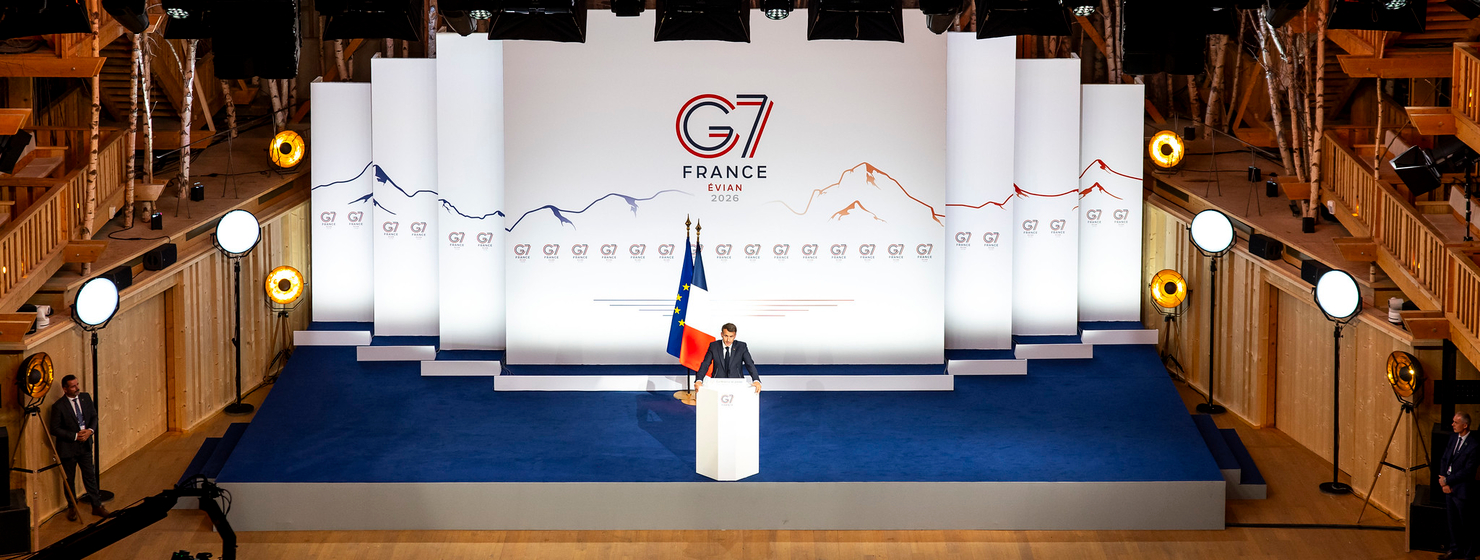
The President of the Republic and Brigitte Macron hosted the G7 Summit in Évian from 15 to 17 June 2026.
On the final day of the Évian G7, an initial working session was held on the theme “Reviving balanced, inclusive and sustainable economic growth for the benefit of all”, with the participation of G7 countries, partner countries, the International Monetary Fund, and the OECD.
This was followed by a working lunch on “Ensuring the safe, rapid and effective deployment of artificial intelligence”, attended by G7 countries, partner countries, and business leaders.
In the afternoon, President Emmanuel Macron held a press conference to close the Summit.
Watch the press conference:
17 June 2026 - Check against delivery
Press Conference of the President of the Republic at the close of the G7 Summit in Évian.
Emmanuel Macron
Ladies and Gentlemen, thank you for being here at the conclusion of the G7 Summit. Fifty-one years after Rambouillet, this Summit was a major event, and I would like to thank everyone who made it possible, including the town and the people of Évian. We would like to thank the Mayor, all her teams, all the towns which hosted the various events, government services in Haute-Savoie which were naturally in heavy demand under the authority of the Prefect, all our internal security forces, our military, our customs officers, our civil security, our fire-fighters, our medical staff and the many volunteers who made every aspect of this event possible. We were immensely proud to host this G7 in Évian, to be back in Haute-Savoie 23 years after the last G7 here, and to highlight our beautiful landscape, our young people yesterday evening, our culture and the rich diversity of our country.
I’d also like to mention all the teams who worked so hard on these texts. The teams of sherpas and negotiators from my office, the Foreign Ministry, the Ministry for the Economy and Finance, all Ministries which were called upon, the Ministers who chaired G7 meetings in their formats, State Protocol, the G7 Secretariat which coordinated the whole operation, and all the teams who made this work possible, and of course the teams who welcomed us and the entire group. I wanted to express my gratitude because events like this are only possible and are only a success when women and men are fully committed to the cause and give their all, which has been the case over the past few months and, more visibly, over the past few days. To all of you, bravo!
And I say this because everyone knows that this G7 has taken place against an extremely difficult backdrop with a divided world and multiple crises and conflicts, so a lot was at stake during our discussions, and in recent months we have seen fragmentation, division and disagreement, and we have acknowledged that. Part of the success of summits, and the reason why I can objectively say that this G7 has been a success, is having a moment of unity, with high-quality discussions and genuine cooperation between the leaders who met here. It allowed us to coordinate very closely to address the crises and work on the major challenges of our times, first and foremost following a method, in which the G7 Member States were naturally closely involved, but also the G7+ partner countries of India, Kenya, as co-chair of the Africa Forward Summit, South Korea, Brazil and Egypt, as well as leaders of international organizations. So it was truly the G7+ which coordinated this work from start to finish, which enabled us to agree on this text. We also involved President Zelenskyy, to whom I will refer in the conclusions in a moment, with an important discussion on Ukraine, and with President El-Sisi we held discussions alongside the Emir of Qatar and the President of the United Arab Emirates on the issues of Iran, the Strait of Hormuz and all the consequences in the Gulf. Naturally, international organizations were also involved in our work, the IMF, the World Bank, the African Development Bank and the OECD, for specific sessions.
Nine statements were adopted unanimously by the G7 leaders, and many received support from the G7+. All of the G7 leaders adopted the Leaders’ statement on geopolitical issues, to which I will return, the Leaders’ call on the fight against cancer, the Leaders’ call for a coordinated response to the Bundibugyo Ebola outbreak, the Leaders’ declaration on mutually beneficial international partnerships, the Leaders’ declaration on securing supply chains for critical materials, the Leaders’ statement for a more balanced, durable and resilient growth, the Leaders’ declaration on tackling migrant smuggling, the Leaders’ declaration on the fight against drug trafficking, and finally the Leaders’ call on a safer digital space for minors. So nine statements, all unanimous.
I would now like to return to the agreements we reached on each of the most important issues. First, Ukraine. President Zelenskyy’s participation allowed us to hold in-depth discussions on Ukraine, which for the first time in these terms, led to important areas of agreement. First, on our unwavering support for Ukraine, our solidarity with its people whose essential infrastructure and cultural heritage have been targeted through multiple attacks on its civilian population. The Ukrainians have shown incredible resilience and all G7 Member States agreed on the need for this support for Ukraine’s territorial integrity, but also on the fact that recent months have seen a huge shift in the balance of forces.
Ukraine is advancing, resisting, Russia is retreating. That is why we all agreed to increase the provision of additional air defence capabilities, systems and interceptors, as well as long-range capabilities. On these issues, the US President highlighted the mobilization of the American defence industry, the ability to provide such equipment and many of us stressed, at the request of the Ukrainians in recent months, the importance of licensing and producing this equipment in Ukraine in order to move even faster. We also unanimously agreement to provide further support to Ukraine to enable it to get through the next winter with a G7 initiative to support energy infrastructure, meaning rebuilding many facilities which have been destroyed and have left much of the civilian population in the cold and in the dark. At the same time, we are also finalizing funding from G7 countries and our main partners to fully secure and safeguard the facilities at Chornobyl.
Finally, we committed to step up the pressure, including by strengthening our sanctions, and G7 agreement on stepping up pressure on Russia is extremely important, and comes a few weeks after French authorities boarded a shadow fleet vessel and a few days after the same operation by British authorities, with our cooperation. We continue to work together in an oil and gas price environment that has changed over the last few days. So with regard to Ukraine, this was the first time we have had such strong convergence at the G7, and the first time we have set out such clear conclusions because we also know that there can be disagreement and differences within the G7, so I believe this demonstrates real progress and is essential for us to work together towards a successful Ukrainian war of resistance.
We then turned to the situation in the Middle East with, as I said, Qatar, Egypt and the United Arab Emirates, and here too, the G7 Member States reached very clear conclusions. We unanimously welcomed the very good deal between the United States of America and Iran, delivered by President Trump. We support this agreement as it brings an end to a highly unstable situation, which had terrible consequences for our economies. Everyone sees this instability in their daily lives, we see the effects on our companies, our citizens see it and therefore it was good to put an end to it. We reaffirmed that the right of transit passage through the Strait of Hormuz without restrictions or tolls is the bedrock of the beginning of this deal and is starting immediately.
We agreed that the multinational, independent and defensive initiative led by France and the UK could play an important role to facilitate the resumption of maritime traffic in the Strait of Hormuz by protecting merchant vessels. We have, of course, offered to do this but everything depends on the agreements concluded between Iran and the United States of America, with the agreement of Oman as well, as it lies on the other side of this Strait. In any case, it is an availability that we have confirmed and there are several countries that are in the region and ready to respond very quickly if requested to do so, including France, and some 20 countries that have already voiced their firm commitment to contributing to this type of an operation.
We did not forget to underscore the importance of Lebanon and our support, which was also unanimous, for the ceasefire, which was attained for Lebanon, an immediate, robust ceasefire that is a matter of absolute urgency, and the need to defend the territorial integrity and sovereignty of Lebanon and of all its political and military authorities. In Gaza, we also committed to accelerate humanitarian and reconstruction efforts and the swift implementation of relevant political and security measures. We call for ending violence in the West Bank, which was also a need recalled and endorsed by everyone.
We committed to accelerate the diversification of energy supply routes in order to reduce global vulnerability to the Strait of Hormuz, which means jointly financing alternative routes to move gas and oil out of the region and onto international routes. Our joint statement also reaffirmed G7 positions on the Indo-Pacific, which are long-standing constant positions. But the importance of this point on the Middle East lies in the fact that all G7 countries supported this agreement and stressed the importance of the Hormuz situation, Lebanon and, of course, the conclusion of nuclear and ballistic discussions, as well as regional destabilization, which is a condition for stability in the whole region.
Regarding international partnerships, something we have fought hard for in recent years, as you know, we made tangible progress through discussions we held, ministers’ meetings and the agreement we reached. To do so, we had a working meeting with our partner countries, Brazil, Egypt, India, Kenya and the Republic of Korea, as well as the World Bank and the African Development Bank. The G7 is relevant in this regard because it continues to account for around 70% of official development assistance. Our reflection has long been in the making because it is grounded in the initiative that France has put into new financing for Africa since 2021, the New Global Financing Pact in 2023, which led to the creation of the Pact for Prosperity, Peoples and the Planet, and the 2026 Africa Forward Summit that we co-chaired with President Ruto.
Basically, what we have achieved through work in recent years and what has been consolidated and backed in this G7 with partners, is first and foremost a profound change in philosophy. We are defending a concept of solidarity investment, respectful partnerships with countries, and the building of financing solutions together, as opposed to vertical aid provided by donors who decide priorities with recipients who do not have much of a say in the matter. Therefore, the traditional system is changing its philosophy, it’s official. Next, we are implementing tools, which too are being updated, with more work being done by all international finance stakeholders. And this is what we have been building in recent years, on the initiative of the French Foreign Ministry, the Finance Ministry and the Agence Française de Développement, with Finance in Common. We have consolidated and backed the work of Finance in Common, and we have also strengthened instruments to improve the complementarity of public and private finance.
To keep things brief, I would like to refer to the statement in which we stressed the importance of solidarity with countries and populations in the sectors of health, nutrition and education, which are truly necessary investments for all. But we have also agreed support for first-loss guarantee mechanisms that are required so that private investments can be made, for example in Africa. Today, many countries, given their ratings or lack thereof, are unable to attract private sector investment. That is the consensus we came to at the Africa Forward Summit. We decided to expand the scope, to include the entire African continent, of a mechanism that already exists, called the African Trade and Investment Development Insurance (ATIDI) which covers first losses. It was endorsed by the African Development Bank and African countries, and many G7 countries have taken shares, agreed to provide guarantees and supported its action, as well as coordinating with the World Bank’s action, the clearly important MIGA and the second-loss fund the World Bank is establishing. It is an important step forward and we will monitor the implementation of this work and have decided to meet on the sidelines of the United Nations General Assembly to take stock.
In addition to this text that is clearly very important, we have also adopted a call for a coordinated response to the Ebola outbreak. This call was supported by India, Egypt, the Republic of Korea and Kenya in addition to the G7 countries. The message of support regarding Ebola is clear: to help the Democratic Republic of the Congo, Uganda and all the countries that could be affected to deal with the epidemic. This means rapidly developing a vaccine and effective treatment and establishing appropriate procedures in line with WHO standards. The G7 committed to earmark more than €1 billion in emergency aid through this call for action, which is also very important, with a very strong commitment of the Europeans and Americans behind this mechanism and close collaboration with Africa CDC.
When it comes to scientific and health cooperation, we have also issued an important text on the fight against cancer for the first time in the history of the G7. And it is a key time of reconvergence on health issues that have often given rise to disagreements and divisions. This priority reflects a universal reality. Cancer kills nearly 10 million people each year. The number of new cases is projected to increase by 80% globally by 2050, given the aging of the population and its interactions with environmental and behavioural risk factors. This ambitious call puts cooperation mechanisms with three main priorities at the heart of the fight against cancer. Concerning paediatric cancer, we are promoting data sharing. For cancers with poor prognosis – lung, liver and pancreatic cancer – we are promoting universal access to high-quality health care in both wealthy and developing countries.
At this Summit, we were also able to make real progress on major global macroeconomic imbalances. We will build shared growth, drawing on all the preparatory work we conducted, the experts’ report published in spring and discussions we held. Basically, we all endorsed a text that defends a vision of balanced growth. We are aware of the major global imbalances. China must address the problem of overcapacity, excessive subsidies and a lack of domestic consumption. Europeans must invest more and modernize and streamline their economies, and the United States must address the issue of its twin deficits. Consensus has been reached regarding these points. Ahead of this G7 Summit, we successfully organized an unprecedented virtual convergence summit. We held a videoconference on 11 June with the G7 member and partner countries and China, for the first time in over 20 years, which allowed us to put this issue on table, if you will, to initiate better coordination. Within the G7 and with the G7+ countries, we began to build very clear elements of coordination, that is to say building unity and acknowledging that divisions, everything that fractures our economies, prevent us from effectively resolving these imbalances.
So beyond the convergence summit, which in a way will set in motion a process that we will continue in preparation for the G20, China will have a seat at the table along with many others. We also very clearly affirmed cooperation mechanisms with the G7 and partner countries, first of all by recognizing the role of the IMF and its consolidation, and asking our ministers, as well, to work in preparation for September on clear cooperation approaches on the issues of fertilizers and food. This is absolutely key, as that is where we see the most striking imbalances that affect the most vulnerable populations.
We also adopted important texts on the strength of our value chains, and in particular on critical minerals. While we began discussion on this topic last year under the Canadian presidency, until now we had never succeeded in constructing practical solutions, and to the contrary there were even risks of division. Faced with China, which has sometimes accumulated strategic reserves – which I do not say as a reproach, this is a strategy developed for over 15 years – we are all confronted with risks of over-dependence and thus vulnerability in our value chains. If we act in an uncoordinated fashion, we will aggravate the situation and create even greater imbalances. We have agreed to proceed together, as G7 members and within the G7+. We have thus agreed to develop cooperation projects together – and the projects that have been adopted are moreover highly concrete, in the annex to the declaration that I mentioned – specifically to reduce our sources of dependence, and together diversify our sources of supply. A total of 195 concrete projects representing €64 billion in joint investments have been established through this text, and we will continue to build on this momentum. I believe that this a key point for improving the resilience of our value chains, reducing their dependence, and doing so in a cooperative manner.
Lastly, we just held a discussion on digital technology and artificial intelligence with all of the G7 and G7+ leaders, along with around a dozen leaders in digital technology and artificial intelligence from all G7 countries. What emerged from this discussion? First of all, the need to protect children online. Consensus is growing, as seen from Canada and the United Kingdom to the European Union and Brazil. Australia was not present, but I would like to commend their pioneering role as well. Several of us have already taken concrete initiatives and finalized laws. We have adopted a statement agreeing on the need to act and the importance of calling for platforms’ accountability. This momentum will be continued, and Prime Minister Modi has furthermore confirmed what he began to announce at the summit last February in Delhi. Once again, India is joining this plan, making the gathering of G7 and partners a true platform. This, I would say, is the DNA of the G7: liberal democracies with developed economies. This G7+ brings together other democracies in partnership, and together we have the same approach which is in keeping with our democratic values: protecting our children. This is a very important moment and an important milestone for progress.
Several of us have also underlined the importance of better regulating artificial intelligence and the marking of AI content. There too, it is important to build initiatives. I will push for action at European level, but this consensus is necessary because we are seeing the impact that this issue has on our democracies. It was important to have this discussion with leaders in digital technology and AI. Concerning artificial intelligence, we are all faced with the same thing and it was important to hold this joint discussion. We all want innovation, we all want computing capabilities and data centres, we all want to develop the opportunities, productivity, transformations, and improvements in health and digital technology that AI can offer. But it is no longer possible for anyone, either political or business leaders, to ignore its impact on our democracies and our societies. This is why the opportunity and the need for a regulation have become clear today. This must be undertaken on an international level. We began this work with the G7 with a Global Partnership on Artificial Intelligence initiative backed by France and Canada to build an initial structure hosted at the OECD. We must now go further and succeed in improving regulation.
The challenge that lies before us – and we had many discussions with the AI and technology leaders as well as with the US administration – concerns frontier models. We must succeed in better regulating them to prevent them from falling into the hands of authoritarian regimes, people who could pose a threat to our cyber security or our societies. To do so, however, the answer cannot be a lack of cooperation between democracies. So basically, what we are working on building over the coming months, if you will, is a platform for discussion and cooperation between a number of democracies faced with the risks of artificial intelligence, a platform for cooperation to jointly establish common standards, as well as to share, with regard to cyber security, and security more broadly, the impacts and thus the right solution. This is exactly what we have agreed upon and what we will continue to work on together. A meeting is planned in September so that our ministers can finalize this work and several leaders will come together as well. In any case, there is broad consensus confirming that international cooperation is necessary on this point as well, and to reassess the situation in several months.
I don’t want to go on too long, but I would just like to say that beyond what I have just described, major statements were also adopted to work together to fight drug trafficking, and to work on setting up a port alliance to better counter this issue through stronger coordination. You see the synergy with all that the Government is currently doing in France as well as to fight against migrant smuggling, with a text that also builds on the work of the Italian and Canadian G7 presidencies and enables the improvement of our mechanisms in coordination and in synergy with the statement on new partnerships that I just mentioned.
This Summit does not mark the end of our G7 Presidency. It ends at the end of the year, and we will therefore continue working in the various ministerial formats required to finalize certain points, such as the one I just mentioned on AI and digital technology. Many historic steps forward were made during the G7 on the topics I just mentioned, though, and many examples of very concrete progress for which we have been preparing these last few months, even these last few days, that I wanted to share with you and clarify here. I will now take questions. Thank you.
Find below the statements adopted this Wednesday, 17 June:
Leaders'statement for a more balanced durable resilient growth.
Leaders'call on a safer digital space for minors.
G7 leaders'declaration on securing supply chains for critical minerals.
Latest news
See all articles and topics-
2 September 2026 Franco-Dutch tech dialogue.

-
8 September 2026 Joint statement by President Macron, Prime Minister Burnham and Prime Minister Carney on the two-state solution.
-
2 October 2026 G7 Leaders’ Statement on global energy security and market stability.
-
2 October 2026 Videoconference with G7 leaders on the global energy situation.