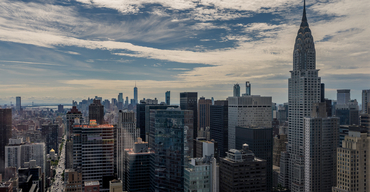
President Emmanuel Macron is in New York from 21 to 23 September 2026 to take part in the 81st session of the UN General Assembly.
On this first day, the Head of State first held talks with US President Donald Trump on the wars in Ukraine and the Middle East.
They agreed in particular to act together to ease tensions on energy markets. On Ukraine, they will also pool their efforts to secure a moratorium on strikes against energy infrastructure and against Ukrainian civilian infrastructure.
Watch the President’s statement:
The President of the Republic was then presented with the “Rising Nations Leader Award”, recognising France’s commitment to ocean protection and the fight against climate change.
Watch his speech:
21 September 2026 - Check against delivery
Speech by the President of the Republic at the Rising Nations Gala Dinner in New York.
Emmanuel MACRON
Majesties, Madam President, Heads of State and Government, Ministers, Excellencies, Ladies and Gentlemen, dear friends,
First of all, I want to apologise. I made you wait. I was with the President of a big island, but still an island, President Trump, so the agenda was a little bit up and down. But I am finally here, and I wanted to be here with you. I am greatly honoured to accept this award, especially in recognition of the involvement of France and of the whole team. The Minister is here, the Ambassador, Olivier Poivre d’Arvor, and many people who have worked very hard on this agenda. I want to thank all of them.
I also wanted to be here to express my gratitude to my dear friends from what we sometimes call the small island states. As an Indo-Pacific nation, I have visited some of you. I have taken part in some of your formats, and I have always been impressed by your commitment and educated by your lucidity. For years and years, many people underestimated this agenda. But this agenda is existential for you.
Second, I am also very happy to see so many of my African friends, who are also being severely affected by the same phenomenon and by climate change. Many mayors are here with us, alongside many leaders, expressing how important this agenda is because their coastlines are being completely reshaped and damaged by its consequences. I am also happy to see some of our good European friends, Belgium, Luxembourg, Sicily and others, including islands that are affected on a daily basis by the consequences of this phenomenon.
My point is that this is no longer a small-island agenda. This is a truly global agenda. You were the frontrunners. You were the first to warn the rest of the world. But today, when we speak about the vulnerability of our countries, the consequences of climate change and the need to address the climate, biodiversity and ocean agendas, this concerns all of us.
This morning, just a few hours ago, before coming to New York, I was in Saint-Pierre-et-Miquelon, a French overseas territory. Let me tell you that Miquelon is becoming the first French town whose inhabitants must be relocated because of rising sea levels. We are investing tens of millions of euros to relocate 600 inhabitants because, in ten, fifteen or twenty years’ time, the village will be damaged by precisely this phenomenon. This is not a potential threat. We know that. It is already here, and it represents an existential risk for a growing number of countries.
This is why your gathering is so important, and this is why what you are doing here is so important. Mr Acting Prime Minister, you were extremely clear and strong, and I share your view. This is now a matter of cooperation, responsibility and justice. It is not a question of charity, but of genuine partnership. It is a question of how we can learn from the frontrunners, because all of us will be affected, to a greater or lesser extent, in the years to come.
The adoption by the United Nations General Assembly of a high-level declaration on sea-level rise sent a clear message to the international community. In line with the Nice Ocean Action Plan, we must turn awareness into action. To do so, we must rely on local actors who are directly confronted with rising sea levels.
In 2025, at UNOC 3, together with the Global Centre for Climate Mobility, and thank you so much for this commitment, we launched a global coalition of cities and regions facing sea-level rise, in order to share knowledge and good practices and to develop concrete solutions together. This initiative, which was the first of its kind at the time, brought together a unique group of actors. We learned a great deal from local communities and municipalities as they shared their experiences and helped us to improve our global agenda.
I also want to insist on how much we need science in order to deliver on this agenda. We must protect those who raise their voices and seek to draw the international community’s attention to this devastating and important issue. We must continue to support independent scientists, journalists and civil rights advocates. Sea-level rise is a direct consequence of climate change. Climate mitigation efforts are therefore an integral part of ocean protection efforts.
France has been a tireless defender of science and of the scientists who deepen our knowledge and understanding of climate change, including through the IPCC. I want to insist on this point because we all know that independent science is under threat today. The independence of science is being threatened, and this agenda is also being threatened by some nations, I would say.
I would also like to acknowledge the central role of the Rising Nations Institute, whose launch we are celebrating today, in carrying forward the recommendations and commitments we have made together. Dear Kamel, I want to assure you that France is fully engaged in the Institute’s activities. Thank you for your commitment.
UNOC 3 and the Nice Declaration demonstrated that multilateralism can achieve concrete results when nations choose to act together. I mean, look at the atmosphere. It is sometimes a little gloomy. When we look at multilateralism, it can sometimes be quite discouraging. I am a strong believer. I remain passionate and optimistic through a daily decision to be so.
But when you look at the achievements of the past few years, the ocean agenda is one of the very few areas in which we have achieved concrete results. We concluded the BBNJ negotiations. Within a few months, more than 60 nations had ratified the agreement, making its implementation possible. We held the Nice Conference and adopted its conclusions. And in a few months’ time, at the beginning of next year, we will hold the first Ocean COP. Look at that.
The United Nations declaration is also one of these achievements. We are therefore right to remain mobilised. We welcomed 64 Heads of State and Government. We managed to secure the ratification of the BBNJ Agreement, and now we have to keep fighting. The Nice Ocean Action Plan has delivered concrete results, including the swift entry into force of the BBNJ Agreement and accelerated ratification of the WTO Agreement on Fisheries Subsidies.
As I mentioned, these are signs of hope. But there is still much work to be done. We must reach an ambitious agreement within the International Maritime Organization on the decarbonisation of maritime transport by 2050. This is extremely important. We must secure an ambitious treaty to fight plastic pollution, which is severely affecting our oceans. And let us be honest : on this agenda, we are not doing very well. It is inexplicable to me that we have not yet reached an agreement on plastics.
We must bring together a majority of countries in support of, at the very least, a precautionary pause on deep-sea mining. Let me insist on this agenda. We must deliver on the Kunming-Montreal Global Biodiversity Framework and protect 30 per cent of our marine and terrestrial areas by 2030. We must continue our efforts, and we must make progress towards Sustainable Development Goal 14 on the conservation and sustainable use of the oceans in the years to come.
I will stop here. But these priorities constitute a list of concrete actions and realistic deliverables. We have to work hard to make this agenda a reality. We have to keep fighting and mobilising all countries. We must rise to the occasion and follow up on the efforts launched by the small island states and by the leaders present in this room.
For them, this concerns their future in just a few years’ time. But it also concerns the future of the entire planet for the years to come. This is why this agenda is a biodiversity agenda. It is an agenda for reducing CO₂ emissions when we speak about our oceans. It is an agenda concerning the very existence of so many nations around the world. And it is an agenda of cooperation and justice.
Let me thank you for this award. But I accept it only as a modest recognition of, and catalyst for, our mobilisation in Nice. You can count on me to remain a true fighter alongside you, to continue advancing this agenda and to achieve further results. And we will do it all together.
Thank you so much.
After dinner with António Guterres, UN Secretary-General, the President of the Republic met with Volodymyr Zelensky, President of Ukraine, to reaffirm France’s support for Ukraine, particularly in the face of Russian strikes on energy infrastructure.