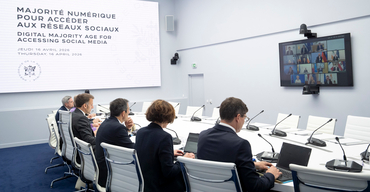

Le Président Emmanuel Macron a réunit, ce jeudi 16 avril, en visioconférence, plusieurs chefs d’État et de gouvernement européens ainsi que la Présidente de la Commission européenne, pour un échange sur la majorité numérique pour accéder aux réseaux sociaux.
Cet échange s’inscrit dans le prolongement de « l’initiative sur la démocratie à l’heure des réseaux sociaux » impulsée par le Président de la République.
Il a porté notamment sur la protection des mineurs, en particulier la mise en place d’un âge minimum d’accès aux réseaux sociaux basé sur le Digital Services Act (DSA), ainsi que sur la mise en place de solutions européennes harmonisées d’outils de vérification d’âge.
Revoir les propos introductifs :
26 octobre 2026 - Seul le prononcé fait foi
Propos introductifs du Président de la République - Réunion sur la majorité numérique pour accéder aux réseaux sociaux.
Emmanuel MACRON
I'm very pleased to virtually welcome all of you for this meeting. The main purpose is obviously social networks for children and teenagers. Last October we had six member states : France, Denmark, Cyprus, Spain, Greece, Slovenia, moving forward at national levels towards a definition of digital majority age for accessing social media as a response to the risks posed by social media for safety, physical health and mental well-being for our children. Some of us had expertise, reports in order to highlight all these risks for children and teenagers.
Today we are more than a double. We have a dozen of states being represented here. This issue is gaining momentum in Europe, which is good. The objective of this VTC is to coordinate our efforts at European level to strengthen both the protection of children and teenagers in the digital space, as well as the obligations and responsibilities of major online platforms. So, if you agree, the meeting of today could have three topics.
One, an overview of the legal framework envisaged at national levels. Second, implementation and enforcement issues, including technical solutions for age verification. And this is clearly the Commission's competence. Ursula worked a lot with her team and yesterday you made first clarification and it's very important to have this exchange in your view and third, perspective for European action. And thank you again, Ursula, for being with us. Your expert panel provided as well a lot of results on the age verification solution. So yesterday you announced in relation to the EU Digital Identity Wallet, some clear solution.
On this issue to be super brief regarding France, so we had a first, a committee in July 2025, based on the commission's guidelines under the DSA Article 28. We decided to launch the process and we started a draft law to ban access to social media for minors under the age of 15. Long awaited solution based as well on a series of reports issued in 2024 in France. The draft law is now before Parliament and was notified to the Commission a few days ago on the 9th of April under the Transparency Directive. There is a broad consensus on the objective of the draft law. We are looking forward to the swift processing of this standstill procedure so as to move ahead as quickly as possible. Thanks to the support of the Commission and Member States, and our willingness is to have the ban in force at the start of the next school year, which means September 1st in France, alongside the other key measures of this bill, because we have other measures regarding mobile phones, etc.
It's also our responsibility to ensure that this digital majority rule can be enforced in practice and that we respect users’ rights. So age verification solutions that will be implemented by social media platforms must respect privacy principles such as data minimization, purpose limitation, moreover, DSA guidelines, but also DMA provides solid safeguards. Social media platforms shall ensure the availability of several reliable age verification solutions, including European ones. And this is why we also need to develop digital identifying solutions on the basis of sovereign technologies. We joined others in the Mini Wallet age verification pilot project. We have what is called the « France Identité» app. But the idea is clearly to elaborate on this Mini Wallet age verification project at the European scale. We clearly support the Commission's work on the technical aspect of this project. Also in the context of the European Digital Identity Wallet, EUDI Wallet, which all member states need to provide by the end of 2026.
Some of you, and this is my last remark, because this is a debate we had, and I know, which does exist in a lot of countries, about ban versus parent consent mechanisms. I think it's much more a complement to that. But clearly, we need age verification to do so. But we decided the ban under 15 and not the parent consent mechanisms. First, because we tried the parent consent mechanism and it doesn't work so well. And second, because this is quite unfair because for vulnerable families, those who are the least equipped to navigate the digital environment, it doesn't work. This is why we decided this ban under 15. The responsibility must lie with the platform and this is the sense of the DSA regulation and we have next steps after this measure to clearly have better responsibility with our platform. I don't want to be longer. I will now give the floor to those who wish to speak.
Cette initiative vise à fédérer les initiatives nationales, à renforcer la coopération européenne et à accélérer la mise en œuvre de solutions communes face aux enjeux démocratiques et numériques.