
Le Président de la République et Madame Brigitte Macron se sont rendus en Inde pour une visite officielle du 17 au 19 février 2026.
A son arrivée à New Delhi le mercredi 18 février, le chef de l'État s'est rendu sur le campus All India Institute of Medical Sciences (AIIMS) où il a été accueilli par Jagat Prakash Nadda, Ministre de la Santé indien, et Dr. Srinivas, Directeur Général du campus AIIMS.
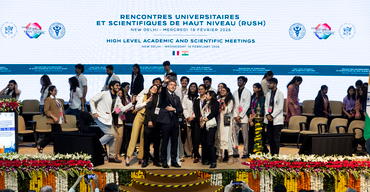
Le chef de l'État a échangé avec des talents indiens à l’occasion des Rencontres Universitaires et Scientifiques de Haut niveau sur l’avenir de la coopération franco-indienne (RUSH).
Revoir l'événement :
18 février 2026 - Seul le prononcé fait foi
Discours du Président de la République lors des Rencontres universitaires et scientifiques de haut niveau sur l’avenir de la coopération franco-indienne.
Emmanuel MACRON
Thank you very much. I'm very honored and happy to be here with the delegation. I recognize a lot of friendly faces and very familiar people here and a lot of potential new friends. I mean, we will be debriefed about RUSH and the whole initiative by the two co-chairs. But I think what's important for me to convey as well, on top of RUSH and this cooperation between high schools, universities, research centers, and so on. It's about exchanging more between our students.
Both of you have, I mean, you had a PhD, if I understand properly and you did a PhD as well. But it's very important for us to welcome more Indian students and to have more French students coming here. We speak about 10,000 per year, more or less. It depends on the season. Sometimes people tell me it's 9,300. Sometimes, my ambassador told me it's 11,000. It should be around 10,000 per year. Okay. We decided with Prime Minister Modi to have 30,000 by 2030. It's largely feasible.
On the French side, we have to simplify and we will simplify our sourcing and as well as a visa facility, to have a visa which meets the expectation of the students and is appropriate. For instance, if you have a PhD, I don't know how many years it took for you, three years normally. So if I give you a visa for one year, I'm a little bit crazy. I create a sort of uncertainty and probably we deliver the visa for one year, and you have to renew it and so on. It's not optimal. So on the French side, we will clearly streamline this approach in order to have something which meets the expectations and is much more practical for the students and the schools. And by RUSH, precisely, we will establish better connections in order to have better sourcing. Because India 10 years ago, 15 years ago, was not the number one source of students, let's be honest. So I want our universities and high schools to do much more, but we will do as well, much more in terms of administrative facilities.
At the same time, I want all the Indian students to be sure that if you come to France, you have the best-in-class teaching, you have access to the research centers and exactly the ecosystem you mentioned, with a lot of interdisciplinarity. If you study in AI, you can have both, obviously data scientists, mathematicians, you can have fundamental research with interaction with startups, but you can have interdisciplinarity as well, with philosophy and other disciplines. Because it's super important to have the model of AI we do believe in. This is exactly what we have on our campus.
I want you to be sure that you can have all your different lessons, your approach in English, because I know that sometimes they are still exchanging with a lot of students. They say, I will not join France. I don't have a sufficient level in French language. No, you can come for a PhD, even for a Master degree, and you will be taught in English. Obviously, you can learn French in parallel, but you will be educated and you will have all the facilities in English. And it's very important to have that in mind to convey to all the students here in India that we do have these facilities and this access.
My last point, because sometimes there is a source of misunderstandings, I'm making my pitch for attracting more Indian students as you see. It's a strange argument, but in France, the cost of studies is largely less expensive than in a lot of other countries. It's not a signal that it's bad quality. I'm serious. I had a lot of students thinking : “okay, it's almost for zero”. It should be a terrible level of quality because everywhere in the rest of the world, you have to pay a lot of money to have one year. It's our, I would say, collective choice in France. The taxpayer contribute much more than the student. It's more fair. You can have some contributions that are non-French students. But it's much more limited than in the equivalent Anglo-Saxon universities. We can ask for some fees. It depends. And I think it's good that each university and each high school has its own model and will be free to have its own model. But we are very far from the level of fees in the Anglo-Saxon universities. But just take it as a collective choice but not a signal that it is a lower quality. It's not true at all. The Government is paying for the difference. This is my clarification after several interactions with students.
So I clearly invite much more Indian students to come at Master level or for PhD and to share the experience you had. Because I really believe that we can provide a unique experience and that you pitch France much better than I could do.
***
Emmanuel MACRON
Thank you. I think the summit organized tomorrow by India is extremely important regarding all these issues. And after our action summit one year ago, we follow up on the conversation in order to have, I mean, to try to make sure that our countries benefit from the innovation, but to make sure as well that this innovation will be at the service of our common goods and our humanity. And I think it's as important as allowing the innovation to be part of our countries. I really believe that we have the same obsession both in India and in France, I would say, and in Europe, which is that we don't want to be dependent on a totally US or a totally Chinese model, but we really believe that we need a broader one and we want to be part of the solutions and we want to have players being part of the solutions.
You perfectly described what is at stake. What we want to do is to make sure that we have the data centers and the computing capacities, that we train the talents in our countries, that we have all the capacities. And it's clearly about computing capacities, talents and capital. Here are the three elements and I mean when I speak about computing capacities, it's about having affordable or at least competitive low carbon energy in order to deliver this agenda. On this agenda, I really believe we have a lot of assets and we are in the race. We are lagging behind both the U.S. and China, but we are in the race.
Now, the question is on the downstream side, how to accelerate adoption. And you mentioned it, both of you. And adoption is critical. Why ? Because it's how to make sure sector by sector, with the right ethical approach, AI will be adopted and transform your productivity, will allow you to discover new diseases, to completely change your energy model to be much more productive. And this is one of the only ways clearly to see the consequences of AI in the statistics and to avoid a well-known paradox where AI can be seen as a wonderful innovation but without a lot of impact. Adoption is absolutely critical.
But when we speak about adoption, we speak about the speed, the depth of this adoption, but as well how the key players of each sector are familiar with AI in order to make it, I mean to transform AI solutions and technological solutions at the service of their objective and not something which will completely and just disrupt their approach. And this is exactly what we want to do, especially in the healthcare sector. And we will have the occasion a little bit later today to illustrate this transformation. It's true on space, it's true on energy and so on.
On the other side, you mentioned frugality. I think the way we want to be part of this race and this global competition is slightly different. When we speak about data, when we speak about energy, I think both India and France do consider that we can do it in a different way, the hyperscalers are organizing this approach. This is why when we speak about large language models with Mistral AI, we adopted a much more frugal approach. What Yann Le Cun is building, by the way, in France and with we are very proud of that, leaving Meta is clearly another approach to modelize AI which is much more frugal. And India was one of the rare countries to choose small language models as well based on this frugality and to be much more targeted. I think we're right because otherwise you can see that this race is already unsustainable by itself, having these hyperscalers buying and building, booking for huge data centers everywhere in the world. Most of them don't have any access to energy, most of them even in the U.S. don't have energy and none of them have a clean energy. I mean, it's not sustainable even on the midterm. I really believe that our common approach makes much more sense, but we have to clearly bridge the gap at the same way. But the alliance and the partnership between both of us makes a lot of sense.
My last point is about the fact that we really believe both India and France in an AI at the service of our humanity, meaning we are ready to put regulations and I want just to mention three examples of that. The first one was largely developed, it’s about childhood. It's clear that in the system today something is rotten, and look at the situation of our children, our teenagers. When you speak about social media, if you add to this social media some chatbox with agentic capacities, I mean, this is the beginning of a terrible situation. And we already have all the symptoms of the situation. So we have to protect our children, and we are aligned with that.
Second, we are in favor of transparency. And one of the key achievements of this summit is to requests from perhaps at the end of the day, force these hyperscalers to provide the full transparency on their algorithm. And I think it's extremely important. It's important for our researchers, but it's very important for all of us as citizens, because all the algorithms have bias. We know that there is no doubt and they are so impactful when you speak about social media, that having just no clue about how the algorithm is made, how it is tested, how it is trained and where it will guide you. I mean the democratic consequences of this bias could be huge.
We don't ask for regulation by itself, we don't want the IP, but we say, I mean, just make it transparent. You are for the free speech. Some of them claim to be in favor of free speech. Okay, we are in favor of free algorithm, totally transparent. Because I mean free speech is a pure bullshit if nobody knows how you are guided through this so-called free speech, especially when it's to be guided from one hate speech to another hate speech. I just want to have a transparent road through these different speeches and I want, by the way, to have a sort of public order. I want to avoid racist speech, hate speech, and so on.
The third one is respect of language diversity. And it's extremely important and I think this is something we have in common between India and France. You have at least 22 official languages, but hundreds of languages, and we are very much attached to Francophonie. And the big risk is to have just a global AI with LLMs and apps being 100 % trained on English models and on a portfolio largely dominated by the Anglo-Saxons and the Chinese. Protection of diversity and especially diversity of our languages is a guarantee to avoid a lot of biases and to improve the quality of our models. Especially you described very fairly the impact that AI could have on education if you want a proper monitoring. I don't think that AI will replace teachers and researchers, but I think we will have to learn how to teach with AI, to have a different approach in order to improve the quality of the lessons, and to have a better, probably personalized education. But it will be impactful and meaningful if precisely the model you use is trained on the right portfolio of content and trained on the right language. I think it's very important as well if we want an ethical AI and if we want a safe AI to clearly protect the diversity of languages.
Le Président de la République a également inauguré le centre franco-indien d’IA en santé.
Il s'est ensuite rendu à l’Institut français de New Delhi où il a échangé avec des « passeurs de culture » indiens et où le projet culturel The Brij lui a été présenté. Ce centre futuriste sera consacré aux arts et à la culture et accueillera de nombreux projets de création et d'expression.
Le chef de l'État a également donné une interview à Brut India.
En fin de journée, il a participé au dîner de gala inaugural du Sommet pour l’impact de l’IA au Centre de conventions Bharat Mandapam, en présence de nombreux chefs d'État et de gouvernement, et de chefs d'entreprises.