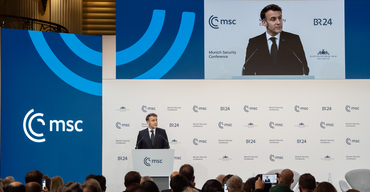
Le Président de la République s'est rendu en Allemagne, le vendredi 13 février 2026, à l’occasion de la 62e Conférence de Munich sur la sécurité.
Lors de son intervention, le chef de l’État a souligné l’importance de poursuivre les efforts engagés pour renforcer la base industrielle et technologique de défense européenne et bâtir le pilier européen de l’OTAN.
Dans la continuité de son discours du Forum économique mondial de Davos, le Président de la République a aussi réaffirmé l’ambition de la France en faveur d’une Europe souveraine et indépendante, dans un environnement international en pleine mutation.
Le Président de la République a aussi pu se concerter avec ses partenaires européens sur la résolution du conflit en Ukraine afin de consolider et poursuivre les travaux menés dans le cadre de la Coalition des volontaires.
Il a également pu échanger avec avec ses partenaires britannique et allemand.
Revoir l'intervention du Président :
13 février 2026 - Seul le prononcé fait foi
Discours du Président de la République lors de la 62e Conférence de Munich sur la Sécurité
Emmanuel MACRON
Thank you very much, Heads of State and Government,
Madame la Présidente de la Commission,
Ministers, Ambassadors, ladies and gentlemen,
Thank you very much, Dr. Eschinger, dear Wolfgang, first for organizing the upload before the speech, which is always the best guarantee, and second to be in a certain way the embodiment of the transatlantic relation, because I was not here last year, but I see you're back, and this is good news, nevertheless, I will try to address your point of self-assertion of European, and I wanted to come today in front of you with a message of hope and determination.
Where some see threats, I see our fortitude. Where some see doubts, I want to see opportunity, because I believe that Europe is inherently strong and can be made even stronger yet, and this is now. That a stronger Europe will be a better friend for its allies, especially for the United States, and that everybody is asking us to be stronger, except our adversaries, of course, sometimes also less understandably ourselves. And this is what we need to remedy as well, and this is why I really believe, and I want to start with this remark, we need a much more positive mindset, and in support of it, I would like to start by offering a brief clarification. There has been a tendency these days in this place and beyond to overlook Europe, and sometimes to criticize it outright. Caricatures have been made, Europe has been vilified as an aging, slow, fragmented construct sidelined by history, as an over-regulated, listless economy that shuns innovation, as a society preyed upon by barbaric migration that would corrupt its precious traditions. And most curiously yet, in some quarters, as a repressive continent where speech would not be free and alternative facts could not claim the same right of place as truth itself, that old-fashioned, cumbersome concept.
I want to offer a wholly different view. Europe is a radically original political construction of free sovereign states that conjured together centuries of rivalry and war to institutionalize peace through economic interdependence. And don't believe one second this is an old-fashioned construction. This is what we need. This is what we have to advocate. And I see so many friends from the Western Balkans and Moldova here, they want to join the European Union. Why ? Because they know the value of this approach. And we are too shy to say we are in a certain way starting not to believe in ourselves, which is a huge mistake. Everyone should take their cue from us instead of criticizing us or trying to divide us.
When President Putin came here 20 years ago to make the case for spheres of influence for his country, he was actually arguing for spheres of coercion at the expense of Europe. He was, in effect, advocating for the resumption of a doctrine repudiated even before the breakup of the USSR. We all said no. And it is the same resounding no that we are opposing to the reckless assault against Ukraine. But that line of thought, where your neighbors are considered as captive satellites and they should be forced back when they stray away from orbit, has not disappeared.
Quite the contrary. It seems to gain new traction. And to all those who are thus inclined, I would say, look at Europe. Obviously, the European Union, but as well all these close friends of Europe, Western Balkans, Norway, UK, Canada. Look at what we can achieve with a partnership of equals. Look at that incredible space for the free movement of goods and people, a space of freedom, a space of peace and prosperity. Look at the life expectancy, health, equality, and freedom indicators. And we still believe in science in Europe, even when we speak about health and this type of things. And I really believe it's much better. Look at our climate and competitiveness policies. Look at the number of EU Nobel Prizes and Fields Medals. Look at how the European cohesion policies ensured economic convergence. And how citizens, their liberties, their press, schools, universities, and academic freedoms are protected. It is a space, not a cohesion, but of cooperation. We should be proud of our European achievement and know our strengths.
Obviously, we have to fix a lot of things. We were all together yesterday in a retreat to speak about our competitiveness. And we know the homework we have to deliver. But let's speak about our homework behind closed doors and let's deliver. But let's provide a positive image of ourselves and let's be proud of ourselves. Because this is what our fellow citizens need. And this is, I really believe, the reality of this continent. We should be proud of our European achievements, indeed. And we Europeans are proud to play down ourselves and to endure that others would do so, too. We shouldn't. Period.
It doesn't mean that we are not challenged. But let's face this challenge and let's fix them. But I wanted to start with this clarification. And I will not speak – perhaps you will have questions about Middle East, I will not speak about Iran, even if all of us, we are in total support with civil societies after what happened. But I want to focus precisely on our existential challenge, Ukraine. Ukraine today, Ukraine tomorrow, Ukraine the day after, and security in Europe. Ukraine is obviously the first challenge we have. And on this challenge, we delivered. We delivered. With a total assistance of €170 billion package, making Europe by far the main donor and today almost the only source of military funding. We imposed 20 sanctions packages on Russia and entirely rearranged our economic model to reduce dependency on Russia. And very rapidly. Nobody thought in February 22 we would be able to do so. We did it. I fully support President Trump's drive towards a negotiated peace, one that should be just, lasting and robust. And I want to believe that we are getting closer.
But as discussions are taking shape, Russia keeps pounding civilians and destroying energy facilities with the obvious aim of freezing Ukrainians into submission. The answer cannot be to cave in to Russia's demands, but to increase pressure on Russia instead. And let us look at the broader picture. If you take the past four years, Russia, after invading Ukraine, is a weakened country. It squandered inordinate amounts of money on a senseless war and has now entered a recession. It is isolated economically. It is completely dependent on China. While the country already had a severe demographic problem, it lost hundreds of thousands of young lives to an illusion. It meant to fight NATO expansion, Sweden and Finland joined NATO. It meant to weaken Europe, Europe is massively rearming. This is a strategic, an economic and even a military failure. And when I hear some defeatist speech about Ukraine, when I hear some leaders urging Ukraine to accept they are defeated, overpricing Russia in this war, this is a huge strategic mistake because this is not a reality.
One day Russians will have to reckon with the enormity of the crime committed in their name, with the futility of the pretexts and the devastating longer-term effects on their country. But until that time comes, we will not lower the guard. We must ensure that the settlement protects Ukraine, preserves European security, disincentivizes Russia from attempting again and also doesn't give the rest of the world a calamitous example to follow.
So the Europeans have a direct stake. As main actors of the support to Ukraine, as members of the Coalition of the Willing, as fellow inhabitants of the same continent and because of the European destiny of Ukraine. First we have to make sure that Ukraine is in a position to continue to resist the aggression. Last December, the European Council decided on the 90 billion euro loan to Ukraine for 2026 and 2027, two thirds of which will be devoted to military equipment with a clear Ukrainian and European preference. And France will do its part and I want to thank the President of the Commission for the hard work in order to deliver this package and it will be voted in the days to come. Our Defence Minister just visited Kyiv, our Deputy Defence Minister did the same and we sent new equipment to Ukraine on top of what is done. I want to thank Germany for the great commitment and all the financing.
Second, we should keep going after the Russian war economy. We are preparing a 20-sanction package in the EU, focusing on the energy and financial services actors and we should continue to hit harder the Russian shadow fleet. Russian oil revenue is down 25% and 75% of sanctions ships do not return to Russia. We should definitely step up and generalise this effort against the Russian shadow fleet because it is efficient and it is painful for the war economy in Russia. Third, we should intensify the work carried out with the Coalition of the Willing on Security Guarantees. Imagine, one year ago, we were just looking at the US to try to clarify if they were ready to engage in Ukraine or pushing just for the end of the war without any condition. The big change during this year is the Coalition of the Willing. From the Canadians to the EU, Norway, Iceland, Western Balkans countries, Australia, New Zealand, Japan, we financed 100%. When some US materials are delivered to Ukraine today through the Coalition of the Willing, it is financed by the Coalition of the Willing. So it is the first wake-up call and it worked. We organised ourselves to frame the support to Ukraine and we did organise and finalise in January with a clear political mandate the security guarantees for the day after the peace in order to make this peace credible and sustainable. Our military staff are finalising this work with now a clear backstop provided by the US and a monitoring process but a clear commitment of all the Europeans and allies in these security guarantees.
Fourth, the Europeans will have to agree to any possible deal because they will be an essential part of any security guarantees, any prosperity package, any sanctions relief, any decisions on the European future for Ukraine. No peace without the Europeans. I want to be very clear. You can negotiate with all the Europeans if you prefer but it will not bring peace at the table. It is for the same reason that I have decided to establish a direct channel of communication with Russia in full transparency with Ukraine and our European partners and our American allies. We will be part of the solution and we should be part of the discussion. And we have our own European interests to defend in this, especially when it comes to the future of strategic stability on our continent.
And this is for me the second challenge ahead of us. How will we in the future co-exist in Europe with an unreconstructed aggressive Russia on our borders ? And we have to discuss this issue now. If we reach a settlement on Ukraine, we will still have to contend with an aggressive Russia, with a defensive industry on a sugar high and a bloated army. We will have to define rules of co-existence that limit the risk of escalation beyond current work on separation of forces after a future ceasefire. As Europeans, we will start with defining our own security interests. And this is part of such a peace deal. Should we accept the deployment of long-range missiles within distance of our borders ? Should we accept Russian interference in our neighborhood ? What does arms control look like in the age of drones ? Will it be possible to define missile limitation arrangements in Europe, like the INF Treaty, while China has become a factor in arms control ? And what about the nuclear domain, where New START, the last treaty still in force between the US and Russia, is now terminated ?
How will we rebuild our alliances in our immediate neighborhood when Russia is trying to maintain or increase its footprint in the Mediterranean Sea or in Africa, aligning with all the forces of destabilization ? I'm clearly incomplete in this list. But all of these questions have to be carefully prepared by the Europeans. Because we will have to be at the table of these discussions, and these discussions will occur. And we have to be prepared. And we all forgot that a few years ago, we just lived in an order where all these questions were partially fixed by very old treaties, negotiated without the Europeans, for the Europeans. Betrayed without any consent of the Europeans. And sometimes with the withdrawal of some allies, without any coordination with the Europeans. And I still remember the end of the INF Treaty. I discovered it in the newspapers, as all the allies. We have to be the ones to negotiate this new architecture of security for Europe the day after. Because our geography will not change. We will live with Russia at the same place and the Europeans at the same place. And I don't want this negotiation to be organised by somebody else as the Europeans.
Even in periods of less confrontation, it took sometimes decades to craft any of these treaties that help mitigate the dangers of the Cold War. But the Europeans must start this work with their own thinking and their own interests. So my proposal today is to launch a series of consultations on this important issue, which we have started to flesh out with our British and German colleagues, but in a broader European consultation with all the colleagues here, with a lot of capacities, a lot of strategic thinking. I see my Swedish colleague and a lot of European colleagues. We will address together these issues. We will coordinate and we have to face it.
This leads me to the third challenge. How do we build leverage to enter into such discussions in a position of strength ? Europe is rearming, but we must now go beyond. Europe has to learn to become a geopolitical power. It was not part of our DNA. We conceived ourselves as a political construction to provide peace. We delivered. Second, a single market to provide growth and prosperity, we delivered. Now we have to reform it in this new order. In this new geopolitical environment, Europe has to become a geopolitical power. It's ongoing, but we have to accelerate and clearly deliver all the components of a geopolitical power, in defence, in technology, and in the derisking vis-à-vis all the big powers in order to be much more independent.
But when I speak about Europe becoming a power, I don't speak about France or Germany becoming a power. I speak about Europe. So we have to think and act as Europeans, I would say, by design. And this is what we have to do now. And if this time of rearmament is a time of dis-synergies, of separation, or national power, it would be a huge mistake. We have to think now, power at the European scale. We have to think about our defence, obviously, but we have to reduce our dependencies through policies of European preference. This must be the case for the entire value chain, from AI and cloud computing, critical minerals, space, cleantech, as well as defence industries and design of armament. Everywhere we have over-dependencies. We have to de-risk our model, and we have to endorse, clearly, a European preference. Targeted, perfectly designed, and I want to thank the Commission for this hard work, but this is a necessity.
We will be credible only if we are able to procure and produce what we need, without foreign strings attached. We have achieved significant progress last year within the EU. We have agreed on a defence readiness roadmap to 2030, to fill our critical capability gaps with standardised and interoperable equipment in Europe. And in this spirit, I believe, clearly, we have to follow up. This is why it makes sense to make the future air combat system together with Germany and Spain. It does make sense to have concrete projects like air defence with SAMP/T New Generation, with Italy and the UK. It does make sense to have early warning systems like JEWEL, our initiative with Germany. And we have to accelerate the cooperation we organised sometime seven, eight years ago, and we have to build additional cooperation. And I want to warn everybody, you have a lot of money on the European market on defence and security. If this money is used just to have national solutions, or just to favor national players without a clear European approach, to build European standards, to make European simplification, and to play Europeans and to help countries to deploy as well additional industrial footprints, we will waste our money, waste our time, and create a lot of these synergies. Huge mistake. So, I'm an old-fashioned guy for these days, but I do believe in the FCAS, I do believe in JEWEL, and I do believe in SAMP/T New Generation, because it's hard for me to understand how we will build new common solutions if we destroy the few ones we have. Sorry to say that.
And we have adopted new EU financing instruments such as EDIP and SAFE. And don't underestimate the strength of these instruments. We decided to raise money on the market for the EU to make common protection. I don't want to pronounce any names, I know the taboos sometimes we have. But de facto, we decided to issue money on the market, have common borrowing programmes on defence. It's a very good thing. Because this money, we have a lot of appetite in the market to take it. There is an appetite for safe and liquid assets, this is European money, and it will be used for European solutions and European programmes. It's a wonderful innovation. We should actively expand our toolkit to include items of strategic value such as deep precision strike capacities, as well. And the European initiative called ELSA is very important in this regard because it is something, despite the end of the INF Treaty, which will allow us to close the gap. And it's very important, the discussion we have with the UK, Germany, but open to a lot of other European players, to have a new generation of long-range missiles that will give Europe a new edge.
But credibility is not only a question of missiles, it is in large part a question of determination. If we want to be taken seriously on the European continent and beyond, we must show the world our unwavering commitment to defend our own interests. It starts, of course, with continuing to extend our support to Ukraine, but it could nicely follow with fanning off unjustified tariffs and politely declining unjustified claims on European territory. This is what we did and this is what we will do.
Therefore, before concluding, I would like to mention briefly a last challenge. As many of us Europeans, we will soon have important elections. Defending our sovereignty also involves protecting the integrity of public debate and democratic process. And this is as well a question of security and safety for our democracies. And they are quite clearly under attack, and I speak under the control of several leaders largely attacked during the electoral process. And information manipulation, foreign interference amplified by online platforms and social media is clearly a critical issue for all of us. How is it that the craziest and most harmful narratives can go unchecked in our digital space, where they would fall under the law if published in print ? We started to deliver a good agenda in Europe with the DSA.
This is a very important regulation, because for the first time we created the framework to regulate this platform. But how do you want to be serious and consistent when we speak about defense and security, and to say free speech means no regulation on our social media ? Meaning free speech would mean I will give the mind, the brain, the heart of my teenagers to algorithm of big guys, I'm not totally sure I share the values, or Chinese algorithms without any control. We are crazy. This is why we launched this initiative to ban under-15-years old access to social media, because it's a matter of health, but as well as protection of our education and democracy. But how can we imagine that everything which is forbidden in the public space, racist speech, hatred speech, anti-Semitic speech and so on, could be allowed in the digital space because it would be free speech ? We have a good knowledge of free speech, it comes from this very region of the world. We designed it during the European Aufklärung, and there is a clear meaning of that. When you have free speech, you have respect, you have rules, and the limit of my freedom is the beginning of your freedom. And respect is part of free speech.
And it's a matter clearly of democracy, but as well, when we are democracies, we want to respect and we want to be respected. This is where we are. This is our view as well of the transatlantic relationship, and this is the basis of a good transatlantic relationship. And this is why it's extremely important we go further on the regulation of social media in order to preserve the DNA of our democracy In order, as well to preserve the integrity of our democracies. Because at the same time, we are opening Pandora's box and allowing a lot of hatred speech in these platforms and social media. We are too weak and too naive vis-à-vis external interferences and foreign interferences, no doubt. We should forbid the capacity of these guys to interfere in our public space. And we should ask those platforms first to completely block trolls, bots. We have to be sure there is one single person with one account. If this is an AI system, if this is bought or organized by a big organization, it should be just forbidden.
Second, we need the transparency of the algorithm. We are a democracy. We don't ask for the IP. And we ask for transparency, which is part of our democracy. Third, we need the responsibility of this platform. When they don't respect our social order, when they don't respect our rules. And as the DSA allows us to do so, we have to go further in order to sue those who clearly decide not to respect our rules and our regulation. And we should block all those will-o'-interferences in our systems. So as you can see, it's quite a menu of things to do. And I will stop here.
We should exhibit strength and tenacity on Ukraine. We should articulate among Europeans our real long-term security interests in our region. And give ourselves the mettle and the clout to prosecute them. And at the same time, fortify ourselves as confident democracies. These are no mean challenges. And I really believe in the power of our audacity. This is the right time for audacity. This is the right time for a strong Europe. And this is Europe. Clear in the support of Ukraine. Determined to support Ukraine to the very last minute. Clear on the condition of a sustainable peace. Clear on the conditions vis-à-vis Russia and building its own architecture of security. Clear on how to de-risk its model. This Europe will be a good ally and partner for the United States of America. Because it will be a partner taking its fair share of the burden. It will be a partner being respected. And we have to be respected. We did a lot and we will do more. But we will follow this path, believe me. Thank you very much.
Wolfgang ISCHINGER
Thank you very much, Mr. President, for this really extremely interesting presentation. We have time for just a couple of questions, I'm afraid. I'd like to start the questions by referring to something which Friedrich Merz, when he spoke earlier today, referred to. If I remember correctly, it was in 2020, six years ago, when you spoke here, you talked about nuclear strategy, you repeated what you had said earlier in a speech in Paris. And it is now six years later, if I'm correctly informed, that my government is now reacting by saying : « yes, we are starting to talk ».
Could you talk about this again, please, and tell us : have we lost six years ? Is our answer six years late ? And what exactly could we expect if there is now going to be a dialogue, hopefully not just a Franco-German dialogue, but a dialogue between France as a nuclear power with her European partners ?
Emmanuel MACRON
Thank you very much. I think it normally takes time, because it's a very sensitive and complicated issue, but I want here to remind everybody that since the very beginning, the French deterrence, nuclear deterrence, has what I would call a European inspiration. General de Gaulle, since the 1960s, mentioned the fact that part of the vital interest of France was precisely the European footprint. So it's not new, and all my predecessors reiterated this approach. But I think in this very time, and for me, it's clear, it's clear since 2019, and the unilateral withdrawal of the INF Treaty by the US… We have to reshuffle and reorganize our architecture of security in Europe. Because the past architecture of security was totally designed and framed during Cold War times. So it's no more adapted.
Obviously, today, we are 100% focused on the support of Ukraine, which is normal. But this new architecture of security will be part of a long-standing peace package, for sure. And it's extremely important in this regard to take into consideration all the capacities, our own military capacities at the national level, perhaps some common capacities at the European scale, we should think about that, long-range missiles, and deep precision strikes. This is why I mentioned this capacity, because it's extremely important, at least to be credible in this dialogue with Russia, because they do have these capacities. So if you want to start a credible dialogue, sometimes you have to do more, even if this is to do less after a negotiation. But it's extremely important.
And we have to re-articulate nuclear deterrence in this approach. And this is why we are conceiving, and in a few weeks' time I will detail that, but we engaged a strategic dialogue, obviously with Chancellor Merz, but with a few European leaders in order to see how we can articulate our national doctrine, which is guaranteed and controlled by the Constitution, with special cooperation, common exercises, and common security interests with some key countries. This is exactly what we are doing for the first time in history with Germany.
I think this dialogue is important by itself, but it's important because this is a way to articulate nuclear deterrence in a holistic approach of defense and security. And this is a way to create convergence in our strategic approach and strategic culture between Germany and France. And I think for me it's very important, because this is a cornerstone of such a path forward. I want to say as well we have obviously a specific dialogue with the UK as another nuclear power, and in Northwood a few months ago we finalized a new treaty precisely going forward in this cooperation. And we have as well some leaders disclosed this discussion, and Ulf is part of them. With Sweden we have as well a very specific discussion, but with a selected approach.
Intervenant
Monsieur le Président, merci beaucoup pour votre soutien à l'Ukraine dans votre discours. But my question is next. We hear a lot of support here in Munich for the fourth year in a row, but unfortunately less and less Ukrainians survive during these years. So my question is when the coalition of willing will become coalition of sending troops to Ukraine now ? Because when you are saying we will send troops after the ceasefire, it's a signal to Putin : « don't end the war ». But when you will say : « we are sending troops now », that's the signal there is no sense to continue the war. He will not achieve his goals in any way, because we need peace as soon as possible here in Ukraine. Thank you very much, merci beaucoup.
Emmanuel Macron
Thank you, and let me express my gratitude for your French words and our respect to the Ukrainian people and their strength and their resistance. What you describe is perfectly true, because since day one what we decided is to help Ukraine in this resistance war, but to refuse to engage in an escalation process with Russia, meaning not to attack Russia on its territory and not to engage boots on the ground. So we still work within this limit, and you're right, and I totally understand your frustration and what you say.
At the same time, we did a lot of things a lot of people thought as unthinkable a few years ago. I mean, sending fighter jets, tanks, long-range capacities, a lot of financing, etc... So one year ago, a lot of people were just hoping that this effort would not stop. What I can tell you is, first, as Europeans, we provided a clear message. This support is not contingent on the financial support of the U.S., and it's very important because it is undervalued. We are no more dependent on the U.S. financial support. The Coalition of the Willing members financed 100 percent of the war effort. We are still dependent on some U.S. capabilities, some equipments, but we buy it to the U.S. They don't even give it. We buy it to the U.S. with European taxpayers' money, with Canadian taxpayers' money, Norwegian taxpayers' money, etc. So we de-risk from this point.
Now what we have to do is clearly – I mean, to make clarification on the ongoing discussion.
I don't see any evidence and confirmation that the Russians want to finalize peace now. They still bomb, they bomb civilians, they procrastinate, and what they do quite classically is that they bank all the concessions being made by negotiators on territories and other things. They want to last. We have to organize ourselves to last and to resist.
Today, if we engage and send troops on the ground in this situation, we take the responsibility of escalation. I'm honest with you. If we send troops on the battlefield. I think today you will not have any consensus to do so, and I don't want to over-promise and under-deliver, and I think we would be responsible for triggering, I think, probably a loss of control of the situation. What is important to us now is to deliver the package we voted and we decided, to put your country in a situation on energy and defense and security to resist, but as well to reconverge with the U.S. on a common perception of the situation.
As long as the U.S. will have number one scenario, « I have a short-term deal and I will favor this scenario », we will lose efficiency in terms of sanctions and pressure and so on. I think our top priority should be in the weeks to come to reengage with the U.S., assessing with us the fact that there is no more room for credible short-term negotiation, and putting additional sanctions, additional actions against the shadow fleet, and increasing the pressure on the Russian economy in order clearly to stop this war, but in a much better situation. This is my view.
I perfectly understand and respect the fact that this view is not the ideal one for you, but this is, I think, a credible one, and in the short run, the best possible scenario.
Wolfgang ISCHINGER
Thank you very much, Mr. President. I'm sorry to all those who wanted to ask additional questions. We've really run out of time. Dinner is waiting for, I hope, all of you, certainly for you, Monsieur le Président, and this is why I would like to invite you once again to offer a round of applause to our speakers. Thank you.
À consulter également
Voir tous les articles et dossiers-
31 août 2026 Déplacement en Suède.
-
14 septembre 2026 Déclaration conjointe sur la participation de la Finlande à la dissuasion avancée française.
-
15 septembre 2026 Avec la première promotion des appelés au Service national sur la base aérienne 115 d'Orange.
-
18 septembre 2026 Situation internationale : réunion avec les chefs des partis.