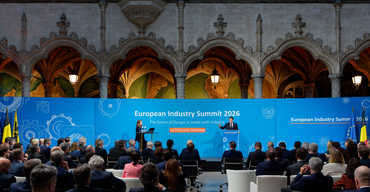
Le Président de la République s'est rendu à Anvers le mercredi 11 février 2026 dans le cadre du troisième sommet industriel européen.
Le chef de l’État a participé à ce sommet aux côtés d’homologues européens et de la présidente de la Commission européenne.
Il a échangé avec des acteurs industriels européens concernés par les enjeux de compétitivité auxquels est confrontée l’Union européenne.
Le Président de la République a défendu un agenda de souveraineté et d’indépendance européenne, porté par la France depuis 2017, structuré autour de quatre piliers :
- la simplification réglementaire et l’approfondissement du marché unique européen,
- la diversification commerciale et la réduction des risques,
- la protection en particulier par la promotion d’une préférence européenne,
- l’augmentation des investissements pour soutenir l’innovation.
Ces échanges ont contribué à la préparation de la retraite informelle du Conseil européen, qui aura lieu le jeudi 12 février et qui portera sur l’accélération de l’agenda de compétitivité européen, dans le sillage des rapports Draghi et Letta.
Revoir l'événement :
11 février 2026 - Seul le prononcé fait foi
Discours du Président de la République lors du troisième Sommet industriel européen
Emmanuel MACRON
Ladies and gentlemen, thank you very much, thank you very much Mr. Prime Minister for welcoming us, not just as a Prime Minister, but in the heart of your heart, if I may say. And you mentioned Napoleon, and you mentioned us, well, this Etat Généraux, and in France we know that when we launch Etat Généraux it could be a good signal, but even if you never know how it will finish. But at the end of the day we need them, today.
I think I will go straight to the point, because you started your work with President von der Leyen and had a lot of exchange with commissioners, and Chancellor of Austria and Prime Minister already expressed themselves. We know pretty much the situation in Europe, and both Draghi's report and Letta report I think framed our common thoughts just after the pandemic, and the necessity clearly to work very hard on our competitiveness. But I would say on top of that, we had a big acceleration of history, and we started to deliver on the basis of the Draghi report and the Letta report. Sometimes it's too slow, as a few people say, but it's clearly the commission and probably President von der Leyen explained to you this morning that she started to launch a series of OMNIBUS initiatives with the vice president and the commissioner, but we need the parliament and it's still too slow if you refer to Draghi and the Letta report, but on top of that we had an acceleration of at least three factors.
One which was already on track for Draghi's report, energy costs. You mentioned it. And in fact, cheap Russian energy stopped in 2022, and there is no way back. And this is the first point to be taken into consideration. And we didn't properly fix this issue until now. Second, we thought that China would remain a supermarket for us and for our exports. And this situation is over. 2025 is the first year during which Germany, which was the main exporter of Eurozone and the European economy, had a trade deficit with China. Never happened before. And it's clear that during the past two years, we were overwhelmed by the Chinese exports towards the European market. And this is a total reverse of our history. And the third point is that the United States, our ally, is also increasingly confrontational and post-Draghi report, what happened ? Tariffs. But not just tariffs, a series of economic coercion mechanisms. On pharma, on a lot of other topics. On Greenland, on the board of peace. A lot of threats, sector by sector. End of Russia as a permanent provider of low-cost energy. End of China as a main export market to make them our main competitor. And especially for car makers, especially for key sectors of our competitiveness. And third, having the U.S. now putting tariffs on our economy and coercion mechanisms, this is a game-changer. This is why it's not just a transition. And none of these new factors will change in the short run.
This is not a temporary shock, this is clearly a structural turning point. And we have several options. The first one is to wait. Or to remain quite slow, to make incremental change, and to do what we've done during the past decades. The consequence of this option would be slow decline. The second one is to try to compromise with those who are trying to kill our economy. What I call the happy vassalization. I'm not even sure it would be happy. Another one is a wake-up, but with a clear acceleration. And we need a new scale and new speed in our approach. In order to stop with the fragmentation, weakening, and probably the humiliation of Europe. And this way forward, which is according to me the only one we could defend and advocate, is to make Europe an independent power. Not just being a single market, but an economic power, meaning protecting our producer, defending our producer, and deciding to protect as well our own markets, and building our strategic independence.
If Europe wants to remain an industrial power, we must preserve your key sectors. Obviously chemistry, which is the industry of the industry, but also the sectors you gathered in this room, in this bourse, and because if we lose our capacity to produce critical molecules, these key elements of our economy, we will totally lose our capacity to have our own defense capabilities, our pharmaceutical supply, our agriculture, or to deliver our own green transition. This is why I really consider that your Antwerp declaration in 2024 marked a turning point, but this is why I really believe we have to deliver a new agenda.
For me this agenda is based on four pillars. The two first ones, I would say, are largely shared. Simplification and deepening of the single market, the first one. And clearly this is all about implementation and speed. The second one is diversification of our trade partnerships and de-risking, remaining necessary. The third one is protection and European preference. And the fourth one is massive investment and innovation. And we need four of them if we want to be credible and deliver an holistic approach for our European industry.
First, simplification, what we need is a stronger single market. And thinking at scale, I would say. The single market at 450 million consumers must become Europe's primary instrument of power, resilience, and competitiveness. This requires a change of mindset from fragmentation to scale, from national reflexes to European ambition. So we have an agenda in order to deliver this improvement of the single market. And I don't want to be too detailed, but I just want to flag one or two sectors. And obviously the first one is energy. When we built the single market, we decided not to make a single market on energy, telco, and finance. I mean, for relevant reasons at the time, it was 40 years ago. But on energy, clearly today, this is a weakness. Energy is the backbone of European industry, and you mentioned the impact of the post-2022 situation. Let's be honest, Europe cannot defend ambitious climate objectives while allowing its industrial base to disappear. High energy prices, combined with carbon costs, are accelerating de-industrialization and not decarbonization.
We must therefore act on several fronts. First, energy prices. We must deliver a genuine energy union, capable of providing stable, predictable, and competitive energy to industry. This means massive investment in energy grids and interconnections, long-term contracts. And I would say, in fact, what we have to build, it's very simple. We have to build an integrated European grid to provide the free circulation of low-carbon electrons. What we have to offer to the industrials is to have long-term contracts with full visibility, with a pricing for low-carbon electrons. And sometimes it will be low-carbon electrons provided by offshore wind close to here, solar energy in Spain, or nuclear energy in France, depending on the moment of the year and your needs.
What we have to fix is the fragmentation of our market, by building this infrastructure and the single regulation and integration of our national grid and regulation. It also means recognizing that different member states have different energy mixes. And the other points, and we started to fix it, but we lost a lot of time with that, we need technological neutrality. Until last year, we were incapable to have technological neutrality. And as long as we differentiated renewable, nuclear, and so on, it was a stupidity. Because what we need is to provide, on our soil, low-carbon, pilotable energy. So tech neutrality, integration of our grids, and clearly integration of a common energy market. In this regard, France has clear advantage due to our model and the existing model with the nuclear energy and so on. But we need the interconnections, and we want to step up at the European scale. This is a very important concern. This is a structural one. But let's be honest. We have to accelerate and do our best. But it will not fix your situation in six months' time.
The second approach is with CBAM. The Carbon Border Adjustment Mechanism is a necessary tool. But only if it works in practice. And when we make it, when we enforce it, it's a super important instrument. Because it's clearly what we advocated, it's a mirror clause. I was yesterday with ArcelorMittal's facility in Dunkirk. CBAM is the only way to prevent circumvention and not to create new vulnerabilities. And because we have CBAM for steel, they decided to invest in Europe. Without CBAM, it's over. No chance to preserve our steel industry without implementing CBAM. This requires robust default values, rapid identification of high-risk country-product pairs, and a swift extension to relevant downstream products, particularly in chemical value chains. So decarbonization must become a driver of competitiveness, not a vector of industrial decline, and it's extremely important.
And beyond CBAM, what we need, and it's the same if we take REACH as a regulation for the chemical industry, mirror clause. As long as we put additional regulation to our industries, we have to be sure that we reflect them and mirror them to the non-European industries. Otherwise we have to kill our regulation to our own players, because it's just meaning that our over-regulation, our decarbonization strategy, is the killer for our industry.
I want to insist on one point in this regard, predictability. And this is absolutely key for our industrial partners. You need stable and predictable regulation. Shall we look at the emissions trading system mechanism ? It must support decarbonization in the long run, but without undermining competitiveness. With predictability. Carbon leakage must be avoided at all costs. And for energy-intensive industries such as chemistry, uncertainty is as damaging as high prices. So providing visibility and predictability is key.
On simplification, I said it many times, now Europe must deliver quickly and credibly. We have ten omnibus packages. They have to be clearly implemented in the current year. And the stock of EU legislation must be reviewed to eliminate inconsistencies, redundancies and unnecessary burdens. Simplification to provide clarity, predictability and speed. This is a key point. I could revert, but we will have Q&A on the 28th regime on what we have to do in the different sectors. But it's the first pillar.
The second pillar is trade diversification and de-risking. Europe must continue to pursue balanced and mutually beneficial trade partnerships. But trade policy must now become a strategic tool to reduce dependencies and vulnerabilities. This is particularly true for critical raw materials and strategic inputs. Despite dozens of trade and mineral agreements, Europe remains dangerously exposed. So we must move from agreements on paper to concrete projects on the ground. This means supporting extraction, processing and refining capacity, investing in recycling and traceability and building strategic reserves, including a European stockpile of critical materials. But in this diversification and de-risking, rare earths and critical minerals are absolutely one of the key issues where we have to diversify our partnership, where we have to increase as well our circular solution, but build a European capacity and try to negotiate. The G7 we will share this year will be a good framework to try to cooperate with other economies. I think about Canada particularly. But clearly we have to de-risk our economy on that.
The third pillar is about investment and innovation. And I want to insist on that because in the short run it's absolutely necessary to accelerate in terms of investment on strategic technologies. On artificial intelligence, quantum computing, robotics, space, defense, cleantech, biotech, chemistry, chips, etc. etc. We are at the beginning of a big revolution where both China and the US, privately and publicly, are investing much more than we are doing. We are lagging behind. Let's be honest when you look at the figures. It was very clear in Draghi's reports. And on top of that you could clearly add defense and security as a series of key sectors where there is a big acceleration of investment.
Europe must be a technological maker and not just a regulator which will require both private and public investment. This is why the next EU budget from 2028 to 2034 must significantly strengthen Europe's financial firepower. It will be our discussion this year. But this is why we have to activate much more private money. In terms of savings we are number one in the world. Europe's savings amount to nearly 30 trillion euros. But this is over-invested in the bond market, under-invested in equity and innovation. And every year around 300 billion flows from Europe to finance the American economy are leaving our continent.
So what do we have to do in order to do so ? First, we have to deliver the securitisation programme proposed by the Commission. We need a big acceleration. This is the only way to take the money from the balance sheet of banks and insurance, which I want here just to remind you, it's 75% of the financing of our economy. We have to take with the securitization programme a big amount of money to re-channel it to the financing of equity and innovation.
Second, acceleration of the capital market union. It's a game-changer. And we have to accelerate this year, and for me, 2026 is the year where we have to finalize all the texts. If we do the same as what we did with the banking union, we have no chance to be credible. It took us 10 years, not even to finish the job. 2026, we have to finalize the job, and at the middle of this year, if we don't progress, we should consider to do it with a few member states, and clearly to have enhanced cooperation if we are unable to deliver by 2027.
But on top of that, we have to invest much more public money. Our budget, obviously. But this is why I propose to make Eurobonds for the future. Why ? Because nobody wants to put more money from the national scale to increase the European budget. There is no room to increase the European budget with additional taxes. And if I say we will increase the ETS1 or ETS2, I don't think I will be consistent with my former points. So it's not a good room to maneuver. We have no space. So the only way to increase the common budget is to make common issuance on the market. And guess what ? We are under-leveraged at the aggregated level. Kristalina Georgieva came and pitched in front of the European Commission, if you look both : China and the US, they have much more leverage than the Europeans. We have to fix our own national situation in terms of public finance, because it's how to deal with our social model. This is a national issue.
But at the European level, we have to invest for our future and for our industry. If we want to have the right level of investment on space, defence and security, cleantech, AI and quantum, and to transform the productivity and competitiveness, the only way is to have common issuance of debt. Because we are under-leveraged, and because there is a clear demand on the market for new paper. All the big pockets of the world want to diversify their portfolio from the dollar. And they are looking for safe and liquid assets. And a common euro debt is a very good, a very safe, but not a sufficiently liquid asset today. So we have to remember progressively the several issues we made in the past few years. ESM, SAFE programs, what we did during the Covid time with the first emission. So we need a European treasury to have just one common basket for this emission, and more debt and more consistency. But we have clearly the ability to issue common debt to finance this common investment. It's not financing the past mistakes, but it's financing our future. Why ? Because if we are not able to be in the race with the US and China in the coming five years, we have no chance to deliver our agenda.
My last point is about protection and European preference. And I know that when a French guy says protection, some people want to hear protectionism. No. I mean, it's not my political DNA. I don't believe in protectionism. But I don't believe in such a naive continent where we are the only one in this world not to protect the local producers. Go to China. No chance one of you has even the, I mean, the equal opportunity with a Chinese player. Go to the US on the North American market. No chance that one of you has the same chance as a local producer. They have local preference. They have local content being secured in a lot of sectors. Sometimes they even impose you to have a local partner in your JVs. Look at Europe. So many times we invest and finance non-European solutions. We are crazy. Literally. So we started to react. And this is why, when the Commission started these inquiries on EVs, it was normal. It was just restoring level playing field. It was not a protectionist approach. It was just to say, it's clear that some of these EV producers are over-subsidized. It was not a tariff across the board. But just to say, we will restore level playing field. It worked. Look at the figures. It decreased right after. Because it was unfair.
But it's not sufficient. We started to do some protections with this thing, clearly, this first action of the Commission with these inquiries on EVs, with the self-guard clause on steel, with the recent guidelines on the automotive sector. But we have a big issue today. We are too slow. A lot of you probably ask for inquiries in order to trigger self-guard measures. But it takes sometimes 18 months to 24 months to the Commission. I mean, it's sufficient for your challenger to kill you. I mean, you know that on a daily basis. When you have a Chinese challenger based on other subsidies, making price at 20, 30 percent under your price. If two years later the Commission says, you were right, but you are dead. I mean, thank you, God. I'm happy I was right. It's over. So we have to accelerate and need much more swiftly process for these inquiries, clearly.
But I think we have to go further. We need this European preference. We have to secure on strategic sectors a minimum percentage of European content in order to protect a systemic value chain based approach. This is the only way not to be reactive. I was yesterday in Dunkirk with Arcelor, I mentioned it. We saved them with self-guard laws. We took a lot of measures. Thanks to the French nuclear energy, we did what I hope we will do at the European scale in a few years' time, long-term contracts with locals for energy-intensive business. But look at the situation. If the automotive sectors decide to buy Chinese steel, it's over in three to five years' time for these guys. And the same guys we saved vis-a-vis China when they were competitors, they want to build their competitiveness with their suppliers. And they go to the Chinese for their suppliers in order to reduce the cost. This is what we are doing by the lack of solidarity sometimes in some value chains in Europe.
So let's be honest. If you want to preserve jobs in this continent, if you want to preserve our social models, if you want to speak about semiconductors, chemical industry, et cetera, et cetera, we have to preserve and define, by design, European content. To say, in some critical sectors, we need a minimum percentage of European content. This is extremely important. And let's be honest. In the short run, for some of your sectors, this is the most efficient approach. If we don't have sufficiently credible measures in the short run, everything I mentioned before, it will take time. Let's imagine we will deliver the capital market union this year. Before the money will come to your pocket, it will take a few years. Let's imagine we will deliver the simplification, it will take time. We have to urge and accelerate on all these issues. But protection is just the only way to preserve the industrial footprint we have today.
I want us to deliver the next generation with the investment package. But we are clearly in emergency mode. This is why we need that. And if we are not sufficiently and collectively efficient, perhaps for some sectors, we will have to take some tariffs across the board measures in order to deliver this agenda.
But look at your sector. Because of energy costs and oversubsidies in China, 10%, but this is just the beginning. And look at the different sectors under such a pressure. So sorry, I was too long, but I spoke with passion. But I decided to come here first because I love the Prime Minister of this country and I know he loves this city. So I took this commitment. But second, because I clearly share this feeling of emergency. We cannot wait. We have to accelerate our decisions. And tomorrow will be key in our retreat. But we have to take very short-term measures. And sometimes, some of these measures, are not part of our DNA. But we are living totally different new times. So we have to accept to deliver some critical measures not very familiar with the classical European toolkit. Because we are living different times. Emergency mode. So let's move and let's act. Thank you for your attention.
Animatrice
Thank you very much. Yeah, it deserves a round of applause, indeed. It was passionate, Mr. President, as usual, straightforward. You gave us a lot of food for thought. I'm not sure we're going to cover it all. So I'll start the first question when we try to get raised hands. I think I was intrigued by, well, first of all, congratulations. I read it just a few months ago that France, for the sixth consecutive year, is the first destination for FDI in Europe. Wow. So what's your secret ?
Emmanuel MACRON
Because first, we had a lot to recover before.
Animatrice
So that's humble. That's humble.
Emmanuel MACRON
But we've been number one in attractiveness in Europe during the past six years. I mean, it was based on, first, labor market reforms, attractive package with a flat tax. And we designed a very simple approach in order to accelerate investment. So we were non-competitive in terms of taxation on capital. So we just put ourselves, I would say, on the average, in Europe, with something very simple : the flat tax in 2017. Second, we were non-competitive on labor costs and labor regulations, so we fixed it. And third, we identified the fact that on top of regulations and taxes, simplicity and acceleration was key. So we designed a series of processes where we accelerate, and we have a tailor-made approach for the foreign investors.
This is how we attracted in several sectors. And we started to re-industrialize the country. I have to say that France dis-industrialized much more than Germany, Italy, or others 20 years ago and 15 years ago. We are recovering because we are at a different point in the cycle. So we have to be humble. And this is why we are as well, we are clearly suffering less in the short run of the effect I just mentioned, because we were less exposed, because we were less good 15 or 20 years ago. But we are all in total solidarity, because if you kill the chemical sector in Germany or North Italy or Austria, it's bad for everybody. This is how we build this attractiveness strategy. And this is how probably something that is consistent with what I mentioned with protection. I think what we have to do is to convince some of our key challengers not to sell just their products, but to come to invest in Europe. And I think this is a game changer. And this is what we started to do with the US to say, we don't want just to buy your solutions, but we want you, for instance, to build here your solutions, your data centers, your computing capacities. So we had 109 billion commitments last year. And to the Chinese as well, to say, we want tech transfer and investment, because on some competences you are super good. But if we have and if we deliver this European preference and this European content, this is extremely attractive, because you can go to China and just say, if you come to Europe, you are part of the European landscape. So you will be eligible to this European preference. Come invest and make the tech transfer, because we need it. So it's not. It's how you can articulate attractiveness and protection.
Animatrice
And indeed, you are doing it in Europe, attracting Chinese. I mean, before we open the floor, when you speak about the EU, the single markets, the ambition to unify, et cetera, when we hear the commission, they said, well, often we do OMNIBUS, for example, like for chemicals, but when it goes to Parliament, it's not voted. There may be one voice out of the 27 that may block the 26 or the 10. That's number one. And when we meet CEOs and industrial leaders, we just wonder, are you going to have this Greenland moment, I will call it, in Davos, where we felt Europe is behind something, right ? Because it's as important, right, what's going on. We are dis-industrializing Europe. So what does it take for you guys tomorrow to agree, to agree, and if there are disagreements, to prioritize and level it and say, this is good for Europe ? And there may be people not satisfied, but in a way, it's not a democracy.
Emmanuel MACRON
First, I think tomorrow we will agree on that. The difficulty is not one or two member states around the table blocking the others. It's much more in the discussion with the Parliament, with sensitivities and political groups, and the fact that it takes time. So I think it's totally doable if we manage to share and convey this feeling of emergency. And as you know, I'm a big fan of our Europe and European Union and a big fan to change it. But I think we can be reasonably and seriously optimistic because when I look at the past 15 years, we did very bad during the financial crisis. Why ? Because we remained divided between North and South, and we were super slow. And it took us five to eight years to fix the financial crisis when the US, which triggered, by the way, this financial crisis, fixed it in one year max. It killed a lot of growth and opportunities for our continent.
But on the other side, if you take COVID and war in Ukraine, we were extremely fast. And we fixed the situation very rapidly. March 2020, beginning of the COVID pandemic. May 2020, Franco-German summit to decide common debt issuance for the recovery plan. July 2020, common summit, big emergency, three days, we delivered the package, 750 billion common issuance to fix the situation. February 2022, the war in Ukraine. It took us two days to take the first sanctions and the first package of support of Ukraine. Why ? Because in these two cases, we had clearly the feeling we were in front of a symmetric shock hurting all of us and a clear emergency. We were very bad during the financial crisis because we had the feeling it was an asymmetric shock hurting just the over-indebted countries.
What is important today is to be sure that what we are living on our industry is a symmetric shock killing all the countries. If everybody is lucid on the fact that this is a shock and not a transition, it's going super fast and it's hurting everybody at the same scale and same speed, we can deliver this agenda. The problem is that till now, too many countries or political parties have the feeling that they can still be in a sort of normal business mode. It is a big mistake. And when I speak, for instance, about common debt, I don't speak about France. But if we are not able to invest in the key sectors, it's a killer for the small economies. For the smaller countries, they have no fiscal room, no capacity to deliver these common issues. It means either we will not deliver, not invest in common, because we will go back to the fiscal national space and they don't have it. So this is a common interest. My conviction is we have clearly to convey the message that we are in emergency mode, this is a symmetric shock for all the economies, and we are close to being too late. So now, action mode.
Animatrice
And count on us to give you all the data to show you that the industry absolutely...
Emmanuel MACRON
So on the OMNIBUS, to make it short, I think all the OMNIBUS package being prepared, plus the Industrial Accelerator Act, which is to be issued in the days to come, next week, as the Vice President says, I think we have clearly to reshape the agenda and deliver in the weeks and months to come. And commit all together and put our parliamentary group together to say, OK, it's a new world, guys, if we don't make a big move forward.
Intervenant
Monsieur le Président, thank you so much for your passionate speech and interventions also on the energy sector. We hear a lot in your speech that we recognize. What we see in practice for the energy sector, and you spend a lot on it in the first part of your speech. Then when we talked about the preference in Europe, not yet so much. And we see as an energy sector, we're doing a lot to invest in new technologies to really make our system more secure, more resilient. And we see European Union and member states investing a lot in innovation, things like green hydrogen projects, small modular reactors and power plants. But at the same time, when it goes into practice, hydrogen electrolysis, for example, we do see these suppliers from third countries strongly undercutting the European manufacturers. So first of all, we want to show the support and say, really, what can we do in those new industries and really the things where we have the intellectual property here in Europe to ensure that that taxpayer money actually does flow into the hydrogen, the SMRs, the power plants that have supported the supply chain in Europe ? What can we do ? And also, what can we do as business to support you there ?
Emmanuel MACRON
You're perfectly right. It's a perfect example if we take green hydrogen on what we should deliver. First, simplification. If you take hydrogen, this is a new market. A few years ago, we started to frame this market at the European scale. And imagine, what did we do ? We decided to fragment this market by design. We did a crazy thing once again. Why ? Because we were divided amongst member states due to our national energy schemes. And especially because we were divided between France and Germany on the nuclear. This is why we took a series of regulations to regulate the hydrogen to say, you should have X percentage of renewable to produce this hydrogen, Y percentage of nuclear, even if the nuclear was not quoted, because we were not in line. We created something super complicated.
We have to simplify the hydrogen regulation, number one. It should be part of this omnibus, and we push for that in order to have a single super easy hydrogen regulation at the European scale being produced and based on tech neutrality. Tech neutrality and energy neutrality is key. I don't care. It's a renewable coming from Belgium, Netherlands, Denmark, or Spain, or nuclear energy in Europe. I do prefer when it's low carbon, when it's competitive, and when it is produced on European soil. If you take these three criteria, full stop. Whatever the technology will be, let's make it even simpler. We didn't do so. We did the opposite. So first point on hydrogen, simplification based on these criteria.
Second point, European content. European content on hydrogen is key, because what you say is the perfect truth. Countries and some big industrials are buying some of non-European solutions. At the same time, we are financing investment in European solutions. And they are as efficient, both of them. For instance, American solutions were subsidized by the American taxpayers, super good news for them. They are competitive. They enter in the market, and they are treated exactly like a European solution. There is no European preference at the equivalent level of innovation. If you put a European content and European preference, you preserve this advantage. First, you preserve the first investment we made in order to deliver innovation. And second, you guarantee that when you have a mechanism where we put the European taxpayer money, it is to be channeled in priority towards European players. This is exactly what we did on the automotive sectors with the recent regulation. And I think it was a good move, favoring European green steel, for instance. We have to do the same on hydrogen.
The third point is investment. If we want to be in the race on green hydrogen, but as well SMRs and so on, all the new generation on nuclear, the level of investment and public investment as well is huge. We cannot pretend just to have private money. And if you look at the US, you have a lot of private money in the US on the nuclear energy. But you have a lot of public money. If I take energy, it's true. If I take space, it's true. Everybody is fascinated by Starlink. I'm super happy. But if you are lucid, Mr. Musk is probably one of the guys of the world who had in his pocket the most billion, I mean, we had billion dollars of the American taxpayers in order to be subsidized. I mean, Elon Musk is first an oversubsidized guy by the federal agency in the US. Good news. It makes him super innovative. And he became competitive thanks to this American approach. He was financed by public money and private money, but a big bunch of Department of Defense among them. Second, he was preserved by an American preference if you take the institutional launch for space industry, and he became competitive and came to our market.
If we don't do the same for our own players, meaning European preference in space for the institutional launching in your sector to buy green hydrogen when you have a European solution or European SMRs for industry. Then if we don't have the right level of European public investment to have this type of federal program to put a lot of money, no chance we will be in the race. And we are super naive just to consider it's a startup among the others. It's totally bullshit. I mean, it was largely prepared and it's a political program with a lot of public money. So on these key sectors of innovation, we need much more public money. This is why we need, I think, this common issuance because today we are not equipped to do so in order to invest in your sector. Energy is one of the drivers.
So simplification on green hydrogen and other key points to go faster and be tech neutral. European preference and European content to be designed to be sure that we protect you and we favor your growth. And third, common, I mean, Eurobonds to finance innovation in the critical sectors and especially hydrogen and nuclear.
Intervenant
Mr. President. Thank you for your speech and your constant attention to the industry. But in this very difficult period, we need more than words. We need decision. European industry is squeezed between the West, where we have an unfair or an unbalanced trade agreement with the US, 20 percent devaluation of the dollar and a very cheap gas price. To see a few examples on the east side, we have China, who is now threatening more than 70 percent of our European industry with subsidies, a huge capacity of production and the low labor costs. And all that is surrounded by a nice European organization that is still over-regulating everything. The pace of over-regulation has not reduced despite all the announcements. If you look at the reality for industrial implementation of Draghi and Letta report, speed is close to standstill. Two years ago, OMNIBUS were announced. I know that all the industry went on board of the OMNIBUS, hoping for simplification of our life, even knowing that an OMNIBUS is not the fastest train that exists. But today we are all scared that it could reach its destination with no one alive on board. So with decentralization going very fast, how can we wake up industry ? How can we apply mirror clause with much more efficiency ? Just a single proposal, instead of putting pressure on the mirror clause, we say we cannot apply any EU regulation on manufacturer before EU can secure that any product coming in applies to the regulation. And how do you intend to put with us pressure on EU to have all those changes implemented fast ? Because we are all at risk.
Intervenant
President Macron, thank you very much for your inspiring words. We're, a U.S. chemical company with a long and proud history here in Europe. So I first want to thank you for France's strong support for strategic industrial projects, including our project for an energy center in Port-Jérôme, together with the industrial cluster. I think that's a very important message. My question really is, how do you see the balance being calibrated between supportive investment frameworks, as we have seen in France, along with the urgent need for relief on EU ETS free allocation, which is, again, has a risk of undermining the very investment framework that's required ? Thank you.
Emmanuel MACRON
Thank you very much, and thank you for your words and your commitment, both of you in different conditions. I think, as you mentioned, ETS, it's clear that we have today an issue with energy costs, our competitiveness, and as I mentioned, we cannot have this situation on energy costs, plus the mechanism we put on the table, which are clearly hurting a lot of economies. I speak from a country which is not in the same situation as a lot of others, because, I mean, due to our nuclear energy basis, I'm definitely less impacted than a lot of other economies. But if I take the Polish, the Slovakians, the Czechs, I mean, and we are all together in an integrated economic area, it's clear that ETS1 has a big, has a lot of impacts. This is why we propose some, I don't want to be too technical, but we have several measures to take it. I think killing ETS1 or releasing it would be a mistake, because you create unpredictability, and you create a lot of dilemmas, especially vis-à-vis those who made the efforts. So it's counterproductive. I think it would be a huge mistake for the Europeans to say competitiveness means killing the Green Deal and the Green Agenda. I think it's honestly a stupidity for us, because it's part of our competitiveness at the end of this transition. We have to make it compatible, and without demagogy.
We should probably, and we have some technicality, which is to front load all the ETS proceeds, and to use them to accompany and to help the key countries we are impacted, and especially projects to accelerate the decarbonization. This is what we have to do. Those who are super impacted by the ETS mechanism today are those who are too slow or too far in the transition. What we have to do is not to leave them alone, it's to help them to accelerate by making additional process. We should probably use that to front load these proceeds and to invest them in this transition.
As for your point on how to deliver and to be much more concrete. For me, the first point is the situation politically is largely different from even one year ago. One year ago, when I pushed for this agenda, we were much more divided. I can tell you. I think we have today much more consensus on European preference. Ursula von der Leyen backed this agenda a few days ago, probably she reiterated today. I think we are progressing in the level of consensus of some of these measures. But to be very concrete, for me, I will tell and share with my colleagues tomorrow, but we have six months. If by end of June, on the dozen of OMNIBUS, plus capital market union, we didn't deliver, we have to make a big stop and build enhanced cooperation. We have to change the method. It means that this method doesn't work. So for me, I will put us, and I would like all of us to put ourselves in an emergency mode to say we have six months to deliver everything which clearly, which is identified where there is no discussion, no divergence, and say, okay, we have to deliver for this date and provide 100% of the visibility.
I totally agree with you that at the same time, we have to strengthen the credibility of our controls and the solidity of our customs union. It was all the debate we had with our agriculture on Mercosur. There was no mirror clause. Exactly what you say is a problem we had on Mercosur with agriculture. No mirror clause, no control. I cannot explain to a farmer, an industrial, I will punish you with a regulation and I will favor the import of somebody I will not control and not being under the same regulation. This is completely crazy. This is when regulation for climate or social welfare means just deindustrialization on our continent. So at the same time, we are doing this simplification on this agenda. So OMNIBUS, capital market union, for me third point, we have to strengthen clearly this customs union. The commission issued a few months ago some guidelines, but we have to make it much more credible by the increase of controls and the regulations.
Indeed, by June, we need this assessment on some critical regulations. If we are unable to make this control, we need a standstill, I mean, not just a standstill, but we have to withdraw the regulation to put you in a situation clearly to be in competition. And this is why it could cover your point in six months’ time, we don't deliver what I propose.
My last point is clearly on the protection and European preference. Believe me, what we did with the safeguard clause on steel, what we started to do in some critical sectors, this is a timing issue. And on some critical sectors, this European content, sometimes perhaps tariffs or super speed inquiry, this is a top priority. And this one for me is the one where we should deliver tomorrow with a very concrete agenda. I have to be honest, on this point, I'm not sure that I have 27 member states super happy with investment packages and European preference, but you are here to convince everybody with me. So we have the firepower. And I'm serious about that.
Animatrice
Shall we come with you tomorrow ? Well, I mean, we are happy to hear this, and you have really disruptive ideas, you know, from raising, you know, the debts and using it to invest, but also the protection, as France Chimie was saying, we are facing competition from the US 15 to 0, China not only with dirty products, they moved from imitation to innovation, they are investing in the best available technologies like EV or electrification, but there are also tariffs hidden inside the 27 member unions. I mean, we made the math, you know them, 40% for goods and 100% plus for services. So I hope that the single market dream of Delors is going to become a reality at one point of time and tap into the 450 million consumers you talked about, Mr. President. Well, a word, the last word ?
Emmanuel MACRON
No, I think for me these four pillars are to be addressed as rapidly as we can. And one of the issues of the days and weeks to come is clearly to deliver this big acceleration. Clearly, it's a question of life for some parts of our industry, and I'm extremely serious about that. But we have to be lucid as well on the fact that if we want to be serious on the deepening of the single market, even if we go super fast, it will take semesters and sometimes years. This is why we need super short-term measures, reassessment of some regulations, acceleration on some simplifications, and acceleration on the European protection and some protection measures. Otherwise, we will be killed. So in the phasing, I would say, for me, simplification, protection is, I mean, super fast issues. Deepening of the single market is super important, but we know it will take a little bit more time. And investment is to be decided now, to be invested in the months to come and years to come. But it's not sufficient.
Today, what is at stake, really, is that some part of the European industry could disappear in the semesters to come if we don't take the right measures in terms of simplification and protection. And the de-risking is not sufficient to do so. And the investment is as well a necessity. This is why I really believe, and I will leave you on this very simple message, we need a holistic approach, what I call the speed approach, simplification, protection, investment, de-risking. The four pillars of speed are the ones we need. But we have to speed up as well our approach. Because if we don't deliver in the three to four months to come, I take your point. I cannot come back to see you next year and say, guys, I have good news. I'm convinced. I'm on your side. And so on. My credibility will be totally killed. And this is the last minute. So I'm lucid that we are in the same race with you. And we have to deliver this holistic agenda, this speed agenda with much more speed and much more scale. But you can count on me.
One point I want to add, because having said that, you can count on me, you can count on my colleagues. We will do our best. And tomorrow, for me, what's important is that we decide as well a big change in terms of method. Because the one we had during the past year didn't deliver sufficiently fast. But I don't want you to underestimate your strength. We are still an extremely innovative continent. Your companies in all the different sectors, and I recognize a lot of very familiar faces. I mean, you are best in class companies and innovators. And I don't want as well to have, I would say, too much negative narrative coming from the European side. We have to resist. We have to deliver our agenda. But we have to be super ambitious for ourselves and very positive for ourselves. Because we underestimate something we didn't discuss till now. We are, and we remain, a continent where rule of law, predictability remain valid.
Look at the situation. China is an authoritarian regime. I mean, no offense, this is their collective choice. And the US is becoming an unpredictable economy and governance. For companies, and sometimes for countries. At the middle of that, you have the European Union. And it remains a place where rule of law and predictability remain valid. I suggest you to pitch that for your investors. Because if we are able to fix what we are discussing, in the short run, what I mentioned is an extremely important leverage for our future. Because this is our ability to remain a known core geography for a lot of investors. Because it means we are not hectic, we are not unpredictable. Sometimes indeed, it takes time for us to fix some issues. But we are here, well known, and reliable. And when you want to be the guarantor and last resort of a system, it's much better to be in this position. And this is why I believe in my Eurobonds. Because when you provide to the market safe and liquid assets, and you are predictable, it's extremely attractive. And this is the right moment to do so. But don't underestimate that for yourself and for our continent. Thank you.