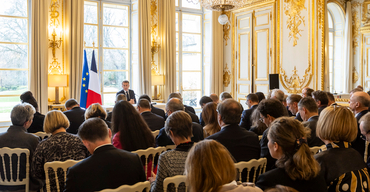
On Thursday, 8 January 2026, the President of the Republic welcomed the French ambassadors to the Élysée Palace for the Conference of Ambassadors.
On this occasion, the President of the Republic led three thematic meetings with the relevant ambassadors, which will shape France’s diplomatic agenda for 2026 :
- the agenda for European sovereignty (in economic, security and other areas);
- the French presidency of the G7, in particular the challenges of reducing global macroeconomic imbalances and financing development and the global climate transition;
- Africa, in view of the Africa–France Summit in Nairobi.
Following these discussions, the President of the Republic addressed all ambassadors in order to set out his diplomatic priorities for 2026.
Watch the President’s speech :
8 January 2026 - Check against delivery
Speech by the President of the Republic before France’s Ambassadors.
Prime Minister,
Ministers,
Foreign Minister of India, thank you in particular for being with us today,
Papal Nuncio,
Prime Ministers,
President of the Constitutional Council,
Members of Parliament,
Armed Forces Chief of Staff,
Mayor of Paris,
Secretary-General of the Ministry for Europe and Foreign Affairs,
Army Chief of Staff,
Directors and Ambassadors,
Ladies and gentlemen,
Thank you for being here today.
In recent years, it has been customary for me to gather you here, and the Minister for Europe and Foreign Affairs has changed the date lately. So this speech is an opportunity for me, to start with, to extend my best wishes for the new year. My wishes for yourselves, your families, your loved ones and all of your staff, everywhere in the world in our embassies, everywhere in the world where you speak in France’s name.
In recent years, it has also been customary for me to give a very long speech, which you endured for several hours, that sought to cover just about all the subjects affecting the world’s States. So this year, I decided not to make a speech. That is why, at the Minister’s request, I have had three round tables to give instructions and talk to the ambassadors concerned by three key themes for the coming year : European affairs ; Africa, with the coming Summit, which I will touch on ; and the G7 and BRICS. However, he did want me to do a speech as well as the round tables. So I would simply like to say that this is not a speech, and it should be very short, or at least a lot shorter than in previous years – and that should be reassuring for you given the time !
Quite simply, now that I have extended my best wishes and expressed my gratitude and my recognition for what you do, I would like to set out a few points this morning that I am convinced of. I am not going to address every subject and every region, but I do think I need to share a few key observations in the times we are seeing.
We know what these observations are. I set them out in detail last year, and the year before. And in particular, what I said last year remains totally valid, I believe. We are in a world that is losing its bearings, where the bodies of multilateralism are working less and less well. We are in a world where great powers are deeply tempted to carve up the world. I believe that what has happened in recent months and even in recent days has in no way changed that observation. And that is the great risk of the international order we live in. The United States is an established power, but it is gradually turning away from some of its allies and breaking free of international rules that it had promoted until just recently, concerning trade, certain aspects of security and certain forums. And China is a power that continues to rise, and that needs to choose diversified partnerships, but which is showing increasingly uninhibited commercial aggressiveness, especially since the post-pandemic period, that is today hurting the European economy. And then there are still destabilizing powers, like Russia, with Ukraine and other regions, and its information interference campaigns, for example, and I could also mention Iran and several others.
And so, in this world, the great risk we face, and which is now happening, is a weakening of all the bodies in which we could settle common issues, a weakening of all cooperation bodies. It is a risk of a weakening of our Europe which, in the face of this brutality and might-is-right dynamics, is set to become the last space in which we continue to reassert the rules of the game that others are no longer applying. That is the risk of erasure that some see coming or denounce. What I said last year about the league of international reactionaries remains true. And I even believe there is a process today, openly in some cases, of recolonization.
Ultimately, we are caught in a very strange state of play where we, France and Europe, endure anticolonial discourse that is no longer connected with realities and our practices, while we endure neo-colonial aggressiveness from certain quarters. Not a good situation, some might say. I believe that if we show consistency and determination, if we take action, it can be fruitful. But we will need a lot of endurance. In this context, I believe there are two behaviours that are not in our nature. That would be, in the face of those who have no qualms about returning to might is right, to follow them like sheep. That is not in our interest : it would be to choose blissful vassalization. It is not in our nature. It is not in the interests of France and Europe, and not compatible with their values. There is also another choice that might be tempting, a moral choice : that of saying that we can no longer do anything about the situation, but to continue saying what is right. That is the choice of powerlessness, and we will not take that path either.
The only choice that seems tenable for me, possible, is to take on board the fact that this is a very difficult time for the world order, which is losing its bearings, in which might is right is seeking to take over, and in which yesterday’s rules are increasingly weakened. But at the same time, ultimately, we must say to ourselves that we are much stronger than many believe, if we can unite more, and the heart of our efforts needs to be to assert ourselves more as a power, for France and Europe, and continue to strengthen. That means openly and completely defending our interests. It means continuing to defend our influence wherever effective multilateralism can be defended, and upholding this line totally.
I am convinced, as I set out these few points in this new year, is that we are not here, not you as ambassadors, directors and ministers, nor yours truly, to lament and comment the state of the world. We are here to act. And there is a path for action in the world as things are playing out. We have a lot of cards up our sleeves on this path, as we have continued to rearm, starting well before others, because we have a much stronger military independence than many others, which is a strength, and because we have a strong strategic culture. Our European agenda has prevailed in recent years, and we also have a diplomatic status in rather particular bodies, which is a unique opportunity for us. Put simply, we may need to shake up some of our habits and improve things on some points, which I will come back to. We must act pragmatically in this environment.
Ultimately, we must fully stand up for our diplomatic ambition in the current state of play. That means defending our interests and our influence, and never giving in to vassalization on the one hand, or, if you will, to the idea that we might become a powerless modest power. No.
So, concerning all that, the few points I wanted to make and discuss are about how we develop and strengthen our interests. The first of our interests is peace and security, and these have been jeopardized in recent years by Russia’s war of aggression in Ukraine. That is the most fundamental subject for us today, for France and Europe. So I would like to thank you for our collective action. The demonstration made 48 hours ago in Paris with the Coalition of the Willing, Ukraine and the United States of America has shown that there is space for useful action. So we are right to help Ukraine. We will continue to do so, and we made important decisions in Europe in this regard at the end of the year. We will continue to build on that and, once again, we need to wake up. Today, all the financial assistance for Ukraine’s resistance is provided by the members of the Coalition of the Willing. All of it. There are dependencies, in terms of capabilities, on certain parties, including the United States of America, but not financial dependencies.
Look at what we have done and where we have come from, in this world that appears to be in disorder and where there is the culture of the day’s event. A year ago, when I spoke to you, we were saying : we don’t know if the Americans will abandon us, they say they will end this war in 15 minutes, we will not be able to help Ukraine without them, we will not be able to bring peace. In February, there was the meeting in the Oval Office that everyone remembers. And in February, too, we launched the Coalition of the Willing. It met in Paris. We did, and consolidated something unprecedented, so it’s possible. And through this Coalition, we are defending our interests, we, Europe, and the allies who join us. I would like to commend the role of Norway, and of course of the United Kingdom and Canada, whose Prime Ministers were here in Paris two days ago. Today, we are providing all the support and we have built security guarantees for when peace comes. That is a genuine revolution in European strategic culture and we must continue these efforts, patiently. Nobody knows when the war will end. We are supporting American diplomatic efforts, which I welcome, and what America’s diplomats are doing. But we have also managed to shift the focus of these efforts and to ensure our interests are taken into account. The result cannot be Ukraine’s surrender. It cannot be the sacrifice of European interests. This Coalition of the Willing addresses our security. It is a genuine revolution in terms of strategy and capabilities, and in joint organization, that has been conducted over the course of the last year.
We will consolidate it as we must, on this subject, show strategic patience. Every day we must wish for peace and do everything possible to build it, but it is clear, here too, that since the United States has renewed these diplomatic initiatives in the last year, that Russia does not genuinely want peace. So we can try to convince ourselves, but they have not provided all the evidence. That means the war effort must continue, to the very end. For me, that is the fundamental pillar. That is what defending our interests means, and it is what France’s diplomats and armed forces have done with the Coalition of the Willing, with a joint staff in Paris, led by France and the United Kingdom together, and with the E3’s asserted role in strategic coordination. That is a real awakening. It is a consolidation. It is our joint action. That is far from being the opinion of all commentators. Our job is not to comment, as I have said. That is very important.
The second thing is Defence Europe, which consolidates all that. You may remember that when we started talking about Defence Europe, it was quite a taboo. People said to us : “Watch it ! You are going to break NATO !”. It took weeks of negotiation to win the mention of the European pillar of defence. Since 2022, we have brought about a revolution, again a strategic one. European strategic autonomy has been an overt goal since the French Presidency of the Council of the European Union. It is becoming a reality, and Defence Europe is a reality, enshrined by the exceptional summit in March last year. It has involved White Papers, work by the European Commission, renewed efforts and the reactivation of the European Defence Agency, as well as financial instruments designed by the Europeans, with a European preference that we advocated for and stood for. That is the incredible step forward in recent years, and particularly the last year. This awakening of Defence Europe is fundamental.
We now have two things to do, collectively. Firstly, it must become a reality in terms of capabilities. Our armed forces, the Directorate-General for Armament and our defence manufacturers are working on how to “think as Europeans”, while we continue to “think as France” all too often. Secondly, everywhere, in all our embassies, you will seek to find possible partners and develop prospects in the defence industry. We have brought in a European preference, we have brought in instruments. We have been at the forefront of this ambition. This must be an incredible opportunity for more innovation, for defence technologies, for European manufacturing to de-risk and reduce dependency on the Americans, to make ourselves more autonomous. The second thing is more commercial benefits for our businesses. Defence Europe must also be about winning and creating value.
That second thing is about our economic interests that we want to defend. The difficulty, here, is two-fold : Chinese aggressiveness and US tariffs. I said I was not going to give a long speech, so I will go straight to the point : having both at once is a real problem. In truth, this problem has not been sufficiently addressed in many quarters. In truth, even the countries that had a trade surplus with China now have a trade deficit with it. In truth, even our German partner, which had incredible success in recent years, now has a trade deficit with China. Last year, 50,000 industrial jobs were destroyed in Germany, largely by this Chinese aggressiveness.
That is the fruit of their work, and of certain imbalances, and I will come back to this. Ultimately, the Draghi report, which we didn’t fully apply, is already out of date, in part because it did not take into account this acceleration of global affairs. Two things have happened since the Draghi and Letta reports. China is moving much faster and much more strongly. It is on our heels in machine tools and in industry, including in Europe. Secondly, faced with this situation, the Americans decided to bring in tariffs, including against Europe. That was unexpected, but it was their approach.
Our economic agenda to defend our interests in response to this situation must be very simple. Firstly, it is about protection. Not protectionism, but protection. It means taking on board the fact that we are not simply a market that requires integration, but an industrial, commercial and customs power that needs to protect itself from unfair practices. That is a real change in thinking. It has already started, and what I described as European successes around Defence Europe is also part of this agenda. It is starting to bear fruit. While we used to be totally isolated when we talked about protection and European preferences, the European Commission has started changing its agenda in recent months. Just look at steel and cars : there is a little conceptual revolution that has started. We need to speed it up with action.
Ultimately, we, the Europeans, need to be ready to better protect our borders and support our own actors above all. When we have, and this is very simple, safeguard measures and mirror clauses, when we impose rules on our producers, how can we, just as we step up the rules that apply to them, open up to markets that do not comply with those rules ? That is no way to bring our producers on board. And common sense means you should listen to them on these subjects, at the very least ! So today, in Europe, we are a power that regulates its own actors too much and does not sufficiently protect its economy from foreign actors, especially when there is unfair competition.
So a Europe that protects is the first pillar of that strategy. That means European preferences and safeguard clauses, and genuine mechanisms to protect our interests. That means seeing Europe not simply as a market for itself, but as a commercial power with 450 million inhabitants and consumers that wants to build agreements – but the right agreements. India is a good example of what we want to continue doing in many areas. We want to respect others, and to be respected. What I am saying is no different than what Canada, Mexico and the United States do when it comes to themselves. It is nothing shocking. We need to put it into actions. If we fail to do it very quickly, European deindustrialization will take place on a massive scale. It has started and it has gained pace since last year.
So the key, these observations made, is to speed up this agenda. One of the European priorities is of course, for us, the design of a budget that takes that into account, and of course the deployment of a policy for protection and European preferences that must gain pace within the year. That also means greater simplification and competitiveness for Europe. So we need to continue the simplification agenda, work on the single market and the capital markets union, because this Europe of 450 million people needs to exist and needs to be more real. Today, this Europe is still too fragmented. And this agenda – and I would like to thank the Vice-President for bringing it forward – is an agenda of simplification and competitiveness for our Europe, which is essential, especially if we want to match up again to the United States. So here, too, we must act constantly. We have done so, and we will continue to do so.
The third pillar, is a pillar of investment in innovation. In our national budgets, but especially the European budget, we need to invest much more in innovation : AI, quantum technology, space, green tech. In these vertical industries, Europe is in a very strong position, but it has been weakened due to public and private under-investment. We must invest much more quickly and much greater amounts to defend our interests. Given this situation, what I am asking you is to champion this agenda in Brussels, and in other capitals, but also to translate this agenda into concrete action. We need to massively relaunch our economic and trade diplomacies in Europe in order to do so. Because as we build a Europe that protects its market better, we need to urge our industrial and economic actors to do even more in the European market. And today, particularly in certain regions of Europe and in certain countries, underinvestment has taken root. Investment has been stimulated in several countries where bilateral partnerships have been relaunched. It is crucial to move much more quickly and do much more. In any case, our technological, economic and strategic interests are a priority of our diplomacy, as Europeans, in a context that I have just mentioned.
The third element is clearly our democratic and intellectual agenda. Amid this global disorder, Europeans risk being battered : first, by authoritarian regimes and second, by algorithms of others, if I can be permitted to say this. Last year I spoke at great length on this subject so I will not go over it again. We are going to continue to pursue an agenda focused on the protection of our children and our young people – the Government has put forward a text and initiatives in this area – but also on the protection of the values and the European democratic space. That is to say, academic independence, freedom of science and the possibility to have a controlled information space where opinions can be shared completely freely, but where choices are not made by the algorithms of a few. Therefore, the Digital Services Act and the Digital Markets Act are two regulations that need to be defended and consolidated, in addition to the European Democracy Shield the European Commission is preparing. And we will continue, in France, to take initiatives on this key agenda.
I do not want to go any further, but you now understand that the first focus is really our security and military, economic, technological, democratic and intellectual interests. In this context, to act at European level, to embrace this position of power and to fully own the results we have produced.
And I would like to emphasize this. In recent years, the French agenda has clearly made a positive impact in Europe. Texts are changing, methods are changing. We now have two challenges : stepping up the pace of this change and making the most of its possible benefits by being much more active – particularly our industrial players, our economic players, and our economic diplomacy – in conveying all of this.
The second element that I wanted to underline is our influence in this context. In this disorderly world that I mentioned, in the face of very aggressive powers, we believe in the consolidation of partnerships, we have said this several times. But we have not merely said this, we have backed our words with actions. I would like to defend them here today and their philosophy and effectiveness.
The Coalition of the Willing is a partnership when it comes to strategy and defence. It is relevant and has a future. It shows that our security and our defence not only stem from NATO. It has established another strategic and defence partnership for France and Europeans.
We have built another major geographic partnership in recent years : the Indo-Pacific partnership launched in 2018 in India [a nod to the Minister]. And today we have consolidated solid partners – India, Indonesia, Australia and others –which are unprecedented partners in terms of defence, security, artificial intelligence, the economy, climate and climate transition. This Canadian-Pacific partnership has a certain interpretation of the world, which we share. It is the same interpretation that, even before deregulations, expressed that we do not want to be vassals of some nor in confrontation with others. But we truly believe in this third path that respects sovereignties and balances on which we can build new alliances. Take a look at the numbers, it is working. Fully engage in this strategy. We need to strengthen it.
The third element consists of building and strengthening a new partnership, as we clearly see, focused on the Mediterranean. The various difficulties, which I will not mention again here, have made this more complicated, but the formats have remained. I am referring to our solid friendship with Egypt and our strong political ties with Lebanon. And we will continue through the organization of conferences for the Lebanese Armed Forces and also for the economic recovery of dear Lebanon, the wonderful comeback of our diplomacy with Morocco and the construction of an extremely strong relationship today. We thus have very solid focuses. France’s diplomatic choices last year to recognize the State of Palestine, to launch an initiative that has resulted in some ten partnerships behind us, to stand by this choice despite tensions and might-is-right behaviour, and to champion this with the New York Declaration has restored our credibility in the Middle East and in the Mediterranean region, and beyond, which was unprecedented, and which corresponds to France’s traditional image. We need, in terms of partnership, to reinvest in this region in the months and the year ahead, and this is one of the most important issues I would like you to focus on.
There are situations that remain very unstable – I promised not to be too long – but I believe in their solidity and potential, including with several partners in the Gulf, who are now solid strategic, economic and military partners.
Our fourth major partnership that we must strengthen is with Africa. I just had a working meeting and I therefore will be brief. We have made a paradigm shift since the Ouagadougou speech. It is now a partnership on equal footing. We reorganized our military bases, and we were right to do so. It was perceived as an abandonment. Do not be mistaken. We steadfastly conducted our action. We brought our partnership back into balance. We removed the military component that was no longer understood by countries and their young populations. We rebuilt a military partnership that is relevant and that has demonstrated its strength and relevance in Benin and that we are now building with several other countries.
We have done this with regard to new themes, entrepreneurship, young people, cultural and creative industries, and sports. We had a completely unprecedented agenda focused on memory and culture that has completely brought things into balance. We wish to involve our diasporas to an even greater extent. Our partnership with Africa is key. In 2026, we need to follow through with these efforts, with a much more ambitious policy regarding our diasporas, which is one of the objectives I issued, with the Nairobi summit to be held this coming May. It is a very important meeting as it will embody this genuine revolutionized approach, make our partnership a focus in the economy, entrepreneurship and cultural and creative industries, and make African players a focus. This is the first time it will be held in Nairobi and that I invited Prime Minister Modi and Federal Chancellor Mertz to attend. This also shows the change in approach and in action.
Regarding Africa, let’s follow through with our plans, let’s be effective, let’s strengthen our partnerships. Of course, I have not spoken of everything we are doing. I mentioned Morocco, but I could have talked about the strong relationship we currently have with Nigeria or South Africa, with Kenya, as it stands, and we will continue to keep a close eye on all of the serious crises in Sudan, the Horn of Africa and the Great Lakes region. But this strategy and this African partnership is a priority for 2026 because we have to promote our interests, our influence and our credibility there, once again with the diplomatic choices we have made and our investment in recent years. I am asking you to convey this message in all the embassies in Africa and elsewhere.
And everywhere we need to improve things, it is through the involvement of the economic realm in Africa. With regard to the economy, we are methodically doing exactly the opposite of what I just said. In other words, while we were completely reinventing the diplomatic relationship to make it more intelligible, too many of our companies were withdrawing from Africa. I would like us to provide responses regarding financial issues. Fifteen years ago, we had a powerful banking and financial presence in Africa. Everyone sold their stakes. Who and what are to blame ? Regulations, we were told. OK, they were stupid. Because the truth is that others took their place. The risk adverse attitude of many is no longer understandable.
I asked the Minister to conduct an in-depth review of everything. Let’s take more and more French companies to Africa, but those who are eager to go. Those who do not behave properly and who are not eager to go, should not be taken there anymore. Yet, there are many who are – SMEs, start-ups, intermediate-sized enterprises wishing to work respectfully in this spirt of partnership – and they should go without hesitation. In any case, it is a partnership in which I believe and we have shown to be effective, about which there is a battle of narratives. It is fundamental. And therefore, we must continue to move forward. I have not mentioned all the partnerships, but those are the ones I wanted to emphasize.
The third element, after our interests and our partnerships of influence, is clearly the instruments to exert this influence and to promote our interests. There are two points that I wanted to mention here very quickly, on which I am asking ministers to move forward. First, consolidating what we have done in terms of influence, namely, combating disinformation, under the authority of the Prime Minister, and I thank him. Massive work has been accomplished. This work is diplomatic, it can be military and it is very inter-ministerial. We cannot lose this battle of narratives. France’s interests and its influence are also defended in the narratives that are made in efforts to combat disinformation everywhere and the defence of what we are doing. And basically, we are reluctant to defend what we do. I have to be honest in stating that many French actors feel that they are not allowed, because they are French, to defend France, its interests and the good things French people are doing. I am always surprised by this, but I have come to the conclusion that that’s the way it is.
Also, people have greatly criticized us for being anti-colonial, at a time when we are doing everything I am telling you – excuse me, I meant to say new colonial powers – and have a very anti-colonial discourse, and therefore, are very anti-European, anti-Western, and anti-French, mixing everything up. We absolutely have to wage this battle. We have established the instruments. A massive investment has been made. I hope that we will go much further.
The second thing, what I am really asking of the ministers and minister delegates is to enhance economic diplomacy. I spoke of Europe and Africa, but more broadly, I want us to be able to have and build a much more proactive agenda for sovereignty, production, diversification of our opportunities, and our supply. And therefore, beyond reform of the Economic Diplomacy Directorate, I want us to build a country-sector strategy that is much clearer and offensive in this area, in the new context in which we are living. And more broadly, with regard to our partnerships, I want us to review the methods, means, and at times the instruments we need to build, although I would like to commend the work of Business France, and all of its partners and actors working with it. It is absolutely amazing in the area and has produced outstanding results, both in terms of economic attractiveness and in terms of export, in recent years. I have talked of this often lately, so I will not expound on this point.
The last point I would like to make is about international cooperation. And as we are experiencing a return of might-is-right behaviour, we often ask what we should do about multilateralism. I have constantly been an advocate alongside you and you have constantly been effective multilateralism players. It so happens that I believe in multilateralism and I will continue to do so. I think that what is happening validates this approach. And I am going to try to talk about some beliefs and events in the year ahead. I think that defending multilateralism is in our interest and maximizes our influence.
When I defend multilateralism, it is not just to defend an idea I find good and intelligent. It is because I think the place we give it, the role it has had historically and recently, is the right one for us and therefore it is in our interest to defend this effective multilateralism. Again, amid the prevailing discourse that is completely defeatist or shocked by the clashes in the world every day, let’s look at what we have been able to do together, the success stories of French diplomacy of last year. An AI Action Summit, the whole world came to Paris. We made progress and it was co-chaired with Prime Minister Modi. And next month, I will be in India for the next one. In the French-Indian relationship, we built an international agenda that provides structure for effective multilateralism regarding artificial intelligence, but which also seeks fair regulations and does not want to delegate to the slightly greedy major powers this entire agenda. It was a success for our diplomacy and work with our major partners. We held the UN Ocean Conference. The successful outcomes produced by French diplomacy should not be under-estimated. The treaty on the regulation of high seas had been in the works for decades. It was signed thanks to your collective work – and I thank you for your efforts – nearly two years ago. But the last time, it took us 12 years to ratify this type of treaty. It was ratified thanks to French diplomacy and our work in Nice. Above all, we built alliances for marine protected areas, to protect sea beds, and therefore to strengthen this famous BBNJ Treaty.
So, there is a path for multilateralism. We just need to take it. We need to find allies. And ultimately, we must respect everyone and remember that those who are somewhat crushed by this duopoly want to return to a respectful path that gives them a place. What we did for artificial intelligence, just like what we did for the oceans, was to act as a balancing power that forges effective multilateralism and which will include many countries that want to be respected, that want globalization with a clear rulebook, which do not want to be subjected to a “might is right” mentality, and who share some of our interests and values, even if we do not agree on everything. So it does work. And I will say that here today, while defending your actions in recent years.
We will continue to do that. First, by continuing to consolidate certain instruments on our agenda and which are part of this effective multilateralism in a number of fields. We will continue to do so on matters regarding climate and biodiversity, by completing the work that was done between France and the United Kingdom on biodiversity, with many partners, and by advancing on the agenda to combat plastic, which is one of my priorities for 2026. We must not give up on that. And we will continue to consolidate, as we have continuously done in recent years, the climate and biodiversity agenda, including with such tangible initiatives as the One Planet Summit, which is the definition of effective, multi-stakeholder multilateralism.
Secondly, we will also consolidate healthcare, a key component of our strategy, because we contributed to building the One Health approach. At a time when the WHO is being undermined and threatened, we will consolidate it and bring together all the vertical funds from all countries. There will be a key moment, a very important moment in this defence of effective multilateralism on health issues at the summit in Lyon in April. We will do so, as I was saying, for artificial intelligence with India in February, and we will continue to do so regarding critical minerals, rare earths and materials, to try and build concrete, cooperative alliances. We have started to do this within the G7. We have a European strategy, but we must be much more inclusive and also try to gradually globalize it.
Alongside all that, we have events that will require an agenda, and a certain interpretation of the situation. And of course, the French Presidency of the G7 will place us at the heart of this relationship with multilateralism and give us a unique role. I would like to say a few words on how I see that. It will be held in Evian next June. I would like to thank the entire team, its Secretary-General and all the teams working on it, as well as all the embassies conducting this project. The key aspect of our goal for the G7 Presidency is global imbalances, and to show that we have a response to these international macroeconomic imbalances. In fact, it is returning to the essence of the G7, and also the heart of our problems. Because all of this conflict that I have spoken about, everything we are going through today – what is it linked to ? The United States, which has twin deficits : trade and budgetary. A Europe that does not invest enough and which has an innovation and growth problem. And a China that produces a lot, but which underconsumes locally.
The only way to resolve these imbalances is through cooperation. If we respond with a tariff war and a battle of overproduction, we have no chance of solving these issues. So what we are doing is first of all building intellectual and political convergence between partners, and trying to find cooperative solutions. We are trying to re-engage the Chinese in more domestic consumption, and also in direct investments in Europe in key technologies where we can ensure more cooperative transfers ; to re-engage the United States to dismantle their tariff policy by showing them that foreign direct investment is in their own interests, and to re-engage Europeans in an investment policy.
The second priority, while we manage the global imbalances of this G7, is to do everything to avoid a fragmentation of the world, and not make the G7 an anti-China club or a club that fragments the world, or an anti-BRICS club, and not allow the BRICS to become an anti-G7 club. That would be a recipe for disaster. And we are going to devote all our energy – and that is also why you are here, Minister, and I wish to thank you, as India takes over the presidency of BRICS – into establishing a common agenda and trying to find the right areas of convergence, and to act as bridges, each of us, in that respect, and to build cooperation among us and capacity for resilience.
And I truly appreciated your ability to rename BRICS in a more inclusive manner too, through its priorities. Ultimately, the priorities that you give to BRICS are exactly the same as those we could give to the G7. So we are going to try and bring together, in a way, this club, which is also in our interest I think, considering the demographic and economic strength of the major emerging countries. It is in our interest to try and reunify these clubs in a tangible way. So that will be in addition to the more clearly identified themes and items, which we can talk about later, but for me, that is the importance of this G7. It is to make it a tool that we can use together and recreate cooperation on these global macroeconomic imbalances.
I could have mentioned the issues of payments, monetary issues and more, but I do not want to continue even longer. The second question is to succeed in reconnecting with BRICS and to avoid a major divergence which would otherwise be at play.
Next, there are three multilateralism projects that we are going to work on this year and which I believe are key.
The first is the crisis regarding security instruments. I spoke about it earlier with some of you. At the core, we need to resume security-focused multilateralism and I think that France and the Europeans can do it. First, we have the credibility, the culture and the history. A few months ago, we defended UNIFIL which plays a key role in Lebanon, but it is evident there is fatigue and crisis within the major peacekeeping operations. This needs to be an opportunity for us, as French people and Europeans, to suggest new instruments, to propose working again with regional organizations on new peacekeeping structures and to lead new initiatives.
The second is that there is a crisis in official development assistance. We were extremely successful, until 18 months ago, in overcoming this, and reinvesting. I defend this policy which has been subjected to unacceptable attacks, contrary to the very interests of France today. But we cannot deny there is a crisis in this area of funding. The massive withdrawal of the US and the financial difficulties of many in the West are creating a stressful situation. Let’s not stand idly by. In recent years, we have laid the foundations : In 2021, we held the Summit on the Financing of African Economies ; in 2023, the Paris Summit for the Prosperity of Peoples and the Planet, resulting in the 4P. We have created all the instruments that have enabled us to rework this. We must revamp and see through the work we have done with the AFD in recent years, which means designing social and sustainable investment, and redesigning the mechanisms, doing more with the private sector, using more levers, reforming the governance of key actors as we had started to do but not fast enough. We cannot simply observe the massive withdrawal of certain major players of official development assistance and conclude that it’s all over. We need to get back to work, including to propose more innovative solutions, to propose new partnerships, as I just said, on the issue of defence.
The final point is international governance. Of course, it is a wide-ranging issue, and ultimately, there could be a completely naïve, irenic side to this, where I say we will take care of international governance, while simultaneously saying that there is great disorder, might-is-right behaviour, and every day people wondering if Greenland will be invaded, or if Canada will be threatened with becoming the 51st state or something else, or if Taiwan will be encircled even further. Many of you mentioned it in the discussions we held this morning. I think, on the contrary, now is the right time. And honestly, maybe it is the only time. And it might be the right time to fully reengage in the United Nations as we see that the leading stakeholder no longer believes in it, the second-largest has not fully disengaged, but is causing concern to some, and nobody can tell us which organization is the most respectful of the international order of nations and everything we defend every day. And it would be silly not to do it, because we would become a country of vestals of an order, of a temple that we are allowing to disappear.
Personally, I cannot become accustomed to what is going on around us. Every day, people say to us : “What you did wasn’t right, because you weren’t critical enough of what was wrong”. So we want to condemn French diplomacy to being a daily commentator of what everyone else is doing. But at the same time, to being the spectators of what is unravelling. Do the opposite ! We are not here to make comments, we are here to take action. If someone acts wrongly, we provide a response. If we have an intelligent response, we provide it. If we do not have an intelligent response, then we look elsewhere. In the relevant bodies, we defend what we always have : international law, the sovereignty of States, which is what we believe in. And the fact there are no double standards. France is one of the few States that can say that, from what we are doing in Ukraine, to what we have done concerning Palestine, to what we are doing in every country in the world. But at the same time, we are doing this. We need to rally. And one of the things that we want to do with the countries of the G7 who want to participate, but most importantly with all the major emerging countries who want to and who are currently losing out because of international governance and how the UN functions, is to try together to reform this global governance that we must build ; otherwise, the world will be fragmented. So for this G7 meeting, but even beyond the summit, we must be the actors and take the initiative of reforming international governance and this order, and to be strongly involved, with determination, alongside all the major countries who wish to do this with us.
Ladies and gentlemen, I don’t want to keep you longer, these few words are what I truly wanted to share with you. But my message is first and foremost one of thanks, and a message of acknowledgement of the work you do every day. Thanks in particular to the ambassadors who are working in war theatres, and under extreme diplomatic pressure, and in very unstable countries. Thanks to you and your teams. And I want to say to you : have faith in what we are doing. Do not give in to the trend of commentary, do not give in to defeatism. On the contrary, all the observations that we have made in recent years, I think I can say that they were the right ones. What we have succeeded in doing for France and in Europe is to move in the right direction : more strategic autonomy, less dependency on the United States and China, reasserting the discourse of military, technological, economic, and scientific power, and defending our interests in all of these areas, as well as being a reliable, inclusive actor of a globalization that must create solutions with others and new partnerships. All of this has been tried and tested over time.
In the face of an acceleration of might-is-right behaviour and the brutalization of the world, we must not give in to dismay and inertia. We must accelerate our agenda. So be proud of what you have done. You have achieved results. Be proud and determined of everything that is left to be done, because the only answer to what is playing out is to double down on our efforts. What we did with the Coalition of the Willing, what we will continue to build and what we will do for each of the points I mentioned, because France is a country that is respected, a country that keeps its word, a country that doesn’t threaten its allies or partners, that respects all its partners. And because through what we have built, we have also proven something : that we are consistent, reliable and supportive.
Sometimes, we are not the strongest. Often, we are not the biggest. But wherever we make commitments, we see them through. You can defend that in the capitals where you serve the country, because this is an unprecedented value. We reject this new colonialism and new imperialism, but we also reject vassalization and defeatism. We want to be strong partners, and do all we can, but when we commit, we see it through. That has a lot of value for our diplomacy, our businesses, and our strategic interests everywhere in the world.
Thank you to all of you.
Long live the French Republic and long live France.
Latest news
See all articles and topics-
18 November 2025 Summit on European Digital Sovereignty Delivers Landmark Commitments for a more competitive and sovereign Europe.

-
18 November 2025 Summit on European Digital Sovereignty in Berlin.
-
18 November 2025 Fairer Markets in Support of Digital Sovereignty.
-
18 November 2025 Achieving Europe’s Cloud and Data Sovereignty.