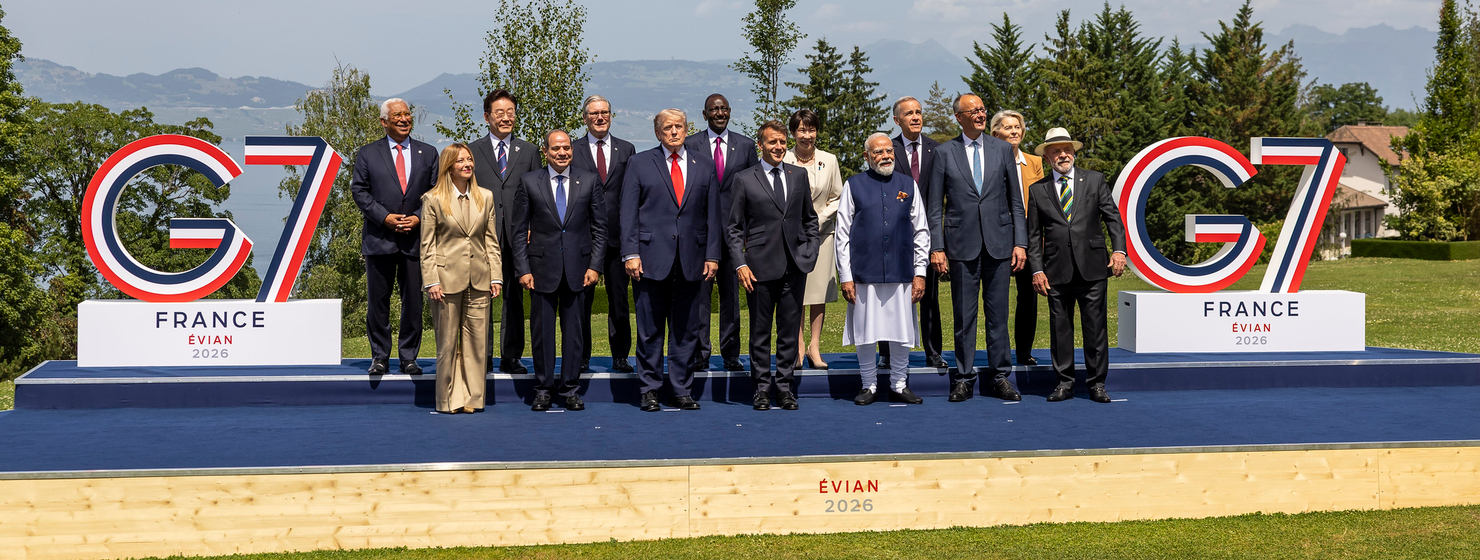
The G7 Summit in Évian was a summit of convergence and unity in response to multiple crises.
A G7 of convergence
First, in its approach, as France involved partner countries (India, Kenya, South Korea, Brazil, Egypt) throughout the discussions, because today’s major challenges can only be effectively addressed together. This method is unprecedented.
France also engaged civil society and the private tech sector, as this is essential for effective exchanges on issues of digital and AI regulation and innovation.
A G7 delivering concrete results on key issues
Leaders adopted no fewer than nine declarations.
- First, on major crises:
Ukraine: In the presence of Ukrainian President Volodymyr Zelensky, G7 leaders demonstrated their unity with a genuine strategic awakening in support of Ukraine. They reaffirm their commitment to Ukraine’s freedom, sovereignty, and territorial integrity. They agreed to increase military support for Ukraine’s defense (including air defense capabilities, additional systems and interceptors, and long-range capabilities), to support Ukraine’s energy resilience, and to increase pressure on Russia’s war effort, notably through sanctions, including on Russian oil and gas.
Middle East: This agreement is positive news, as there is a shared need for the immediate and unconditional reopening of the Strait of Hormuz. It opens the door to an effective response to underlying issues related to Iran’s nuclear and ballistic threats and its regional destabilization activities.
Lebanon: Leaders call for a strong and immediate ceasefire and support efforts by Lebanese authorities to achieve Hezbollah’s disarmament and ensure the state’s monopoly on weapons. The country’s territorial integrity and sovereignty are key.
- Next, significant results were achieved on major shared challenges that shaped the agenda of this presidency:
Macroeconomic imbalances: Leaders recognize that it is in everyone’s interest to cooperate and coordinate economic policies to address these imbalances as effectively as possible, while ensuring fair competition, protecting industries and jobs, and avoiding future trade wars and financial crises. The IMF has a central role in monitoring these imbalances and guiding action. Discussions will continue at the G20.
Digital and AI: Protecting young people, for example by adapting the language of AI chatbots when interacting with children. G7 members are working together with leading companies to accelerate the safe and beneficial deployment of AI for society.
Critical minerals: Leaders agree on the importance of working together to reduce dependencies.
Cancer: Promoting a coordinated approach and information-sharing on poor-prognosis cancers, pediatric cancers, and universal access to healthcare.
Ebola: In response to what could become a major health crisis, the G7 sends a message of support and commits over one billion dollars in funding, in line with UN efforts.
Combating drug trafficking: By strengthening cooperation between international seaports.
International partnerships: Reaffirming the need for international solidarity, particularly for human development and the protection of the most vulnerable, while also developing tools to mobilize private financing.
Combating migrant smuggling: Leaders renewed their commitment to prevent, combat, and dismantle organized criminal networks that profit from migrant smuggling, human trafficking, and related crimes.